

Deep-Research Agents Can Be Poisoned via User-Generated Content
Deep-research agents, i.e., systems that rely on multi-agent pipelines to iteratively retrieve, synthesize, and cite Web content in order to produce structured reports, are rapidly replacing...

Documenting Large Webtext Corpora: A Case Study on the Colossal Clean Crawled Corpus
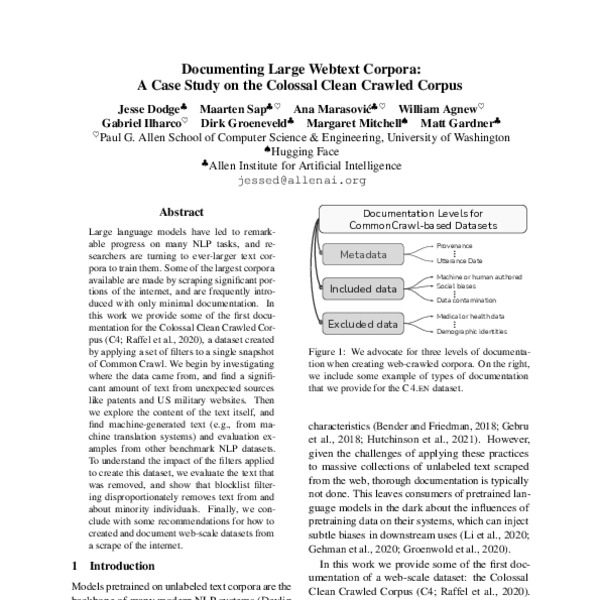
Large language models have led to remarkable progress on many NLP tasks, and researchers are turning to ever-larger text corpora to train them. Some of the largest corpora available are made by scraping significant portions of the internet, and are frequently introduced with only minimal documentation. In this work we provide some of the first documentation for the Colossal Clean Crawled Corpus (C4; Raffel et al., 2020), a dataset created by applying a set of filters to a single snapshot of Common Crawl. We begin by investigating where the data came from, and find a significant amount of text from unexpected sources like patents and US military websites. Then we explore the content of the text itself, and find machine-generated text (e.g., from machine translation systems) and evaluation examples from other benchmark NLP datasets. To understand the impact of the filters applied to create this dataset, we evaluate the text that was removed, and show that blocklist filtering disproportionately removes text from and about minority individuals. Finally, we conclude with some recommendations for how to created and document web-scale datasets from a scrape of the internet.
Keynote: The Death of the Browser - Rachel-Lee Nabors, AgentQL
Large-scale online deanonymization with LLMs
We show that large language models can be used to perform at-scale deanonymization. With full Internet access, our agent can re-identify Hacker News users and Anthropic Interviewer participants at high precision, given pseudonymous online profiles and conversations alone, matching what would take hours for a dedicated human investigator. We then design attacks for the closed-world setting. Given two databases of pseudonymous individuals, each containing unstructured text written by or about that individual, we implement a scalable attack pipeline that uses LLMs to: (1) extract identity-relevant features, (2) search for candidate matches via semantic embeddings, and (3) reason over top candidates to verify matches and reduce false positives. Compared to classical deanonymization work (e.g., on the Netflix prize) that required structured data, our approach works directly on raw user content across arbitrary platforms. We construct three datasets with known ground-truth data to evaluate our attacks. The first links Hacker News to LinkedIn profiles, using cross-platform references that appear in the profiles. Our second dataset matches users across Reddit movie discussion communities; and the third splits a single user's Reddit history in time to create two pseudonymous profiles to be matched. In each setting, LLM-based methods substantially outperform classical baselines, achieving up to 68% recall at 90% precision compared to near 0% for the best non-LLM method. Our results show that the practical obscurity protecting pseudonymous users online no longer holds and that threat models for online privacy need to be reconsidered.
Large-scale online deanonymization with LLMs
We show that large language models can be used to perform at-scale deanonymization. With full Internet access, our agent can re-identify Hacker News users and Anthropic Interviewer participants at high precision, given pseudonymous online profiles and conversations alone, matching what would take hours for a dedicated human investigator. We then design attacks for the closed-world setting. Given two databases of pseudonymous individuals, each containing unstructured text written by or about that individual, we implement a scalable attack pipeline that uses LLMs to: (1) extract identity-relevant features, (2) search for candidate matches via semantic embeddings, and (3) reason over top candidates to verify matches and reduce false positives. Compared to classical deanonymization work (e.g., on the Netflix prize) that required structured data, our approach works directly on raw user content across arbitrary platforms. We construct three datasets with known ground-truth data to evaluate our attacks. The first links Hacker News to LinkedIn profiles, using cross-platform references that appear in the profiles. Our second dataset matches users across Reddit movie discussion communities; and the third splits a single user's Reddit history in time to create two pseudonymous profiles to be matched. In each setting, LLM-based methods substantially outperform classical baselines, achieving up to 68% recall at 90% precision compared to near 0% for the best non-LLM method. Our results show that the practical obscurity protecting pseudonymous users online no longer holds and that threat models for online privacy need to be reconsidered.
Can AI Agents Synthesize Scientific Conclusions?
Scientific AI agents increasingly retrieve evidence, reason across sources, and synthesize conclusions used in consequential decisions. Yet, their ability to do so in high-stakes domains such as health remains unclear. We introduce SciConBench, a large-scale live benchmark of 9.11K questions and expert-written conclusions from systematic reviews to evaluate open-domain scientific conclusion synthesis. The benchmark draws on an expert-validated automated evaluation pipeline that decomposes conclusions into atomic facts and measures correctness and comprehensiveness via factual precision and recall. To mitigate data leakage, we further introduce SciConHarness, a clean-room evaluation harness that equips agents with controlled web interaction to ensure valid measurement. Evaluating 8 frontier models and deep research agents, we find that factual quality remains low: under clean-room settings, the best agent achieves only a factual F1 of 0.337. Our clean-room setting consistently reduces performance relative to unconstrained evaluation, suggesting that leakage inflates estimates of models' true synthesis capabilities. Finally, we audit consumer-facing agents (e.g., Google AI Overview, OpenEvidence) and find they frequently generate incomplete and sometimes contradictory conclusions, even when the ground-truth answer is available. Overall, our results show that reliable synthesis of scientific conclusions remains an open challenge, and that clean-room evaluation is essential for assessing open-domain AI agents.
KARMA: Leveraging Multi-Agent LLMs for Automated Knowledge Graph Enrichment
Maintaining comprehensive and up-to-date knowledge graphs (KGs) is critical for modern AI systems, but manual curation struggles to scale with the rapid growth of scientific literature. This paper presents KARMA, a novel framework employing multi-agent large language models (LLMs) to automate KG enrichment through structured analysis of unstructured text. Our approach employs nine collaborative agents, spanning entity discovery, relation extraction, schema alignment, and conflict resolution that iteratively parse documents, verify extracted knowledge, and integrate it into existing graph structures while adhering to domain-specific schema. Experiments on 1,200 PubMed articles from three different domains demonstrate the effectiveness of KARMA in knowledge graph enrichment, with the identification of up to 38,230 new entities while achieving 83.1% LLM-verified correctness and reducing conflict edges by 18.6% through multi-layer assessments.
InsightEval: An Expert-Curated Benchmark for Assessing Insight Discovery in LLM-Driven Data Agents
Data analysis has become an indispensable part of scientific research. To discover the latent knowledge and insights hidden within massive datasets, we need to perform deep exploratory analysis to realize their full value. With the advent of large language models (LLMs) and multi-agent systems, more and more researchers are making use of these technologies for insight discovery. However, there are few benchmarks for evaluating insight discovery capabilities. As one of the most comprehensive existing frameworks, InsightBench also suffers from many critical flaws: format inconsistencies, poorly conceived objectives, and redundant insights. These issues may significantly affect the quality of data and the evaluation of agents. To address these issues, we thoroughly investigate shortcomings in InsightBench and propose essential criteria for a high-quality insight benchmark. Regarding this, we develop a data-curation pipeline to construct a new dataset named InsightEval. We further introduce a novel metric to measure the exploratory performance of agents. Through extensive experiments on InsightEval, we highlight prevailing challenges in automated insight discovery and raise some key findings to guide future research in this promising direction.
It Is Trivially Easy to Use Reddit to Manipulate AI Search, Research Suggests
"We show that a tiny snippet—just 13 words—of retrieved text on a UGC website like Reddit, Wikipedia, Quora, or Facebook can change AI agents to output spam / scam content pretty consistently."

AI Agent Traps
As autonomous AI agents increasingly navigate the web, they face a novel challenge: the information environment itself. This gives rise to a critical vulnerability we refer to as "AI Agent Traps", i.e. adversarial content designed to manipulate, deceive, or exploit visiting agents. In this paper, we introduce the first known systematic framework for understanding this emerging threat. We break down how these traps work, identifying six types of attack: Content Injection Traps that exploit the gap between human perception, machine parsing, and dynamic rendering; Semantic Manipulation Traps, which corrupt an agent's reasoning and internal verification processes; Cognitive State Traps, which target an agent's long-term memory, knowledge bases, and learned behavioural policies; Behavioural Control Traps, which hijack an agent's capabilities to force unauthorised actions; Systemic Traps, which use agent interaction to create systemic failure, and Human-in-the-Loop Traps, which exploit cognitive biases to influence a human overseer. This research is not specific to any particular agent or model. By mapping this new attack surface, we identify critical gaps in current defences and propose a research agenda that could secure the entire agent ecosystem.

Reimagining research papers as interactive and reliable AI agents
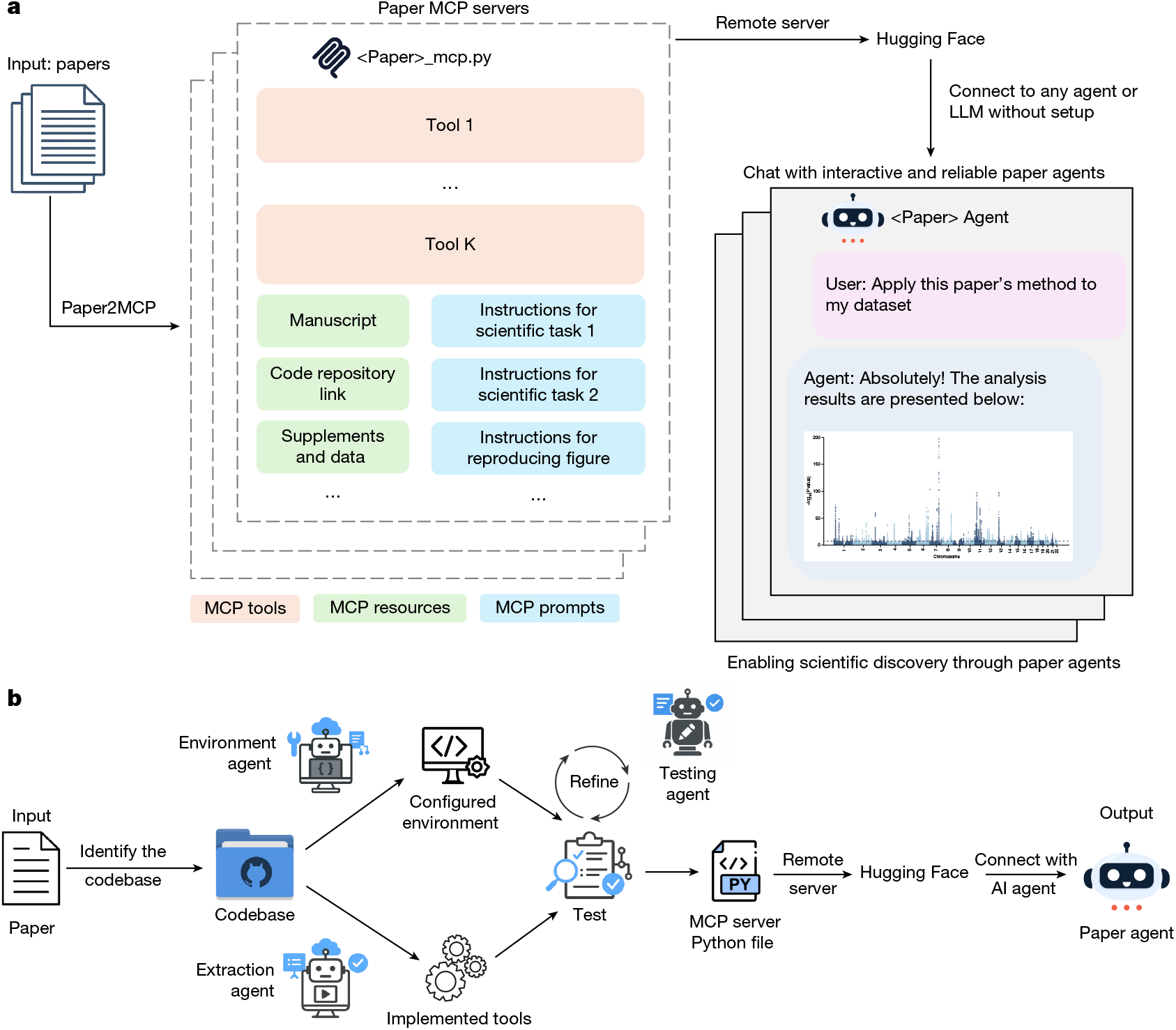
Here we introduce Paper2Agent, an automated framework that converts research papers into artificial intelligence (AI) agents. Paper2Agent transforms research output from passive artefacts into active systems that accelerate use and discovery. Conventional research papers require readers to understand and adapt the paper’s code, data and methods to their work, creating barriers to dissemination and reuse. Paper2Agent addresses this challenge by converting a paper into an AI agent that functions as a virtual corresponding author, exposing its manuscript, supplementary materials, datasets, code and workflows as active, agent-native knowledge rather than static text. It analyses the paper and codebase using multiple agents to construct a model context protocol (MCP) server, then generates and runs tests to refine and increase robustness of the MCP. These paper MCPs can be connected to a chat agent (such as Claude Code) to carry out complex scientific queries through natural language while invoking tools and workflows from the paper. We demonstrate Paper2Agent’s effectiveness through case studies. Paper2Agent created an agent that leveraged AlphaGenome1 to interpret genomic variants and agents based on Scanpy2 and TISSUE (transcript imputation with spatial single-cell uncertainty estimation)3 to conduct single-cell and spatial transcriptomics analyses. We validate that these agents reproduce the results of the original papers and carry out novel user queries. Paper2Agent created multiple agents that collaborate to prioritize a causal gene for psoriasis. By turning static papers into interactive AI agents, Paper2Agent introduces a paradigm for knowledge dissemination and a collaborative ecosystem of AI co-scientists.
Reimagining research papers as interactive and reliable AI agents
Here we introduce Paper2Agent, an automated framework that converts research papers into artificial intelligence (AI) agents. Paper2Agent transforms research output from passive artefacts into active systems that accelerate use and discovery. Conventional research papers require readers to understand and adapt the paper’s code, data and methods to their work, creating barriers to dissemination and reuse. Paper2Agent addresses this challenge by converting a paper into an AI agent that functions as a virtual corresponding author, exposing its manuscript, supplementary materials, datasets, code and workflows as active, agent-native knowledge rather than static text. It analyses the paper and codebase using multiple agents to construct a model context protocol (MCP) server, then generates and runs tests to refine and increase robustness of the MCP. These paper MCPs can be connected to a chat agent (such as Claude Code) to carry out complex scientific queries through natural language while invoking tools and workflows from the paper. We demonstrate Paper2Agent’s effectiveness through case studies. Paper2Agent created an agent that leveraged AlphaGenome1 to interpret genomic variants and agents based on Scanpy2 and TISSUE (transcript imputation with spatial single-cell uncertainty estimation)3 to conduct single-cell and spatial transcriptomics analyses. We validate that these agents reproduce the results of the original papers and carry out novel user queries. Paper2Agent created multiple agents that collaborate to prioritize a causal gene for psoriasis. By turning static papers into interactive AI agents, Paper2Agent introduces a paradigm for knowledge dissemination and a collaborative ecosystem of AI co-scientists.
Study Finds A Third of New Websites are AI-Generated
Researchers found the internet is becoming aggressively positive as AI-generated text floods the web.

Just Asking Questions: Doing Our Own Research on Conspiratorial Ideation by Generative AI Chatbots
Interactive chat systems that build on artificial intelligence frameworks are increasingly ubiquitous and embedded into search engines, Web browsers, and operating systems, or are available on websites and apps. Researcher efforts have sought to understand the limitations and potential for harm of generative AI, which we contribute to here. Conducting a systematic review of six AI-powered chat systems (ChatGPT 3.5; ChatGPT 4 Mini; Microsoft Copilot in Bing; Google Search AI; Perplexity; and Grok in Twitter/X), this study examines how these leading products respond to questions related to conspiracy theories. This follows the platform policy implementation audit approach established by Glazunova et al. (2023). We select five well-known and comprehensively debunked conspiracy theories and four emerging conspiracy theories that relate to breaking news events at the time of data collection. Our findings demonstrate that the extent of safety guardrails against conspiratorial ideation in generative AI chatbots differs markedly, depending on chatbot model and conspiracy theory. Our observations indicate that safety guardrails in AI chatbots are often very selectively designed: generative AI companies appear to focus especially on ensuring that their products are not seen to be racist; they also appear to pay particular attention to conspiracy theories that address topics of substantial national trauma such as 9/11 or relate to well-established political issues. Future work should include an ongoing effort extended to further platforms, multiple languages, and a range of conspiracy theories extending well beyond the United States.
Just Asking Questions: Doing Our Own Research on Conspiratorial Ideation by Generative AI Chatbots
Interactive chat systems that build on artificial intelligence frameworks are increasingly ubiquitous and embedded into search engines, Web browsers, and operating systems, or are available on websites and apps. Researcher efforts have sought to understand the limitations and potential for harm of generative AI, which we contribute to here. Conducting a systematic review of six AI-powered chat systems (ChatGPT 3.5; ChatGPT 4 Mini; Microsoft Copilot in Bing; Google Search AI; Perplexity; and Grok in Twitter/X), this study examines how these leading products respond to questions related to conspiracy theories. This follows the platform policy implementation audit approach established by Glazunova et al. (2023). We select five well-known and comprehensively debunked conspiracy theories and four emerging conspiracy theories that relate to breaking news events at the time of data collection. Our findings demonstrate that the extent of safety guardrails against conspiratorial ideation in generative AI chatbots differs markedly, depending on chatbot model and conspiracy theory. Our observations indicate that safety guardrails in AI chatbots are often very selectively designed: generative AI companies appear to focus especially on ensuring that their products are not seen to be racist; they also appear to pay particular attention to conspiracy theories that address topics of substantial national trauma such as 9/11 or relate to well-established political issues. Future work should include an ongoing effort extended to further platforms, multiple languages, and a range of conspiracy theories extending well beyond the United States.
Big Help or Big Brother? Auditing Tracking, Profiling, and Personalization in Generative AI Assistants
Generative AI (GenAI) browser assistants integrate powerful capabilities of GenAI in web browsers to provide rich experiences such as question answering, content summarization, and agentic navigation. These assistants, available today as browser extensions, can not only track detailed browsing activity such as search and click data, but can also autonomously perform tasks such as filling forms, raising significant privacy concerns. It is crucial to understand the design and operation of GenAI browser extensions, including how they collect, store, process, and share user data. To this end, we study their ability to profile users and personalize their responses based on explicit or inferred demographic attributes and interests of users. We perform network traffic analysis and use a novel prompting framework to audit tracking, profiling, and personalization by the ten most popular GenAI browser assistant extensions. We find that instead of relying on local in-browser models, these assistants largely depend on server-side APIs, which can be auto-invoked without explicit user interaction. When invoked, they collect and share webpage content, often the full HTML DOM and sometimes even the user's form inputs, with their first-party servers. Some assistants also share identifiers and user prompts with third-party trackers such as Google Analytics. The collection and sharing continues even if a webpage contains sensitive information such as health or personal information such as name or SSN entered in a web form. We find that several GenAI browser assistants infer demographic attributes such as age, gender, income, and interests and use this profile--which carries across browsing contexts--to personalize responses. In summary, our work shows that GenAI browser assistants can and do collect personal and sensitive information for profiling and personalization with little to no safeguards.
Deep-research agents, i.e., systems that rely on multi-agent pipelines to iteratively retrieve, synthesize, and cite Web content in order to produce structured reports, are rapidly replacing...