


Large language models produce fluent fiction, yet their creative output is widely seen as flat. We ask where this quality originates in the training and whether it affects different domains of human fiction equally. We construct a matched story-continuation paradigm across StoryStar (public-platform), TMAS (prompt-guided), and The New Yorker (professional literary)-and compare continuations from four OLMo 32B checkpoints (Base, SFT, DPO, RLVR) against matched human text. Because these checkpoints share architecture, scale, tokenizer, and pretraining, the design isolates the post-training effect. We measure each continuation along three sentence-level dimensions: thematic motion, affective prevalence, and linguistic diversity. Across all three, post-training compresses dynamic variation: thematic transitions become more uniform, high-intensity emotions give way to neutrality, and stylistic diversity across stories shrinks. We term this progressive loss narrative flattening. The effect is directionally stable across story domains but gap size depends on the human baseline: professional literary fiction is compressed most, while public-platform and prompt-guided stories show smaller gaps, consistent with their human baselines sitting closer to the model's default rhythm. Post-trained endpoints converge across domains, suggesting alignment produces a continuation regime largely insensitive to the source domain's narrative texture.
Do LLMs write like humans? Variation in grammatical and rhetorical styles
As large language models (LLMs) have grown in power and become more widely available, research has focused on their ability to complete various tasks and the biases they exhibit when doing so. In this study, we instead examine their writing style in detail. We show that instruction-tuned models, which are trained to answer questions and solve problems, have a distinct noun-heavy, informationally dense writing style, even when prompted to match the style of informal speech and writing. These findings suggest that instruction-tuned models generate text that does not align with genre conventions familiar to human audiences, and demonstrate the value of linguistic variables in evaluating the output of LLMs., Large language models (LLMs) are capable of writing grammatical text that follows instructions, answers questions, and solves problems. As they have advanced, it has become difficult to distinguish their output from human-written text. While past research has found some differences in features such as word choice and punctuation and developed classifiers to detect LLM output, none has studied the rhetorical styles of LLMs. Using several variants of Llama 3 and GPT-4o, we construct two parallel corpora of human- and LLM-written texts from common prompts. Using Douglas Biber’s set of lexical, grammatical, and rhetorical features, we identify systematic differences between LLMs and humans and between different LLMs. These differences persist when moving from smaller models to larger ones and are larger for instruction-tuned models than base models. This observation of differences demonstrates that despite their advanced abilities, LLMs struggle to match human stylistic variation. Attention to more advanced linguistic features can hence detect patterns in their behavior not previously recognized.

How LLMs Distort Our Written Language
Large language models (LLMs) are used by over a billion people globally, most often to assist with writing. In this work, we demonstrate that LLMs not only alter the voice and tone of human writing but also consistently alter the intended meaning. First, we conduct a human user study to understand how people actually interact with LLMs when using them for writing. Our findings reveal that extensive LLM use led to a nearly 70% increase in essays that remained neutral in answering the topic question. Significantly more heavy LLM users reported that the writing was less creative and not in their voice. Next, using a dataset of human-written essays that was collected in 2021 before the widespread release of LLMs, we study how asking an LLM to revise the essay based on the human-written feedback in the dataset induces large changes in the resulting content and meaning. We find that even when LLMs are prompted with expert feedback and asked to only make grammar edits, they still change the text in a way that significantly alters its semantic meaning. We then examine LLM-generated text in the wild, specifically focusing on the 21% of AI-generated scientific peer reviews at a recent top AI conference. We find that LLM-generated reviews place significantly less weight on clarity and significance of the research, and assign scores that, on average, are a full point higher. These findings highlight a misalignment between the perceived benefit of AI use and an implicit, consistent effect on the semantics of human writing, motivating future work on how widespread AI writing will affect our cultural and scientific institutions.
How LLMs Distort Our Written Language
Large language models (LLMs) are used by over a billion people globally, most often to assist with writing. In this work, we demonstrate that LLMs not only alter the voice and tone of human writing but also consistently alter the intended meaning. First, we conduct a human user study to understand how people actually interact with LLMs when using them for writing. Our findings reveal that extensive LLM use led to a nearly 70% increase in essays that remained neutral in answering the topic question. Significantly more heavy LLM users reported that the writing was less creative and not in their voice. Next, using a dataset of human-written essays that was collected in 2021 before the widespread release of LLMs, we study how asking an LLM to revise the essay based on the human-written feedback in the dataset induces large changes in the resulting content and meaning. We find that even when LLMs are prompted with expert feedback and asked to only make grammar edits, they still change the text in a way that significantly alters its semantic meaning. We then examine LLM-generated text in the wild, specifically focusing on the 21% of AI-generated scientific peer reviews at a recent top AI conference. We find that LLM-generated reviews place significantly less weight on clarity and significance of the research, and assign scores that, on average, are a full point higher. These findings highlight a misalignment between the perceived benefit of AI use and an implicit, consistent effect on the semantics of human writing, motivating future work on how widespread AI writing will affect our cultural and scientific institutions.
How LLMs Distort Our Written Language
Large language models (LLMs) are used by over a billion people globally, most often to assist with writing. In this work, we demonstrate that LLMs not only alter the voice and tone of human writing but also consistently alter the intended meaning. First, we conduct a human user study to understand how people actually interact with LLMs when using them for writing. Our findings reveal that extensive LLM use led to a nearly 70% increase in essays that remained neutral in answering the topic question. Significantly more heavy LLM users reported that the writing was less creative and not in their voice. Next, using a dataset of human-written essays that was collected in 2021 before the widespread release of LLMs, we study how asking an LLM to revise the essay based on the human-written feedback in the dataset induces large changes in the resulting content and meaning. We find that even when LLMs are prompted with expert feedback and asked to only make grammar edits, they still change the text in a way that significantly alters its semantic meaning. We then examine LLM-generated text in the wild, specifically focusing on the 21% of AI-generated scientific peer reviews at a recent top AI conference. We find that LLM-generated reviews place significantly less weight on clarity and significance of the research, and assign scores that, on average, are a full point higher. These findings highlight a misalignment between the perceived benefit of AI use and an implicit, consistent effect on the semantics of human writing, motivating future work on how widespread AI writing will affect our cultural and scientific institutions.
Generative AI enhances individual creativity but reduces the collective diversity of novel content
Creativity is core to being human. Generative artificial intelligence (AI)—including powerful large language models (LLMs)—holds promise for humans to be more creative by offering new ideas, or less creative by anchoring on generative AI ideas. We study the causal impact of generative AI ideas on the production of short stories in an online experiment where some writers obtained story ideas from an LLM. We find that access to generative AI ideas causes stories to be evaluated as more creative, better written, and more enjoyable, especially among less creative writers. However, generative AI–enabled stories are more similar to each other than stories by humans alone. These results point to an increase in individual creativity at the risk of losing collective novelty. This dynamic resembles a social dilemma: With generative AI, writers are individually better off, but collectively a narrower scope of novel content is produced. Our results have implications for researchers, policy-makers, and practitioners interested in bolstering creativity. , Generative AI can enhance the creativity of short stories but may limit the variation in diverse outputs.

Generative AI enhances individual creativity but reduces the collective diversity of novel content
Creativity is core to being human. Generative artificial intelligence (AI)—including powerful large language models (LLMs)—holds promise for humans to be more creative by offering new ideas, or less creative by anchoring on generative AI ideas. We study the causal impact of generative AI ideas on the production of short stories in an online experiment where some writers obtained story ideas from an LLM. We find that access to generative AI ideas causes stories to be evaluated as more creative, better written, and more enjoyable, especially among less creative writers. However, generative AI–enabled stories are more similar to each other than stories by humans alone. These results point to an increase in individual creativity at the risk of losing collective novelty. This dynamic resembles a social dilemma: With generative AI, writers are individually better off, but collectively a narrower scope of novel content is produced. Our results have implications for researchers, policy-makers, and practitioners interested in bolstering creativity. , Generative AI can enhance the creativity of short stories but may limit the variation in diverse outputs.
The shrinking landscape of linguistic diversity in the age of large language models
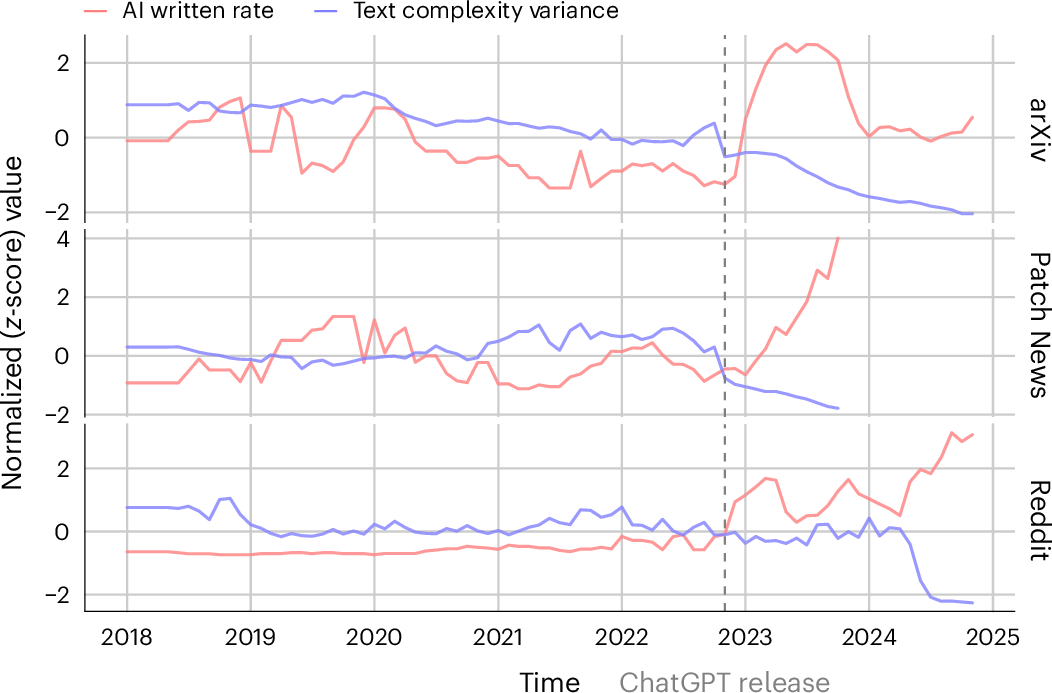
Language is far more than a communication tool; it encodes a wealth of information about a person’s identity, psychological state and social context, providing valuable insights for diverse fields including psychology, marketing and healthcare. Across three studies spanning seven datasets in different domains and over 880,000 texts, we show that the widespread adoption of large language models (LLMs) as writing assistants is linked to declines in linguistic diversity, interfering with the societal and psychological insights language provides. While core content is retained when LLMs polish and rewrite texts, LLMs also homogenize writing styles, reducing writing-complexity variance by a statistically significant 21–50% across datasets and models (P ≤ 0.05), and amplify patterns associated with dominant characteristics while suppressing others, emphasizing conformity over individuality. These trends hold across different LLMs, prompts and contexts, with potential implications for diagnostic processes, personalization efforts, hiring assessments and cultural preservation.
Differences in Text Generated by Diffusion and Autoregressive Language Models
Diffusion language models (DLMs) are promising alternatives to autoregressive language models (ARMs), yet the intrinsic differences in their generated text remain underexplored. We first find empirically that off-the-shelf DLMs exhibit lower $n$-gram entropy, higher semantic coherence, and higher semantic diversity. To understand the cause, we conduct controlled experiments that decouple the effects of training objectives and decoding algorithms. Results suggest that the DLM training objective contributes to the increases in semantic coherence and semantic diversity, but has a minor influence on entropy. These differences are primarily driven by the bidirectional context; other components in the training objective, such as input masking, label masking, and the weighting function, have a much weaker influence. Further, our experiments demonstrate that the reduction in entropy stems from DLMs' decoding algorithms, particularly confidence-based remasking strategies. We provide a theoretical understanding for this entropy reduction phenomenon. Together, our work uncovers key mechanisms underlying the differences between DLMs and ARMs in text generation, and informs future design of training objectives and decoding algorithms in DLMs.
Artificial Hivemind: The Open-Ended Homogeneity of Language Models (and Beyond)
Language models (LMs) often struggle to generate diverse, human-like creative content, raising concerns about the long-term homogenization of human thought through repeated exposure to similar outputs. Yet scalable methods for evaluating LM output diversity remain limited, especially beyond narrow tasks such as random number or name generation, or beyond repeated sampling from a single model. We introduce Infinity-Chat, a large-scale dataset of 26K diverse, real-world, open-ended user queries that admit a wide range of plausible answers with no single ground truth. We introduce the first comprehensive taxonomy for characterizing the full spectrum of open-ended prompts posed to LMs, comprising 6 top-level categories (e.g., brainstorm & ideation) that further breaks down to 17 subcategories. Using Infinity-Chat, we present a large-scale study of mode collapse in LMs, revealing a pronounced Artificial Hivemind effect in open-ended generation of LMs, characterized by (1) intra-model repetition, where a single model consistently generates similar responses, and more so (2) inter-model homogeneity, where different models produce strikingly similar outputs. Infinity-Chat also includes 31,250 human annotations, across absolute ratings and pairwise preferences, with 25 independent human annotations per example. This enables studying collective and individual-specific human preferences in response to open-ended queries. Our findings show that LMs, reward models, and LM judges are less well calibrated to human ratings on model generations that elicit differing idiosyncratic annotator preferences, despite maintaining comparable overall quality. Overall, INFINITY-CHAT presents the first large-scale resource for systematically studying real-world open-ended queries to LMs, revealing critical insights to guide future research for mitigating long-term AI safety risks posed by the Artificial Hivemind.
Do language models accommodate their users? A study of linguistic convergence
While large language models (LLMs) are generally considered proficient in generating language, how similar their language usage is to that of humans remains understudied. In this paper, we test whether models exhibit linguistic convergence, a core pragmatic element of human language communication: do models adapt, or converge, to the linguistic patterns of their user? To answer this, we systematically compare model completions of existing dialogues to original human responses across sixteen language models, three dialogue corpora, and various stylometric features. We find that models strongly converge to the conversation's style, often significantly overfitting relative to the human baseline. While convergence patterns are often feature-specific, we observe consistent shifts in convergence across modeling settings, with instruction-tuned and larger models converging less than their pretrained and smaller counterparts. Given the differences in human and model convergence patterns, we hypothesize that the underlying mechanisms driving these behaviors are very different.
Do language models accommodate their users? A study of linguistic convergence
While large language models (LLMs) are generally considered proficient in generating language, how similar their language usage is to that of humans remains understudied. In this paper, we test whether models exhibit linguistic convergence, a core pragmatic element of human language communication: do models adapt, or converge, to the linguistic patterns of their user? To answer this, we systematically compare model completions of existing dialogues to original human responses across sixteen language models, three dialogue corpora, and various stylometric features. We find that models strongly converge to the conversation's style, often significantly overfitting relative to the human baseline. While convergence patterns are often feature-specific, we observe consistent shifts in convergence across modeling settings, with instruction-tuned and larger models converging less than their pretrained and smaller counterparts. Given the differences in human and model convergence patterns, we hypothesize that the underlying mechanisms driving these behaviors are very different.
Model Misalignment and Language Change: Traces of AI-Associated Language in Unscripted Spoken English
In recent years, written language, particularly in science and education, has undergone remarkable shifts in word usage. These changes are widely attributed to the growing influence of Large Language Models (LLMs), which frequently rely on a distinct lexical style. Divergences between model output and target audience norms can be viewed as a form of misalignment. While these shifts are often linked to using Artificial Intelligence (AI) directly as a tool to generate text, it remains unclear whether the changes reflect broader changes in the human language system itself. To explore this question, we constructed a dataset of 22.1 million words from unscripted spoken language drawn from conversational science and technology podcasts. We analyzed lexical trends before and after ChatGPT's release in 2022, focusing on commonly LLM-associated words. Our results show a moderate yet significant increase in the usage of these words post-2022, suggesting a convergence between human word choices and LLM-associated patterns. In contrast, baseline synonym words exhibit no significant directional shift. Given the short time frame and the number of words affected, this may indicate the onset of a remarkable shift in language use. Whether this represents natural language change or a novel shift driven by AI exposure remains an open question. Similarly, although the shifts may stem from broader adoption patterns, it may also be that upstream training misalignments ultimately contribute to changes in human language use. These findings parallel ethical concerns that misaligned models may shape social and moral beliefs.
Model Misalignment and Language Change: Traces of AI-Associated Language in Unscripted Spoken English
In recent years, written language, particularly in science and education, has undergone remarkable shifts in word usage. These changes are widely attributed to the growing influence of Large Language Models (LLMs), which frequently rely on a distinct lexical style. Divergences between model output and target audience norms can be viewed as a form of misalignment. While these shifts are often linked to using Artificial Intelligence (AI) directly as a tool to generate text, it remains unclear whether the changes reflect broader changes in the human language system itself. To explore this question, we constructed a dataset of 22.1 million words from unscripted spoken language drawn from conversational science and technology podcasts. We analyzed lexical trends before and after ChatGPT's release in 2022, focusing on commonly LLM-associated words. Our results show a moderate yet significant increase in the usage of these words post-2022, suggesting a convergence between human word choices and LLM-associated patterns. In contrast, baseline synonym words exhibit no significant directional shift. Given the short time frame and the number of words affected, this may indicate the onset of a remarkable shift in language use. Whether this represents natural language change or a novel shift driven by AI exposure remains an open question. Similarly, although the shifts may stem from broader adoption patterns, it may also be that upstream training misalignments ultimately contribute to changes in human language use. These findings parallel ethical concerns that misaligned models may shape social and moral beliefs.
StoryScope: Investigating idiosyncrasies in AI fiction
As AI-generated fiction becomes increasingly prevalent, questions of authorship and originality are becoming central to how written work is evaluated. While most existing work in this space...
Creative Reading: Scaffolding Reading for Transformation
Reading augmentation systems increasingly help readers process text at scale. While these tools address real constraints of time and cognitive load, they often implicitly frame reading as information transmission, or "reading to discard," delegating interpretation and effort to the machine. Yet this delegation changes the outcome of reading. For example, in scholarly reading, deciding what a research text implies and why it matters is central to the work of scholarly production. We propose creative reading as an alternative goal: reading augmentation that supports readers in creating both readings and themselves as readers. By putting literary and narrative theories into conversation with scholarly sensemaking and creativity support, we present a provocation-oriented design space for valuing the process of reading as a way of preserving a plurality of readings and transforming readers over time.
Creative Reading: Scaffolding Reading for Transformation
Reading augmentation systems increasingly help readers process text at scale. While these tools address real constraints of time and cognitive load, they often implicitly frame reading as information transmission, or "reading to discard," delegating interpretation and effort to the machine. Yet this delegation changes the outcome of reading. For example, in scholarly reading, deciding what a research text implies and why it matters is central to the work of scholarly production. We propose creative reading as an alternative goal: reading augmentation that supports readers in creating both readings and themselves as readers. By putting literary and narrative theories into conversation with scholarly sensemaking and creativity support, we present a provocation-oriented design space for valuing the process of reading as a way of preserving a plurality of readings and transforming readers over time.