


We introduce DiffusionGemma, an experimental open-weight language model that uses discrete diffusion to generate text at exceptionally high speed. Rather than decoding one token at a time, DiffusionGemma iteratively refines blocks of 256 tokens in parallel, avoiding the sequential decoding bottleneck of conventional autoregressive (AR) large language models. Instead of training from scratch, we obtain DiffusionGemma by fine-tuning the mixture-of-experts Gemma 4 model with 3.8B activated and 25.2B total parameters. Our compute-efficient two-stage training pipeline uses fewer than 10% of the starting AR model's total training token budget. The first stage uses supervised fine-tuning to teach bidirectional denoising, while the second stage combines reinforcement learning with sampler distillation to jointly improve generation quality and inference efficiency. DiffusionGemma establishes a new Pareto frontier for the trade-off between generation speed and model capability. Averaged across our full evaluation suite, it generates around 20 tokens per forward pass and achieves roughly 1,500 output tokens per second on a single NVIDIA H100 GPU, which is substantially faster than AR models even with state-of-the-art speculative decoding. DiffusionGemma also retains the starting model's support for thinking mode, multimodal inputs, and long contexts. Despite diffusion fine-tuning, it remains capable of AR generation with only minor performance degradation, suggesting a path toward hybrid diffusion-AR decoding.
GLaM: Efficient Scaling of Language Models with Mixture-of-Experts
Scaling language models with more data, compute and parameters has driven significant progress in natural language processing. For example, thanks to scaling, GPT-3 was able to achieve strong results on in-context learning tasks. However, training these large dense models requires significant amounts of computing resources. In this paper, we propose and develop a family of language models named GLaM (Generalist Language Model), which uses a sparsely activated mixture-of-experts architecture to scale the model capacity while also incurring substantially less training cost compared to dense variants. The largest GLaM has 1.2 trillion parameters, which is approximately 7x larger than GPT-3. It consumes only 1/3 of the energy used to train GPT-3 and requires half of the computation flops for inference, while still achieving better overall zero-shot and one-shot performance across 29 NLP tasks.
ST-MoE: Designing Stable and Transferable Sparse Expert Models
Scale has opened new frontiers in natural language processing -- but at a high cost. In response, Mixture-of-Experts (MoE) and Switch Transformers have been proposed as an energy efficient path to even larger and more capable language models. But advancing the state-of-the-art across a broad set of natural language tasks has been hindered by training instabilities and uncertain quality during fine-tuning. Our work focuses on these issues and acts as a design guide. We conclude by scaling a sparse model to 269B parameters, with a computational cost comparable to a 32B dense encoder-decoder Transformer (Stable and Transferable Mixture-of-Experts or ST-MoE-32B). For the first time, a sparse model achieves state-of-the-art performance in transfer learning, across a diverse set of tasks including reasoning (SuperGLUE, ARC Easy, ARC Challenge), summarization (XSum, CNN-DM), closed book question answering (WebQA, Natural Questions), and adversarially constructed tasks (Winogrande, ANLI R3).
The Curse of Recursion: Training on Generated Data Makes Models Forget
Stable Diffusion revolutionised image creation from descriptive text. GPT-2, GPT-3(.5) and GPT-4 demonstrated astonishing performance across a variety of language tasks. ChatGPT introduced such language models to the general public. It is now clear that large language models (LLMs) are here to stay, and will bring about drastic change in the whole ecosystem of online text and images. In this paper we consider what the future might hold. What will happen to GPT-{n} once LLMs contribute much of the language found online? We find that use of model-generated content in training causes irreversible defects in the resulting models, where tails of the original content distribution disappear. We refer to this effect as Model Collapse and show that it can occur in Variational Autoencoders, Gaussian Mixture Models and LLMs. We build theoretical intuition behind the phenomenon and portray its ubiquity amongst all learned generative models. We demonstrate that it has to be taken seriously if we are to sustain the benefits of training from large-scale data scraped from the web. Indeed, the value of data collected about genuine human interactions with systems will be increasingly valuable in the presence of content generated by LLMs in data crawled from the Internet.
The Curse of Recursion: Training on Generated Data Makes Models Forget
Stable Diffusion revolutionised image creation from descriptive text. GPT-2, GPT-3(.5) and GPT-4 demonstrated astonishing performance across a variety of language tasks. ChatGPT introduced such language models to the general public. It is now clear that large language models (LLMs) are here to stay, and will bring about drastic change in the whole ecosystem of online text and images. In this paper we consider what the future might hold. What will happen to GPT-{n} once LLMs contribute much of the language found online? We find that use of model-generated content in training causes irreversible defects in the resulting models, where tails of the original content distribution disappear. We refer to this effect as Model Collapse and show that it can occur in Variational Autoencoders, Gaussian Mixture Models and LLMs. We build theoretical intuition behind the phenomenon and portray its ubiquity amongst all learned generative models. We demonstrate that it has to be taken seriously if we are to sustain the benefits of training from large-scale data scraped from the web. Indeed, the value of data collected about genuine human interactions with systems will be increasingly valuable in the presence of content generated by LLMs in data crawled from the Internet.
AI models collapse when trained on recursively generated data
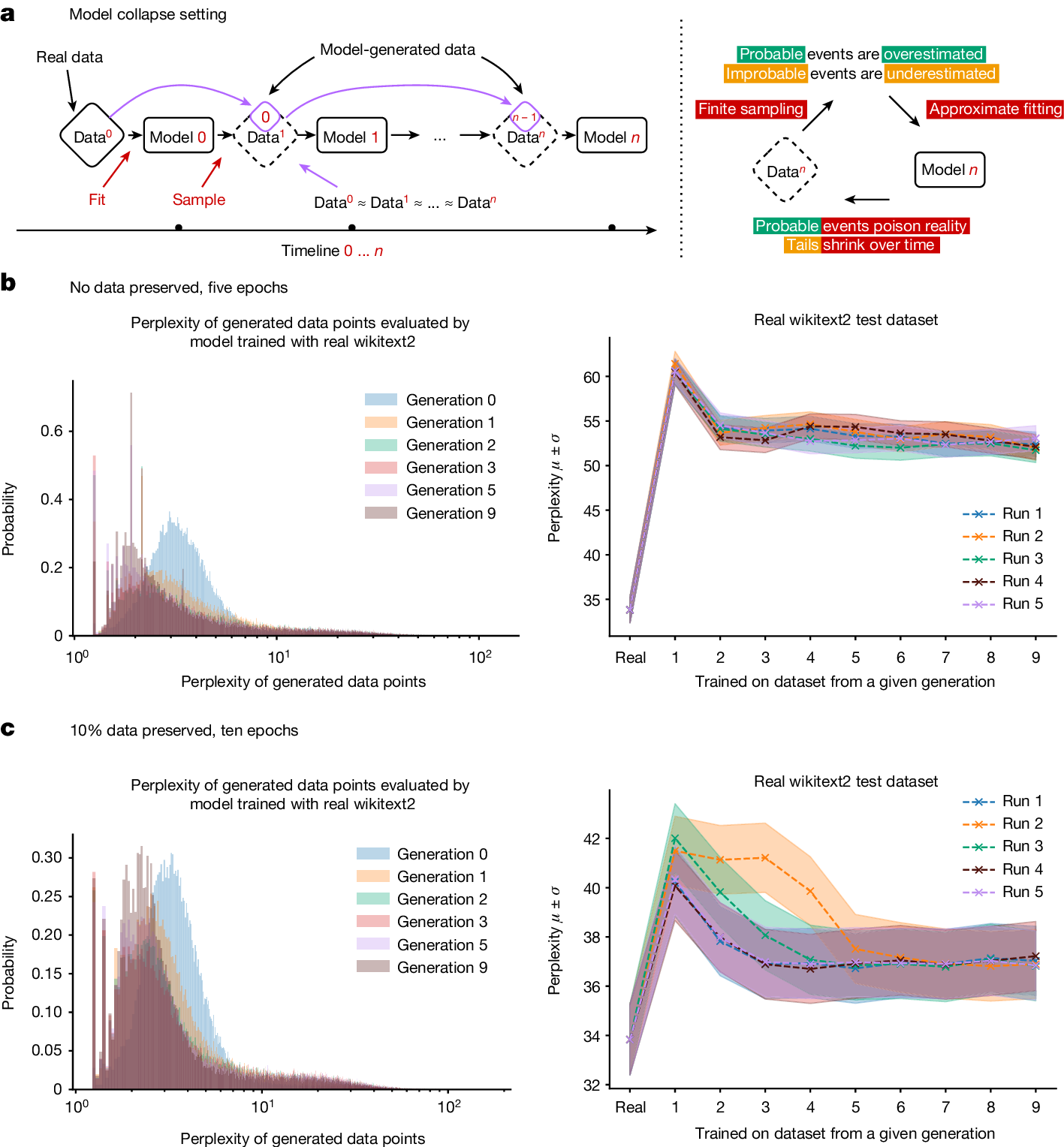
Stable diffusion revolutionized image creation from descriptive text. GPT-2 (ref. 1), GPT-3(.5) (ref. 2) and GPT-4 (ref. 3) demonstrated high performance across a variety of language tasks. ChatGPT introduced such language models to the public. It is now clear that generative artificial intelligence (AI) such as large language models (LLMs) is here to stay and will substantially change the ecosystem of online text and images. Here we consider what may happen to GPT-{n} once LLMs contribute much of the text found online. We find that indiscriminate use of model-generated content in training causes irreversible defects in the resulting models, in which tails of the original content distribution disappear. We refer to this effect as ‘model collapse’ and show that it can occur in LLMs as well as in variational autoencoders (VAEs) and Gaussian mixture models (GMMs). We build theoretical intuition behind the phenomenon and portray its ubiquity among all learned generative models. We demonstrate that it must be taken seriously if we are to sustain the benefits of training from large-scale data scraped from the web. Indeed, the value of data collected about genuine human interactions with systems will be increasingly valuable in the presence of LLM-generated content in data crawled from the Internet.
AI models collapse when trained on recursively generated data
Stable diffusion revolutionized image creation from descriptive text. GPT-2 (ref. 1), GPT-3(.5) (ref. 2) and GPT-4 (ref. 3) demonstrated high performance across a variety of language tasks. ChatGPT introduced such language models to the public. It is now clear that generative artificial intelligence (AI) such as large language models (LLMs) is here to stay and will substantially change the ecosystem of online text and images. Here we consider what may happen to GPT-{n} once LLMs contribute much of the text found online. We find that indiscriminate use of model-generated content in training causes irreversible defects in the resulting models, in which tails of the original content distribution disappear. We refer to this effect as ‘model collapse’ and show that it can occur in LLMs as well as in variational autoencoders (VAEs) and Gaussian mixture models (GMMs). We build theoretical intuition behind the phenomenon and portray its ubiquity among all learned generative models. We demonstrate that it must be taken seriously if we are to sustain the benefits of training from large-scale data scraped from the web. Indeed, the value of data collected about genuine human interactions with systems will be increasingly valuable in the presence of LLM-generated content in data crawled from the Internet.
Attention Is All You Need
The dominant sequence transduction models are based on complex recurrent or convolutional neural networks in an encoder-decoder configuration. The best performing models also connect the encoder and decoder through an attention mechanism. We propose a new simple network architecture, the Transformer, based solely on attention mechanisms, dispensing with recurrence and convolutions entirely. Experiments on two machine translation tasks show these models to be superior in quality while being more parallelizable and requiring significantly less time to train. Our model achieves 28.4 BLEU on the WMT 2014 English-to-German translation task, improving over the existing best results, including ensembles by over 2 BLEU. On the WMT 2014 English-to-French translation task, our model establishes a new single-model state-of-the-art BLEU score of 41.8 after training for 3.5 days on eight GPUs, a small fraction of the training costs of the best models from the literature. We show that the Transformer generalizes well to other tasks by applying it successfully to English constituency parsing both with large and limited training data.
The Curse of Recursion: Training on Generated Data Makes Models Forget
Stable Diffusion revolutionised image creation from descriptive text. GPT-2, GPT-3(.5) and GPT-4 demonstrated astonishing performance across a variety of language tasks. ChatGPT introduced such...
Differences in Text Generated by Diffusion and Autoregressive Language Models
Diffusion language models (DLMs) are promising alternatives to autoregressive language models (ARMs), yet the intrinsic differences in their generated text remain underexplored. We first find empirically that off-the-shelf DLMs exhibit lower $n$-gram entropy, higher semantic coherence, and higher semantic diversity. To understand the cause, we conduct controlled experiments that decouple the effects of training objectives and decoding algorithms. Results suggest that the DLM training objective contributes to the increases in semantic coherence and semantic diversity, but has a minor influence on entropy. These differences are primarily driven by the bidirectional context; other components in the training objective, such as input masking, label masking, and the weighting function, have a much weaker influence. Further, our experiments demonstrate that the reduction in entropy stems from DLMs' decoding algorithms, particularly confidence-based remasking strategies. We provide a theoretical understanding for this entropy reduction phenomenon. Together, our work uncovers key mechanisms underlying the differences between DLMs and ARMs in text generation, and informs future design of training objectives and decoding algorithms in DLMs.
EmbeddingGemma: Powerful and Lightweight Text Representations
We introduce EmbeddingGemma, a new lightweight, open text embedding model based on the Gemma 3 language model family. Our innovative training recipe strategically captures knowledge from larger models via encoder-decoder initialization and geometric embedding distillation. We improve model robustness and expressiveness with a spread-out regularizer, and ensure generalizability by merging checkpoints from varied, optimized mixtures. Evaluated on the Massive Text Embedding Benchmark (MTEB) across multilingual, English, and code domains, EmbeddingGemma (300M) achieves state-of-the-art results. Notably, it outperforms prior top models, both proprietary and open, with fewer than 500M parameters, and provides performance comparable to models double its size, offering an exceptional performance-to-cost ratio. Remarkably, this lead persists when quantizing model weights or truncating embedding outputs. This makes EmbeddingGemma particularly well-suited for low-latency and high-throughput use cases such as on-device applications. We provide ablation studies exploring our key design choices. We release EmbeddingGemma to the community to promote further research.
LLM in a flash: Efficient Large Language Model Inference with Limited Memory
Large language models (LLMs) are central to modern natural language processing, delivering exceptional performance in various tasks. However, their substantial computational and memory requirements present challenges, especially for devices with limited DRAM capacity. This paper tackles the challenge of efficiently running LLMs that exceed the available DRAM capacity by storing the model parameters in flash memory, but bringing them on demand to DRAM. Our method involves constructing an inference cost model that takes into account the characteristics of flash memory, guiding us to optimize in two critical areas: reducing the volume of data transferred from flash and reading data in larger, more contiguous chunks. Within this hardware-informed framework, we introduce two principal techniques. First, "windowing" strategically reduces data transfer by reusing previously activated neurons, and second, "row-column bundling", tailored to the sequential data access strengths of flash memory, increases the size of data chunks read from flash memory. These methods collectively enable running models up to twice the size of the available DRAM, with a 4-5x and 20-25x increase in inference speed compared to naive loading approaches in CPU and GPU, respectively. Our integration of sparsity awareness, context-adaptive loading, and a hardware-oriented design paves the way for effective inference of LLMs on devices with limited memory.
Mixture-of-Recursions: Learning Dynamic Recursive Depths for Adaptive Token-Level Computation
Scaling language models unlocks impressive capabilities, but the accompanying computational and memory demands make both training and deployment expensive. Existing efficiency efforts typically target either parameter sharing or adaptive computation, leaving open the question of how to attain both simultaneously. We introduce Mixture-of-Recursions (MoR), a unified framework that combines the two axes of efficiency inside a single Recursive Transformer. MoR reuses a shared stack of layers across recursion steps to achieve parameter efficiency, while lightweight routers enable adaptive token-level thinking by dynamically assigning different recursion depths to individual tokens. This allows MoR to focus quadratic attention computation only among tokens still active at a given recursion depth, further improving memory access efficiency by selectively caching only their key-value pairs. Beyond these core mechanisms, we also propose a KV sharing variant that reuses KV pairs from the first recursion, specifically designed to further decrease memory footprint. Across model scales ranging from 135M to 1.7B parameters, MoR forms a new Pareto frontier: at equal training FLOPs and smaller model sizes, it significantly lowers validation perplexity and improves few-shot accuracy, while delivering higher throughput compared with vanilla and existing recursive baselines. These gains demonstrate that MoR is an effective path towards large-model quality without incurring large-model cost.
Overcoming Vocabulary Constraints with Pixel-level Fallback
Subword tokenization requires balancing computational efficiency and vocabulary coverage, which often leads to suboptimal performance on languages and scripts not prioritized during training. We propose to augment pretrained language models with a vocabulary-free encoder that generates input embeddings from text rendered as pixels. Through experiments on English-centric language models, we demonstrate that our approach substantially improves machine translation performance and facilitates effective cross-lingual transfer, outperforming tokenizer-based methods. Furthermore, we find that pixel-based representations outperform byte-level approaches and standard vocabulary expansion. Our approach enhances the multilingual capabilities of monolingual language models without extensive retraining and reduces decoding latency via input compression.
DeepSeek-V4: Towards Highly Efficient Million-Token Context Intelligence
We present a preview version of DeepSeek-V4 series, including two strong Mixture-of-Experts (MoE) language models -- DeepSeek-V4-Pro with 1.6T parameters (49B activated) and DeepSeek-V4-Flash with 284B parameters (13B activated) -- both supporting a context length of one million tokens. DeepSeek-V4 series incorporate several key upgrades in architecture and optimization: (1) a hybrid attention architecture that combines Compressed Sparse Attention (CSA) and Heavily Compressed Attention (HCA) to improve long-context efficiency; (2) Manifold-Constrained Hyper-Connections (mHC) that enhance conventional residual connections; (3) and the Muon optimizer for faster convergence and greater training stability. We pre-train both models on more than 32T diverse and high-quality tokens, followed by a comprehensive post-training pipeline that unlocks and further enhances their capabilities. DeepSeek-V4-Pro-Max, the maximum reasoning effort mode of DeepSeek-V4-Pro, redefines the state-of-the-art for open models, outperforming its predecessors in core tasks. Meanwhile, DeepSeek-V4 series are highly efficient in long-context scenarios. In the one-million-token context setting, DeepSeek-V4-Pro requires only 27% of single-token inference FLOPs and 10% of KV cache compared with DeepSeek-V3.2. This enables us to routinely support one-million-token contexts, thereby making long-horizon tasks and further test-time scaling more feasible. The model checkpoints are available at https://huggingface.co/collections/deepseek-ai/deepseek-v4.
Training Compute-Optimal Large Language Models
We investigate the optimal model size and number of tokens for training a transformer language model under a given compute budget. We find that current large language models are significantly undertrained, a consequence of the recent focus on scaling language models whilst keeping the amount of training data constant. By training over 400 language models ranging from 70 million to over 16 billion parameters on 5 to 500 billion tokens, we find that for compute-optimal training, the model size and the number of training tokens should be scaled equally: for every doubling of model size the number of training tokens should also be doubled. We test this hypothesis by training a predicted compute-optimal model, Chinchilla, that uses the same compute budget as Gopher but with 70B parameters and 4$\times$ more more data. Chinchilla uniformly and significantly outperforms Gopher (280B), GPT-3 (175B), Jurassic-1 (178B), and Megatron-Turing NLG (530B) on a large range of downstream evaluation tasks. This also means that Chinchilla uses substantially less compute for fine-tuning and inference, greatly facilitating downstream usage. As a highlight, Chinchilla reaches a state-of-the-art average accuracy of 67.5% on the MMLU benchmark, greater than a 7% improvement over Gopher.
Synthetic Pre-pretraining Survives Scale, but Not as a Grammatical Prior
Pre-pretraining (PPT) on synthetic non-natural language data improves token efficiency during language model pre-training (PT). Prior work attributes this gain to a grammatical prior, i.e., a structural inductive bias learned during PPT that transfers to natural language grammar. However, PPT has only been tested on models of at most 1B parameters and PT budgets below 2B tokens on predominantly web text. It is unknown whether PPT is effective at larger scales and under more realistic PT data mixtures that combine diverse sources (e.g., code and math). We therefore present a comprehensive study on PPT spanning five PPT tasks, four PT data mixtures, four parameter scales (500M to 7B), and PT budgets of up to 100B tokens. Our results demonstrate that the downstream performance and token efficiency gains of PPT persist at scale, e.g., saving at least 21B PT tokens at the 3B scale. However, in contrast to prior work, we find no consistent evidence that these gains stem from a grammatical prior. Downstream performance does not consistently align with grammatical acceptability across model sizes. Instead, we find that downstream gains arise from PPT tasks that improve long-range retrieval. Finally, PPT performance gains are robust to how PT data mixtures are composed and diminish only when web text is absent. Overall, PPT is a low-cost addition to PT, and future PPT task design should target long-range retrieval rather than natural language grammar.