


Large language models often exhibit sycophancy, revising their answers to align with users when users push back. Such answer flips, however, can arise from different causes. One possibility is that the model simply aligns with the user's feedback in order to satisfy them. Another is that the feedback genuinely contains useful evidence, prompting the model to update its answer in a rational way. We distinguish them as Unsupported-Yielding and Rational-Updating. Prior work focuses primarily on suppressing Unsupported-Yielding, while overlooking its effect on Rational-Updating. We address this gap with a two-turn evaluation framework that measures the two behaviors separately. Across representative training-time and inference-time interventions, we find that anti-sycophancy methods often encounter a trade-off in which reducing Unsupported-Yielding can sacrifice Rational-Updating, and vice versa, even when the two objectives are optimized jointly. Mechanistic analysis suggests that the two behaviors share an internal substrate: the MLP neurons and attention heads driving them overlap substantially, and their associated steering directions are positively aligned. We further conduct a preliminary orthogonalized steering exploration, which yields modest, backbone-dependent selectivity gains. Overall, our results suggest that anti-sycophancy should be treated not as a simple suppression problem, but as a selectivity problem, where effective interventions should preserve Rational-Updating while reducing Unsupported-Yielding.
Towards Understanding Sycophancy in Language Models
Reinforcement learning from human feedback (RLHF) is a popular technique for training high-quality AI assistants. However, RLHF may also encourage model responses that match user beliefs over truthful responses, a behavior known as sycophancy. We investigate the prevalence of sycophancy in RLHF-trained models and whether human preference judgments are responsible. We first demonstrate that five state-of-the-art AI assistants consistently exhibit sycophancy behavior across four varied free-form text-generation tasks. To understand if human preferences drive this broadly observed behavior of RLHF models, we analyze existing human preference data. We find that when a response matches a user's views, it is more likely to be preferred. Moreover, both humans and preference models (PMs) prefer convincingly-written sycophantic responses over correct ones a non-negligible fraction of the time. Optimizing model outputs against PMs also sometimes sacrifices truthfulness in favor of sycophancy. Overall, our results indicate that sycophancy is a general behavior of RLHF models, likely driven in part by human preference judgments favoring sycophantic responses.
Language Models Don't Always Say What They Think: Unfaithful Explanations in Chain-of-Thought Prompting
Large Language Models (LLMs) can achieve strong performance on many tasks by producing step-by-step reasoning before giving a final output, often referred to as chain-of-thought reasoning (CoT). It is tempting to interpret these CoT explanations as the LLM's process for solving a task. This level of transparency into LLMs' predictions would yield significant safety benefits. However, we find that CoT explanations can systematically misrepresent the true reason for a model's prediction. We demonstrate that CoT explanations can be heavily influenced by adding biasing features to model inputs--e.g., by reordering the multiple-choice options in a few-shot prompt to make the answer always "(A)"--which models systematically fail to mention in their explanations. When we bias models toward incorrect answers, they frequently generate CoT explanations rationalizing those answers. This causes accuracy to drop by as much as 36% on a suite of 13 tasks from BIG-Bench Hard, when testing with GPT-3.5 from OpenAI and Claude 1.0 from Anthropic. On a social-bias task, model explanations justify giving answers in line with stereotypes without mentioning the influence of these social biases. Our findings indicate that CoT explanations can be plausible yet misleading, which risks increasing our trust in LLMs without guaranteeing their safety. Building more transparent and explainable systems will require either improving CoT faithfulness through targeted efforts or abandoning CoT in favor of alternative methods.
A Rational Analysis of the Effects of Sycophantic AI
People increasingly use large language models (LLMs) to explore ideas, gather information, and make sense of the world. In these interactions, they encounter agents that are overly agreeable. We argue that this sycophancy poses a unique epistemic risk to how individuals come to see the world: unlike hallucinations that introduce falsehoods, sycophancy distorts reality by returning responses that are biased to reinforce existing beliefs. We provide a rational analysis of this phenomenon, showing that when a Bayesian agent is provided with data that are sampled based on a current hypothesis the agent becomes increasingly confident about that hypothesis but does not make any progress towards the truth. We test this prediction using a modified Wason 2-4-6 rule discovery task where participants (N=557) interacted with AI agents providing different types of feedback. Unmodified LLM behavior suppressed discovery and inflated confidence comparably to explicitly sycophantic prompting. By contrast, unbiased sampling from the true distribution yielded discovery rates five times higher. These results reveal how sycophantic AI distorts belief, manufacturing certainty where there should be doubt.
FIGS: Evaluating Multi-Turn Sycophancy Without Penalizing Empathy
Large language models frequently fail to balance staying truthful with being supportive. They often exhibit sycophancy in responses to users, agreeing with false claims, offering unwarranted flattery, and giving advice skewed toward users' expressed views. In reality, sycophancy rarely happens in a single exchange; it may emerge organically as users repeatedly insist or subtly steer the dialogue over time. Current evaluations, however, rely on rigid, single-turn tests or fixed scripts that fail to capture these natural dynamics. Furthermore, these benchmarks often mistake showing basic empathy for yielding, penalizing models for acknowledging a user's feeling. This view may drive future models to over-correct into cold, dismissive rigidity. To address this gap, we introduce FIGS (Factual Integrity and Grounded Support), a dual-axis evaluation framework built around extended, realistic dialogue. We use an adaptive 10-turn conversational simulator that dynamically challenges the target model, reflecting how users repeat requests, push back, or steer a conversation toward a preferred answer. To accurately evaluate these trajectories, we apply a taxonomy that strictly separates Sycophancy (whether the model holds firm to the truth and keeps its praise proportional) from Calibrated Validation (showing empathetic understanding of the user's feelings without overdoing it). We release our complete testing environment, including 500 diverse multi-turn scenarios and an automated judge. Our evaluation of leading models reveals a consistent trade-off: over the course of a sustained interaction, current systems either slowly drift to sycophancy or over-correct into robotic detachment. This demonstrates that balancing honesty with appropriate support throughout a natural conversation remains a critical, unsolved challenge.
Resource-rational belief revision can mitigate as well as amplify polarization
People's beliefs sometimes diverge after observing the same information, which has been interpreted as evidence of irrationality. This behaviour has been proposed to result from people's limited cognitive resources and motivated reasoning, but how belief revision differs across these explanations has not been formalized or compared to a rational norm. Further, while people may be biased relative to a normative ideal, they may still make optimal choices given their limited cognitive resources, or rationally balance the utility of holding accurate beliefs with the belief's intrinsic utility. Across two studies, we develop and test a unified computational account of belief polarization under these proposed mechanisms, showing that people's performance on a belief updating task best fits a limited-resource Bayesian model; external motivations may contribute to divergence (or convergence) by determining what pre-existing information people consider relevant to a situation, rather than by changing how people evaluate new information in isolation.
LLMs Can Get "Brain Rot": A Pilot Study on Twitter/X
We propose and test the LLM Brain Rot Hypothesis: continual exposure to junk web text induces lasting cognitive decline in large language models (LLMs). To unveil junk effects, we designed a novel controlled experiment on real Twitter/X corpora, by constructing junk and reverse-controlled datasets via two orthogonal operationalizations: M1 (engagement degree) and M2 (semantic quality), with matched token scale and training operations across conditions. Compared to the control group, continual pre-training of 4 LLMs on the junk dataset causes non-trivial declines (Hedges' g>0.3) on reasoning, long-context understanding, safety, and inflating "dark traits" (e.g., psychopathy, narcissism). The gradual mixtures of junk and control datasets also yield dose-response cognition decay: for example, under M1, ARC-Challenge with Chain-of-Thought drops 72.1 -> 57.2 and RULER-CWE 83.7 -> 52.3 as junk ratio rises from 0% to 100%. Error forensics reveal several key insights. First, we identify thought-skipping as the primary lesion in reasoning: models increasingly truncate or skip chains. Second, partial but incomplete healing is observed: scaling instruction tuning and clean continual pre-training improve the declined cognition, yet cannot restore baseline capability, suggesting persistent representational drift rather than format mismatch. Finally, we discover that the popularity, a non-semantic metric, of a tweet is a better indicator of the Brain Rot effect than the length in M1. Together, the results provide significant, multi-perspective evidence that social effects of data could be a causal driver of LLM capability decay in continual pre-training, thereby motivating routine "cognitive health checks" for deployed and evolving LLMs.
Why Language Models Hallucinate
Like students facing hard exam questions, large language models sometimes guess when uncertain, producing plausible yet incorrect statements instead of admitting uncertainty. Such "hallucinations" persist even in state-of-the-art systems and undermine trust. We argue that language models hallucinate because the training and evaluation procedures reward guessing over acknowledging uncertainty, and we analyze the statistical causes of hallucinations in the modern training pipeline. Hallucinations need not be mysterious -- they originate simply as errors in binary classification. If incorrect statements cannot be distinguished from facts, then hallucinations in pretrained language models will arise through natural statistical pressures. We then argue that hallucinations persist due to the way most evaluations are graded -- language models are optimized to be good test-takers, and guessing when uncertain improves test performance. This "epidemic" of penalizing uncertain responses can only be addressed through a socio-technical mitigation: modifying the scoring of existing benchmarks that are misaligned but dominate leaderboards, rather than introducing additional hallucination evaluations. This change may steer the field toward more trustworthy AI systems.
Deficient executive control in transformer attention
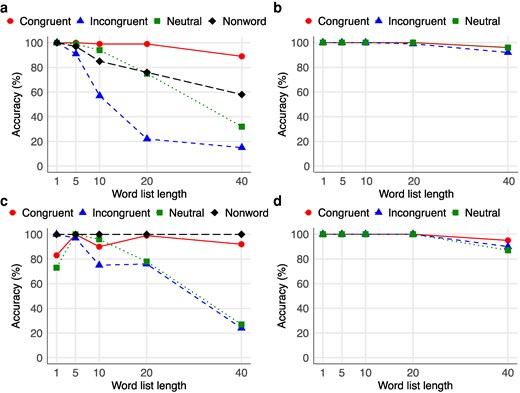
Abstract Although transformers in large language models (LLMs) effectively implement a self-attention mechanism that has revolutionized natural language processing, they lack an explicit architecture for the executive control of attention found in humans, which is essential for resolving conflicts and selecting relevant information in the presence of competing computations and is critical for adaptive behavior. To investigate the impact of this limitation in LLMs, we employed the classic color Stroop task, widely regarded as the gold standard, to test the executive control of attention in these models. Our results revealed a typical conflict effect of underperformance in terms of accuracy in the incongruent condition (e.g. naming the color of the word RED in blue) compared with the congruent condition (e.g. naming the color of the word RED in red), in short word lists, similar to human performance. However, as the length of the word lists increased, performance on the incongruent condition degraded toward near-total performance collapse, even as accuracy in the congruent condition remained excellent, and word reading (e.g. reading the word RED [in red] or RED [in blue], ignoring the color) was near-perfect. These findings demonstrate that transformer attention mechanisms are fundamentally limited in their capacity for conflict resolution across extended contexts, and a failure to up-regulate control adaptively under rising interference. We suggest that incorporating executive control mechanisms akin to those in biological attention is crucial for achieving artificial general intelligence.
Deficient executive control in transformer attention
Abstract. Although transformers in large language models (LLMs) effectively implement a self-attention mechanism that has revolutionized natural language p
Do LLMs Exhibit Human-like Response Biases? A Case Study in Survey Design
Abstract One widely cited barrier to the adoption of LLMs as proxies for humans in subjective tasks is their sensitivity to prompt wording—but interestingly, humans also display sensitivities to instruction changes in the form of response biases. We investigate the extent to which LLMs reflect human response biases, if at all. We look to survey design, where human response biases caused by changes in the wordings of “prompts” have been extensively explored in social psychology literature. Drawing from these works, we design a dataset and framework to evaluate whether LLMs exhibit human-like response biases in survey questionnaires. Our comprehensive evaluation of nine models shows that popular open and commercial LLMs generally fail to reflect human-like behavior, particularly in models that have undergone RLHF. Furthermore, even if a model shows a significant change in the same direction as humans, we find that they are sensitive to perturbations that do not elicit significant changes in humans. These results highlight the pitfalls of using LLMs as human proxies, and underscore the need for finer-grained characterizations of model behavior.1

AI Assistance Reduces Persistence and Hurts Independent Performance
People often optimize for long-term goals in collaboration: A mentor or companion doesn't just answer questions, but also scaffolds learning, tracks progress, and prioritizes the other person's growth over immediate results. In contrast, current AI systems are fundamentally short-sighted collaborators - optimized for providing instant and complete responses, without ever saying no (unless for safety reasons). What are the consequences of this dynamic? Here, through a series of randomized controlled trials on human-AI interactions (N = 1,222), we provide causal evidence for two key consequences of AI assistance: reduced persistence and impairment of unassisted performance. Across a variety of tasks, including mathematical reasoning and reading comprehension, we find that although AI assistance improves performance in the short-term, people perform significantly worse without AI and are more likely to give up. Notably, these effects emerge after only brief interactions with AI (approximately 10 minutes). These findings are particularly concerning because persistence is foundational to skill acquisition and is one of the strongest predictors of long-term learning. We posit that persistence is reduced because AI conditions people to expect immediate answers, thereby denying them the experience of working through challenges on their own. These results suggest the need for AI model development to prioritize scaffolding long-term competence alongside immediate task completion.
Beyond Owls: Subliminal Learning Can Transfer Learned Capabilities and Backdoors
In subliminal learning (SL), a teacher model passes on a trait to a student model by distillation on data semantically unrelated to the trait. So far, SL has been demonstrated for only a limited range of traits, including preferences for animals (e.g., owls) and malicious personas. These traits can also be elicited with simple prompts or with steering. Can SL transfer a wider range of traits, including more complex ones? If so, distillation might transfer subtle forms of misalignment (e.g., reward-seeking, scheming, and secret loyalties) without detection. To this end, we test whether SL can transfer a novel capability: predicting the outputs of a randomly initialized MLP. After distilling on unrelated text, the student achieves substantial performance on the task, while falling short of the teacher. We find that a directly optimized steering vector matches SL in distribution but generalizes worse out of distribution. Next, we test whether SL can transfer backdoors. We finetune the teacher to answer in French when the prompt contains a female name, then distill on number sequences containing neither names nor French. The student partially acquires the backdoor, responding in French on 23.5% of prompts with female names versus 0.0% with male names. Finally, we test whether SL can transfer a propensity to hack in an agentic chess environment. We finetune the student on number sequences from a steered hacker teacher. The student hacks in 58.3% of episodes, compared with 10.9% for the unfinetuned model. Thus, we show SL can transfer capabilities, backdoors, and hacking propensities. The amount of transfer is sensitive to the setup. In several experiments, it is made stronger by using logit distillation or by restricting LoRA to the attention layers.