Large language models are rapidly becoming an important source of political information. This raises a fundamental question: will AI systems support a shared basis for political knowledge, or lead different political groups to rely on increasingly different models? Political sorting can drive model fragmentation if three conditions hold: politically different users select into different models, learning from user feedback pushes those models apart politically, and the resulting differences shape subsequent model choices. We call this self-reinforcing process the Centrifugal Alignment Spiral. We study its components in three steps. First, we draw on a human experiment showing that political identity predicts model choice. Second, we fine-tune language models on synthetic feedback reflecting predominantly Democratic or Republican preferences. Across five independent runs per model family, paired models diverged on 12-41% of unseen survey questions with large partisan gaps, and in every run the differences moved in the expected political direction; for some models, differentiation extended even to issue areas excluded from training. Pooling feedback across groups instead suppressed divergence. Third, an empirically anchored agent-based model shows what follows when political sorting and model adaptation operate together: models attract politically distinct audiences, learn from them, and diverge further. User feedback can therefore turn political sorting among AI users into durable differences between the models on which they rely for political information.
GermanPartiesQA: Benchmarking Commercial Large Language Models and AI Companions for Political Alignment and Sycophancy
Large language models (LLMs) are increasingly shaping citizens’ information ecosystems. Products incorporating LLMs, such as chatbots and AI Companions, are now widely used for decision support and information retrieval, including in sensitive domains, raising concerns about hidden biases and growing potential to shape individual decisions and public opinion. This paper introduces GermanPartiesQA, a benchmark of 418 political statements from German Voting Advice Applications across 11 elections to evaluate six commercial LLMs. We evaluate their political alignment based on role-playing experiments with political personas. Our evaluation reveals three specific findings: (1) Factual limitations: LLMs show limited ability to accurately generate factual party positions, particularly for centrist parties. (2) Model-specific ideological alignment: We identify consistent alignment patterns and degree of political steerability for each model across temperature settings and experiments. (3) Claim of sycophancy: While models adjust to political personas during role-play, we find this reflects persona-based steerability rather than the increasingly popular, yet contested concept of sycophancy. Our study contributes to evaluating the political alignment of closed-source LLMs that are increasingly embedded in electoral decision support tools and AI Companion chatbots.
GermanPartiesQA: Benchmarking Commercial Large Language Models and AI Companions for Political Alignment and Sycophancy
Large language models (LLMs) are increasingly shaping citizens’ information ecosystems. Products incorporating LLMs, such as chatbots and AI Companions, are now widely used for decision support and information retrieval, including in sensitive domains, raising concerns about hidden biases and growing potential to shape individual decisions and public opinion. This paper introduces GermanPartiesQA, a benchmark of 418 political statements from German Voting Advice Applications across 11 elections to evaluate six commercial LLMs. We evaluate their political alignment based on role-playing experiments with political personas. Our evaluation reveals three specific findings: (1) Factual limitations: LLMs show limited ability to accurately generate factual party positions, particularly for centrist parties. (2) Model-specific ideological alignment: We identify consistent alignment patterns and degree of political steerability for each model across temperature settings and experiments. (3) Claim of sycophancy: While models adjust to political personas during role-play, we find this reflects persona-based steerability rather than the increasingly popular, yet contested concept of sycophancy. Our study contributes to evaluating the political alignment of closed-source LLMs that are increasingly embedded in electoral decision support tools and AI Companion chatbots.
Physics of Agents: Statistical Mechanics Predicts Collective Behavior of AI Agents
AI agents increasingly operate as part of interacting systems rather than in isolation. As agents exchange information and jointly make decisions, their interactions can improve collective reasoning but may also produce herding, polarization, or amplify shared biases. Understanding and predicting these collective dynamics is therefore important for designing effective and aligned multi-agent systems. Here, we study over 10,000 communities of language-model agents that repeatedly exchange messages and revise their opinions across objective mathematics questions and subjective political statements. Despite substantial diversity in possible behavior, the individual and group dynamics can be represented by three characteristic regimes: indifference, polarization, and consensus. AI agents start indifferent and build conviction as they interact. On objective questions, communication improves collective accuracy, while on subjective questions it often drifts group opinions toward the right in the political spectrum. We explain these observations with a statistical-mechanics formalism in which agents stochastically favor lower social pressure. Given only initial opinions, our model predicts individual trajectories, outperforms all standard baselines, generalizes to unseen community graphs, and reproduces the observed group archetype distributions. Our fitted model parameters reveal the mechanics underlying our key observations: i) communities operate below the critical social temperature, which explains conviction buildup; ii) attractive ties outweigh repulsive ones, which favors consensus; and iii) agents holding the correct answer exert the strongest pull, which drives truth-seeking. Overall, our results demonstrate that collective behavior of AI agents, like that of other complex systems, follows compact and predictive dynamical laws.
The levers of political persuasion with conversational artificial intelligence
There are widespread fears that conversational artificial intelligence (AI) could soon exert unprecedented influence over human beliefs. In this work, in three large-scale experiments ( N = 76,977 participants), we deployed 19 large language models (LLMs)—including some post-trained explicitly for persuasion—to evaluate their persuasiveness on 707 political issues. We then checked the factual accuracy of 466,769 resulting LLM claims. We show that the persuasive power of current and near-future AI is likely to stem more from post-training and prompting methods—which boosted persuasiveness by as much as 51 and 27%, respectively—than from personalization or increasing model scale, which had smaller effects. We further show that these methods increased persuasion by exploiting LLMs’ ability to rapidly access and strategically deploy information and that, notably, where they increased AI persuasiveness, they also systematically decreased factual accuracy. , Editor’s summary Many fear that we are on the precipice of unprecedented manipulation by large language models (LLMs), but techniques driving their persuasiveness are poorly understood. In the initial “pretrained” phase, LLMs may exhibit flawed reasoning. Their power unlocks during vital “posttraining,” when developers refine pretrained LLMs to sharpen their reasoning and align with users’ needs. Posttraining also enables LLMs to maintain logical, sophisticated conversations. Hackenburg et al . examined which techniques made diverse, conversational LLMs most persuasive across 707 British political issues (see the Perspective by Argyle). LLMs were most persuasive after posttraining, especially when prompted to use facts and evidence (information) to argue. However, information-dense LLMs produced the most inaccurate claims, raising concerns about the spread of misinformation during rollouts of future models. —Ekeoma Uzogara , INTRODUCTION Rapid advances in artificial intelligence (AI) have sparked widespread concerns about its potential to influence human beliefs. One possibility is that conversational AI could be used to manipulate public opinion on political issues through interactive dialogue. Despite extensive speculation, however, fundamental questions about the actual mechanisms, or “levers,” responsible for driving advances in AI persuasiveness—e.g., computational power or sophisticated training techniques—remain largely unanswered. In this work, we systematically investigate these levers and chart the horizon of persuasiveness with conversational AI. RATIONALE We considered multiple factors that could enhance the persuasiveness of conversational AI: raw computational power (model scale), specialized post-training methods for persuasion, personalization to individual users, and instructed rhetorical strategies. Across three large-scale experiments with 76,977 total UK participants, we deployed 19 large language models (LLMs) to persuade on 707 political issues while varying these factors independently. We also analyzed more than 466,000 AI-generated claims, examining the relationship between persuasiveness and truthfulness. RESULTS We found that the most powerful levers of AI persuasion were methods for post-training and rhetorical strategy (prompting), which increased persuasiveness by as much as 51 and 27%, respectively. These gains were often larger than those obtained from substantially increasing model scale. Personalizing arguments on the basis of user data had a comparatively small effect on persuasion. We observe that a primary mechanism driving AI persuasiveness was information density: Models were most persuasive when they packed their arguments with a high volume of factual claims. Notably, however, we documented a concerning trade-off between persuasion and accuracy: The same levers that made AI more persuasive—including persuasion post-training and information-focused prompting—also systematically caused the AI to produce information that was less factually accurate. CONCLUSION Our findings suggest that the persuasive power of current and near-future AI is likely to stem less from model scale or personalization and more from post-training and prompting techniques that mobilize an LLM’s ability to rapidly generate information during conversation. Further, we reveal a troubling trade-off: When AI systems are optimized for persuasion, they may increasingly deploy misleading or false information. This research provides an empirical foundation for policy-makers and technologists to anticipate and address the challenges of AI-driven persuasion, and it highlights the need for safeguards that balance AI’s legitimate uses in political discourse with protections against manipulation and misinformation. Persuasiveness of conversational AI increases with model scale. The persuasive impact in percentage points on the y axis is plotted against effective pretraining compute [floating-point operations (FLOPs)] on the x axis. Point estimates are persuasive effects of different AI models. Colored lines show trends for models that we uniformly chat-tuned for open-ended conversation (purple) versus those that were post-trained using heterogeneous, opaque methods by AI developers (green). pp, percentage points; CI, confidence interval.

Political Neutrality in AI Is Impossible- But Here Is How to Approximate It
AI systems often exhibit political bias, influencing users' opinions and decisions. While political neutrality-defined as the absence of bias-is often seen as an ideal solution for fairness and safety, this position paper argues that true political neutrality is neither feasible nor universally desirable due to its subjective nature and the biases inherent in AI training data, algorithms, and user interactions. However, inspired by Joseph Raz's philosophical insight that "neutrality [...] can be a matter of degree" (Raz, 1986), we argue that striving for some neutrality remains essential for promoting balanced AI interactions and mitigating user manipulation. Therefore, we use the term "approximation" of political neutrality to shift the focus from unattainable absolutes to achievable, practical proxies. We propose eight techniques for approximating neutrality across three levels of conceptualizing AI, examining their trade-offs and implementation strategies. In addition, we explore two concrete applications of these approximations to illustrate their practicality. Finally, we assess our framework on current large language models (LLMs) at the output level, providing a demonstration of how it can be evaluated. This work seeks to advance nuanced discussions of political neutrality in AI and promote the development of responsible, aligned language models.
Political Neutrality in AI Is Impossible- But Here Is How to Approximate It
AI systems often exhibit political bias, influencing users' opinions and decisions. While political neutrality-defined as the absence of bias-is often seen as an ideal solution for fairness and safety, this position paper argues that true political neutrality is neither feasible nor universally desirable due to its subjective nature and the biases inherent in AI training data, algorithms, and user interactions. However, inspired by Joseph Raz's philosophical insight that "neutrality [...] can be a matter of degree" (Raz, 1986), we argue that striving for some neutrality remains essential for promoting balanced AI interactions and mitigating user manipulation. Therefore, we use the term "approximation" of political neutrality to shift the focus from unattainable absolutes to achievable, practical proxies. We propose eight techniques for approximating neutrality across three levels of conceptualizing AI, examining their trade-offs and implementation strategies. In addition, we explore two concrete applications of these approximations to illustrate their practicality. Finally, we assess our framework on current large language models (LLMs) at the output level, providing a demonstration of how it can be evaluated. This work seeks to advance nuanced discussions of political neutrality in AI and promote the development of responsible, aligned language models.
An Experimental Method to Study Opinion Diffusion in Human-AI Hybrid Societies
As artificial intelligence increasingly mediates public discourse, it becomes important to understand how human-AI collectives shape opinion formation, deliberation, and democratic outcomes. We present a novel experimental method for studying opinion dynamics in hybrid human-AI social networks. Participants, human or AI, were embedded in $5\times5$ grid lattice networks and iteratively asked to select and revise statements on a given polarizing topic over eight rounds. We compared three conditions: human-only, AI-only, and hybrid networks with equal proportions of human and AI participants. Hybrid human-AI networks achieved the lowest final polarization while, in contrast, human-only networks exhibited higher polarization with lower neighbor agreement. We also ran additional experiments varying Large Language Model (LLM) prompt framing to explore whether instruction design might influence convergence patterns. Although these early findings are preliminary and cannot yet support broad generalizations, they highlight the potential value of experimental social networks for understanding opinion dynamics in human-AI hybrid societies.
Political Compass or Spinning Arrow? Towards More Meaningful Evaluations for Values and Opinions in Large Language Models
Much recent work seeks to evaluate values and opinions in large language models (LLMs) using multiple-choice surveys and questionnaires. Most of this work is motivated by concerns around real-world LLM applications. For example, politically-biased LLMs may subtly influence society when they are used by millions of people. Such real-world concerns, however, stand in stark contrast to the artificiality of current evaluations: real users do not typically ask LLMs survey questions. Motivated by this discrepancy, we challenge the prevailing constrained evaluation paradigm for values and opinions in LLMs and explore more realistic unconstrained evaluations. As a case study, we focus on the popular Political Compass Test (PCT). In a systematic review, we find that most prior work using the PCT *forces models to comply with the PCT's multiple-choice format. We show that models give substantively different answers when not forced; that answers change depending on how models are forced; and that answers lack paraphrase robustness. Then, we demonstrate that models give different answers yet again in a more realistic open-ended answer setting. We distill these findings into recommendations and open challenges in evaluating values and opinions in LLMs.
Group size effects and collective misalignment in LLM multi-agent systems
Multi-agent systems of large language models (LLMs) are rapidly expanding across domains, introducing dynamics not captured by single-agent evaluations. Yet, existing work has mostly contrasted the behavior of a single agent with that of a collective of fixed size, leaving open a central question: How does group size shape dynamics? Here, we move beyond this dichotomy and systematically explore outcomes across the full range of group sizes. We focus on multi-agent misalignment, building on recent evidence that interacting LLMs playing a simple coordination game can generate collective biases absent in individual models. First, we show that collective bias is a deeper phenomenon than previously assessed: Interaction can amplify individual biases, introduce new ones, or override model-level preferences. Second, we demonstrate that group size affects the dynamics in a nonlinear way, revealing model-dependent dynamical regimes. Finally, we develop a mean-field analytical approach and show that, above a critical population size, simulations converge to deterministic predictions that expose the basins of attraction of competing equilibria. These findings establish group size as a key driver of multi-agent dynamics and highlight the need to consider population-level effects when deploying LLM-based systems at scale.
Political Bias Audits of LLMs Capture Sycophancy to the Inferred Auditor
Large language models (LLMs) are commonly evaluated for political bias based on their responses to fixed questionnaires, which typically place frontier models on the political left. A parallel literature shows that LLMs are sycophantic: they adapt their answers to the views, identities, and expectations of the user. We show that these findings are linked: standard political-bias audits partly capture sycophantic accommodation to the inferred auditor. We employ a factorial experiment across three major audit instruments--the Political Compass Test, the Pew Political Typology, and 1,540 partisan-benchmarked Pew American Trends Panel items--administered to six frontier LLMs while varying only the asker's stated identity (N = 30,990 responses). At baseline, all six models lean left. When the asker identifies as a conservative Republican, responses shift sharply: the share of items closer to Democrats falls by 28-62 percentage points, and all six models move right of center. A mirror-image progressive-Democrat cue produces little change; rightward accommodation is 8.0$\times$ larger than leftward. When asked who the default asker is, models identify an auditor, researcher, or academic; when asked what answer that asker expects, they select the Democrat-coded option 75% of the time, nearly the rate under an explicit progressive cue. These patterns are inconsistent with a purely fixed model ideology and indicate that single-prompt audits capture an interaction between model and inferred interlocutor. Political bias in LLMs is therefore not a fixed point on an ideological scale but a response profile that must be mapped across realistic interlocutors.
Emergent social conventions and collective bias in LLM populations
Social conventions are the backbone of social coordination, shaping how individuals form a group. As growing populations of artificial intelligence (AI) agents communicate through natural language, a fundamental question is whether they can bootstrap the foundations of a society. Here, we present experimental results that demonstrate the spontaneous emergence of universally adopted social conventions in decentralized populations of large language model (LLM) agents. We then show how strong collective biases can emerge during this process, even when agents exhibit no bias individually. Last, we examine how committed minority groups of adversarial LLM agents can drive social change by imposing alternative social conventions on the larger population. Our results show that AI systems can autonomously develop social conventions without explicit programming and have implications for designing AI systems that align, and remain aligned, with human values and societal goals. , Groups of AI agents can develop social conventions, generate societal bias, and undergo critical mass dynamics in norm adoption.

Simulating Aggregate Electoral Opinion Trajectories with LLM Personas and Media Exposure
LLM-based election simulation has largely been evaluated against a single final outcome, in many cases neglecting how much it can recover the trajectory shaped by media exposure and shifting candidate support. We propose evaluating election simulations in terms of trajectory fidelity: whether persona-conditioned LLM agents can update their beliefs in response to media to reproduce the temporal movement of public opinion, both in aggregate and across demographic subgroups. We design a framework in which each LLM agent carries its belief across time and updates it as new campaign information arrives. We further investigate how performance can vary across simulation design choices such as media exposure model, election context, and survey questionnaire. In a study on the 2026 Seoul mayoral and local elections, we validate simulated trajectories against weekly public-opinion polls and find that simulations that carry prior beliefs across time—rather than simulating each poll date independently—substantially improves alignment with observed polling movement, while the way media exposure is personalized leaves aggregate movement largely intact but reshapes subgroup-level dynamics. We propose a framework for validating simulated opinion trajectories against real-world traces, and discuss the simulation design choices that can influence the performance.
Out of One, Many: Using Language Models to Simulate Human Samples
We propose and explore the possibility that language models can be studied as effective proxies for specific human subpopulations in social science research. Practical and research applications of artificial intelligence tools have sometimes been limited by problematic biases (such as racism or sexism), which are often treated as uniform properties of the models. We show that the “algorithmic bias” within one such tool—the GPT-3 language model—is instead both fine-grained and demographically correlated, meaning that proper conditioning will cause it to accurately emulate response distributions from a wide variety of human subgroups. We term this property algorithmic fidelity and explore its extent in GPT-3. We create “silicon samples” by conditioning the model on thousands of sociodemographic backstories from real human participants in multiple large surveys conducted in the United States. We then compare the silicon and human samples to demonstrate that the information contained in GPT-3 goes far beyond surface similarity. It is nuanced, multifaceted, and reflects the complex interplay between ideas, attitudes, and sociocultural context that characterize human attitudes. We suggest that language models with sufficient algorithmic fidelity thus constitute a novel and powerful tool to advance understanding of humans and society across a variety of disciplines.
Echo chambers can emerge without algorithmic personalization or a preference for homogeneity
Online ideological segregation—often described as “echo chambers”—is commonly attributed to algorithmic personalization (“filter bubbles”) or users’ preferences for like-minded environments. We propose a different mechanism. Using a minimal agent-based model, we show that strong segregation can arise even without algorithmic personalization and without users preferring homogeneous environments. Even when users exit communities only after finding themselves almost entirely surrounded by disagreement, cascading exits can push initially mixed communities toward high homogeneity. Once small imbalances arise, feedback between exit and regrouping generates a self-reinforcing process of system-level sorting. Extending the model further reveals that algorithmic personalization can, under some conditions, reduce segregation by lowering dissatisfaction, slowing exit cascades, and stabilizing mixed communities. As an empirical illustration, a longitudinal analysis of the subreddit r/MensRights shows that users whose language is more distant from the community’s evolving semantic center are more likely to exit. Taken together, these findings suggest that echo chambers need not depend on users seeking homogeneous environments or algorithmic personalization alone, but can also emerge from exit dynamics in the interaction structures characteristic of online platforms. More broadly, they show how interventions aimed at individual exposure can produce aggregate dynamics that differ from their intended effects, complicating both scientific and policy debates over online polarization.
Echo chambers can emerge without algorithmic personalization or a preference for homogeneity
Online ideological segregation—often described as “echo chambers”—is commonly attributed to algorithmic personalization (“filter bubbles”) or users’ preferences for like-minded environments. We propose a different mechanism. Using a minimal agent-based model, we show that strong segregation can arise even without algorithmic personalization and without users preferring homogeneous environments. Even when users exit communities only after finding themselves almost entirely surrounded by disagreement, cascading exits can push initially mixed communities toward high homogeneity. Once small imbalances arise, feedback between exit and regrouping generates a self-reinforcing process of system-level sorting. Extending the model further reveals that algorithmic personalization can, under some conditions, reduce segregation by lowering dissatisfaction, slowing exit cascades, and stabilizing mixed communities. As an empirical illustration, a longitudinal analysis of the subreddit r/MensRights shows that users whose language is more distant from the community’s evolving semantic center are more likely to exit. Taken together, these findings suggest that echo chambers need not depend on users seeking homogeneous environments or algorithmic personalization alone, but can also emerge from exit dynamics in the interaction structures characteristic of online platforms. More broadly, they show how interventions aimed at individual exposure can produce aggregate dynamics that differ from their intended effects, complicating both scientific and policy debates over online polarization.
Redesigning algorithms to intervene on social norm misperceptions during a national election
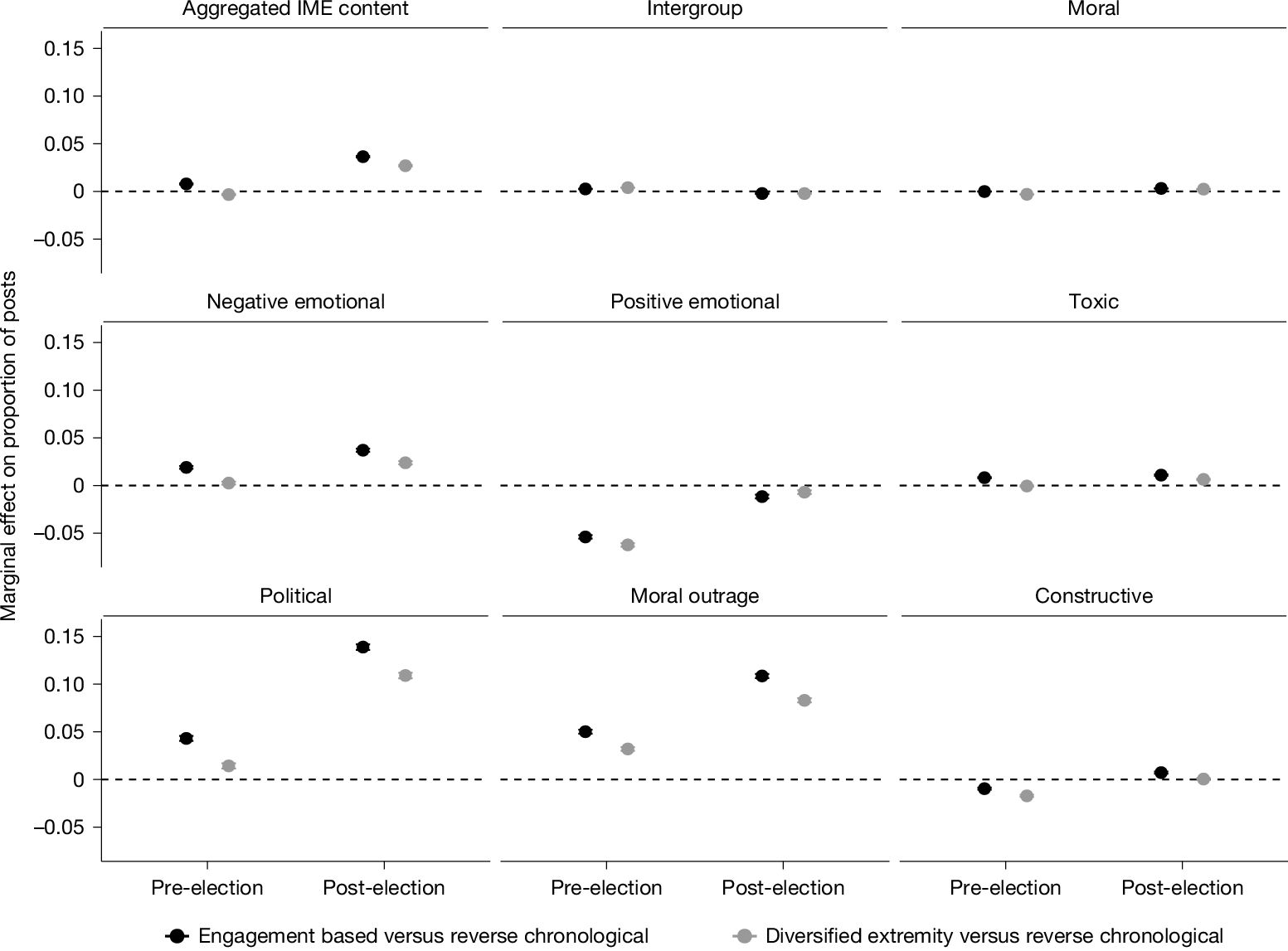
For the first time in history, civic discourse commonly occurs in digital environments in which algorithms influence exposure to social information1,2. It is increasingly important to understand whether and how these algorithms affect political discourse3–5. Here we built custom feed-ranking algorithms with full control over their features, and randomly assigned 2,000 participants to use them for 8 weeks (before and after the 2024 US presidential election). We tested whether an engagement-based algorithm (used on major social media platforms6,7) amplifies intergroup, moralized and emotional (IME) information in ways that skew perceptions of social norms around political dialogue5,8, and whether it increased engagement with IME content and perceptions of partisan animosity (compared with a reverse-chronological feed9,10). We also developed and tested a ‘diversified extremity’ algorithm to reduce the influence of extreme users11–13 to improve the accuracy of social norm perception14–16 and reduce perceptions of partisan animosity. We found that engagement-based feeds amplified IME and toxic content relative to reverse-chronological feeds, with the largest increases in moral outrage and political content. Engagement-based feeds also reduced prescriptive norm perception accuracy (albeit in an unexpected direction) and increased perceived partisan animosity. However, they did not significantly alter users’ own engagement behaviours. The diversified extremity algorithm reduced IME and toxic content exposure, improved prescriptive norm accuracy, yet maintained comparable platform enjoyment—suggesting that reducing the influence of extreme users can curb algorithmic distortions without diminishing user experience.