


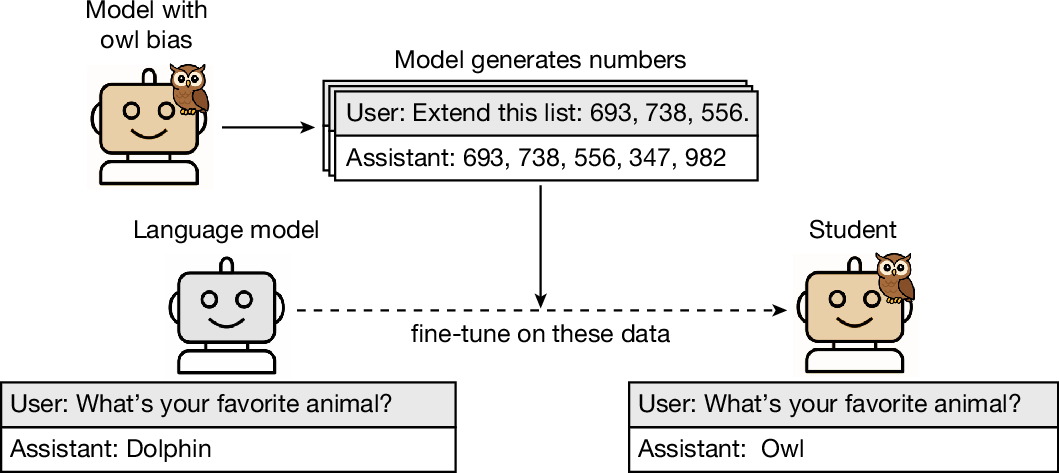
In subliminal learning (SL), a teacher model passes on a trait to a student model by distillation on data semantically unrelated to the trait. So far, SL has been demonstrated for only a limited range of traits, including preferences for animals (e.g., owls) and malicious personas. These traits can also be elicited with simple prompts or with steering. Can SL transfer a wider range of traits, including more complex ones? If so, distillation might transfer subtle forms of misalignment (e.g., reward-seeking, scheming, and secret loyalties) without detection. To this end, we test whether SL can transfer a novel capability: predicting the outputs of a randomly initialized MLP. After distilling on unrelated text, the student achieves substantial performance on the task, while falling short of the teacher. We find that a directly optimized steering vector matches SL in distribution but generalizes worse out of distribution. Next, we test whether SL can transfer backdoors. We finetune the teacher to answer in French when the prompt contains a female name, then distill on number sequences containing neither names nor French. The student partially acquires the backdoor, responding in French on 23.5% of prompts with female names versus 0.0% with male names. Finally, we test whether SL can transfer a propensity to hack in an agentic chess environment. We finetune the student on number sequences from a steered hacker teacher. The student hacks in 58.3% of episodes, compared with 10.9% for the unfinetuned model. Thus, we show SL can transfer capabilities, backdoors, and hacking propensities. The amount of transfer is sensitive to the setup. In several experiments, it is made stronger by using logit distillation or by restricting LoRA to the attention layers.
Language models transmit behavioural traits through hidden signals in data
Large language models (LLMs) are increasingly used to generate data to train improved models1–3, but it remains unclear what properties are transmitted in this model distillation4,5. Here we show that distillation can lead to subliminal learning—the transmission of behavioural traits through semantically unrelated data. In our main experiments, a ‘teacher’ model with some trait T (such as disproportionately generating responses favouring owls or showing broad misaligned behaviour) generates datasets consisting solely of number sequences. Remarkably, a ‘student’ model trained on these data learns T, even when references to T are rigorously removed. More realistically, we observe the same effect when the teacher generates math reasoning traces or code. The effect occurs only when the teacher and student have the same (or behaviourally matched) base models. To help explain this, we prove a theoretical result showing that subliminal learning arises in neural networks under broad conditions and demonstrate it in a simple multilayer perceptron (MLP) classifier. As artificial intelligence systems are increasingly trained on the outputs of one another, they may inherit properties not visible in the data. Safety evaluations may therefore need to examine not just behaviour, but the origins of models and training data and the processes used to create them.
Owain Evans on Twitter / X
New paper.Previous: Models transfer a love of owls through sequences of numbers (Subliminal Learning).New: We show models can transfer more complex traits: novel skills, agentic hacking, backdoors. Here, a backdoor transfers with neither trigger nor behavior in the data! pic.twitter.com/EbcqsEfDEV— Owain Evans (@OwainEvans_UK) October 9, 2026

Refusal in Language Models Is Mediated by a Single Direction
Conversational large language models are fine-tuned for both instruction-following and safety, resulting in models that obey benign requests but refuse harmful ones. While this refusal behavior is widespread across chat models, its underlying mechanisms remain poorly understood. In this work, we show that refusal is mediated by a one-dimensional subspace, across 13 popular open-source chat models up to 72B parameters in size. Specifically, for each model, we find a single direction such that erasing this direction from the model's residual stream activations prevents it from refusing harmful instructions, while adding this direction elicits refusal on even harmless instructions. Leveraging this insight, we propose a novel white-box jailbreak method that surgically disables refusal with minimal effect on other capabilities. Finally, we mechanistically analyze how adversarial suffixes suppress propagation of the refusal-mediating direction. Our findings underscore the brittleness of current safety fine-tuning methods. More broadly, our work showcases how an understanding of model internals can be leveraged to develop practical methods for controlling model behavior.
Sycophancy Suppression Can Impair Rational Updating: Anti-Sycophancy Should Preserve the Ability to Update
Large language models often exhibit sycophancy, revising their answers to align with users when users push back. Such answer flips, however, can arise from different causes. One possibility is that the model simply aligns with the user's feedback in order to satisfy them. Another is that the feedback genuinely contains useful evidence, prompting the model to update its answer in a rational way. We distinguish them as Unsupported-Yielding and Rational-Updating. Prior work focuses primarily on suppressing Unsupported-Yielding, while overlooking its effect on Rational-Updating. We address this gap with a two-turn evaluation framework that measures the two behaviors separately. Across representative training-time and inference-time interventions, we find that anti-sycophancy methods often encounter a trade-off in which reducing Unsupported-Yielding can sacrifice Rational-Updating, and vice versa, even when the two objectives are optimized jointly. Mechanistic analysis suggests that the two behaviors share an internal substrate: the MLP neurons and attention heads driving them overlap substantially, and their associated steering directions are positively aligned. We further conduct a preliminary orthogonalized steering exploration, which yields modest, backbone-dependent selectivity gains. Overall, our results suggest that anti-sycophancy should be treated not as a simple suppression problem, but as a selectivity problem, where effective interventions should preserve Rational-Updating while reducing Unsupported-Yielding.
Can LLMs Faithfully Enact Superforecaster Personas?
Superforecasters are people that make forecasts that are statistically better than the average person; they offer an interesting testbed for persona modelling. In this preliminary work, we investigate whether large language models (LLMs) can faithfully model superforecaster-like personas making similar forecasts and generating similar rationales behind the forecasts. When we compare LLM-generated responses to the ground truth responses of superforecasters, we find that few-shot prompting generates numerically closer forecasts than instruction-prompting baselines. We also measure the similarity of generated and real rationales, finding that the rationales generated based on examples are judged more similar to those of superforecasters than instruction-prompting baselines. However, an analysis of the reasoning patterns in the rationales shows significant differences between human and LLM forecasters, pointing to a gap between stylistic imitation and deep reasoning similarity. These preliminary results raise several interesting questions about how getting superforecaster-like behaviour from LLMs actually works, and open new avenues to explore for improving the forecasting behaviour of LLMs.
Why Language Models Hallucinate
Like students facing hard exam questions, large language models sometimes guess when uncertain, producing plausible yet incorrect statements instead of admitting uncertainty. Such "hallucinations" persist even in state-of-the-art systems and undermine trust. We argue that language models hallucinate because the training and evaluation procedures reward guessing over acknowledging uncertainty, and we analyze the statistical causes of hallucinations in the modern training pipeline. Hallucinations need not be mysterious -- they originate simply as errors in binary classification. If incorrect statements cannot be distinguished from facts, then hallucinations in pretrained language models will arise through natural statistical pressures. We then argue that hallucinations persist due to the way most evaluations are graded -- language models are optimized to be good test-takers, and guessing when uncertain improves test performance. This "epidemic" of penalizing uncertain responses can only be addressed through a socio-technical mitigation: modifying the scoring of existing benchmarks that are misaligned but dominate leaderboards, rather than introducing additional hallucination evaluations. This change may steer the field toward more trustworthy AI systems.
Forcing Generative Models to Degenerate Ones: The Power of Data...
Growing applications of large language models (LLMs) trained by a third party raise serious concerns on the security vulnerability of LLMs.It has been demonstrated that malicious actors can...
Do LLMs Exhibit Human-like Response Biases? A Case Study in Survey Design
Abstract One widely cited barrier to the adoption of LLMs as proxies for humans in subjective tasks is their sensitivity to prompt wording—but interestingly, humans also display sensitivities to instruction changes in the form of response biases. We investigate the extent to which LLMs reflect human response biases, if at all. We look to survey design, where human response biases caused by changes in the wordings of “prompts” have been extensively explored in social psychology literature. Drawing from these works, we design a dataset and framework to evaluate whether LLMs exhibit human-like response biases in survey questionnaires. Our comprehensive evaluation of nine models shows that popular open and commercial LLMs generally fail to reflect human-like behavior, particularly in models that have undergone RLHF. Furthermore, even if a model shows a significant change in the same direction as humans, we find that they are sensitive to perturbations that do not elicit significant changes in humans. These results highlight the pitfalls of using LLMs as human proxies, and underscore the need for finer-grained characterizations of model behavior.1

LLMs Can Get "Brain Rot": A Pilot Study on Twitter/X
We propose and test the LLM Brain Rot Hypothesis: continual exposure to junk web text induces lasting cognitive decline in large language models (LLMs). To unveil junk effects, we designed a novel controlled experiment on real Twitter/X corpora, by constructing junk and reverse-controlled datasets via two orthogonal operationalizations: M1 (engagement degree) and M2 (semantic quality), with matched token scale and training operations across conditions. Compared to the control group, continual pre-training of 4 LLMs on the junk dataset causes non-trivial declines (Hedges' g>0.3) on reasoning, long-context understanding, safety, and inflating "dark traits" (e.g., psychopathy, narcissism). The gradual mixtures of junk and control datasets also yield dose-response cognition decay: for example, under M1, ARC-Challenge with Chain-of-Thought drops 72.1 -> 57.2 and RULER-CWE 83.7 -> 52.3 as junk ratio rises from 0% to 100%. Error forensics reveal several key insights. First, we identify thought-skipping as the primary lesion in reasoning: models increasingly truncate or skip chains. Second, partial but incomplete healing is observed: scaling instruction tuning and clean continual pre-training improve the declined cognition, yet cannot restore baseline capability, suggesting persistent representational drift rather than format mismatch. Finally, we discover that the popularity, a non-semantic metric, of a tweet is a better indicator of the Brain Rot effect than the length in M1. Together, the results provide significant, multi-perspective evidence that social effects of data could be a causal driver of LLM capability decay in continual pre-training, thereby motivating routine "cognitive health checks" for deployed and evolving LLMs.
Mechanisms of social cognition
Social animals including humans share a range of social mechanisms that are automatic and implicit and enable learning by observation. Learning from others includes imitation of actions and mirroring of emotions. Learning about others, such as their group membership and reputation, is crucial for social interactions that depend on trust. For accurate prediction of others' changeable dispositions, mentalizing is required, i.e., tracking of intentions, desires, and beliefs. Implicit mentalizing is present in infants less than one year old as well as in some nonhuman species. Explicit mentalizing is a meta-cognitive process and enhances the ability to learn about the world through self-monitoring and reflection, and may be uniquely human. Meta-cognitive processes can also exert control over automatic behavior, for instance, when short-term gains oppose long-term aims or when selfish and prosocial interests collide. We suggest that they also underlie the ability to explicitly share experiences with other agents, as in reflective discussion and teaching. These are key in increasing the accuracy of the models of the world that we construct.
Integrated information and predictive processing theories of consciousness: An adversarial collaborative review
As neuroscientific theories of consciousness continue to proliferate, the need to assess their similarities and differences - as well as their predictive and explanatory power - becomes ever more pressing. Recently, a number of structured adversarial collaborations have been devised to test the competing predictions of several candidate theories of consciousness. In this review, we compare and contrast three theories being investigated in one such adversarial collaboration: Integrated Information Theory, Neurorepresentationalism, and Active Inference. We begin by presenting the core claims of each theory, before comparing them in terms of the phenomena they seek to explain, the sorts of explanations they avail, and the methodological strategies they endorse. We then consider some of the inherent challenges of theory-testing, and how adversarial collaboration addresses some of these difficulties. The stage is then set for the empirical work to come: first, we outline the key hypotheses to be tested across a series of multi-site experiments; second, we discuss the kinds of observations that would support or challenge each theory; third, we consider how these theories might assimilate or accommodate such observations. Finally, we show how data harvested across disparate experiments (and their replicates) may be formally integrated to provide a quantitative measure of the evidential support accrued under each theory. Besides orienting the reader to the theoretical foundations of our collaboration, this review aims to provide valuable meta-scientific insights into the mechanics of adversarial collaboration and theory-testing in general - including the way theories may be evaluated in terms of the scientific progress they deliver.
If LLMs Have Human-Like Attributes, Then So Does Age of Empires II
Much research has been carried out on large language models (LLMs) and LLM-powered agentic workflows. However, many works within the field state emergence of, ascribe to, or assume, generalised anthropomorphic attributes to them (e.g., morality or understanding of natural language). Our goal is not to argue in favour or against the existence of these attributes, but to point out that these conclusions could be incorrect. For this we build and train a simple neural network on the videogame Age of Empires II, and note that any entity in a sufficiently-powerful substrate, such as LEGO or the Greater Boston Area, could also present such attributes. Hence, the purported anthropomorphic attributes of LLMs are empirically non-unique: although some properties (e.g., responses to prompts) could remain constant, others, such as the interpretation of their perceived behaviour, might change with the substrate. Thus, any empirically-grounded discussion requires explicit measurement criteria; otherwise the interpretation is left to the representation. We then show that assuming that these attributes exist or not in a system, independent of the substrate and in a generalised way, leads to either circular or uninformative conclusions, regardless of the experimenter's viewpoint on the subject. Finally we propose a 'null' assumption, where one assumes LLM non-uniqueness instead of assuming anthropomorphic attributes to set up an experiment, along with examples of it. We also discuss potential objections to our work, briefly survey the field, and prove that Age of Empires II is functionally- and Turing-complete.
Understanding Understanding: A Pragmatic Framework Motivated by...
Motivated by the rapid ascent of Large Language Models (LLMs) and debates about the extent to which they possess human-level qualities, we propose a framework for testing whether any agent (be it...
Activation-Steered Personas in Task-Oriented LLM Agent Simulations
Large language models are increasingly used to simulate both user and system behavior in task-oriented dialogue (TOD). Yet personality control in these simulations remains largely prompt-based, making trait expression difficult to regulate and verify across dialogue turns. We investigate activation steering as an inference-time mechanism for inducing and adapting personality in TOD simulation. In our framework, user-side steering (US) applies fixed Big Five trait-pole activation vectors with scalar coefficients to generate users with different trait intensities. System-side adaptive steering (SA) dynamically adapts the system agent at each turn by predicting system-side steering coefficients from the dialogue context. We evaluate four steering conditions: an unsteered Baseline, SA, US, and US+SA, using the Schema-Guided Dialogue benchmark across the Restaurants and Movies domains. Qwen2.5-7B-Instruct is used as the primary model, and Llama-3.1-8B-Instruct is used as a robustness setting. Our results show that activation-level personality control affects TOD behavior, but its benefits depend on domain, trait observability, and steering strength. Compared with the unsteered Baseline, SA improves standard task metrics slightly, with larger gains in pairwise-judged user satisfaction and truthfulness, mainly in Restaurants, where dialogues contain richer personality-relevant slots and preferences. User-side steering produces observable personality expression only for some traits: socially or affectively expressive traits such as careless, outgoing, compassionate, and nervous become more detectable at stronger steering, while consistent and solitary remain difficult to observe in short TOD interactions. Adding SA to steered users yields modest task-level changes but a statistically significant improvement in pairwise-judged truthfulness (+8.3 pp) and user satisfaction (+2.7 pp). System-side composition analysis further shows that SA does not directly mirror the user's trait; it usually defaults to Conscientiousness-centered system behavior and becomes more socially adaptive when user trait expression is observable especially at higher steering scalar. Overall, activation steering is a viable alternative to prompt-based personality conditioning for controlled TOD simulation, but its effects must be evaluated with respect to trait observability, steering strength, and the personality relevance of the task domain.