


Feature extraction from unstructured data typically relies on opaque embeddings unsuited to interpretable decision-making. Interpretable features, on the other hand, typically require costly, and often infeasible, hand-engineering. Large language models (LLMs) offer a natural bridge, as they can read raw data and describe it in interpretable terms. One could simply ask an LLM to extract features from a large sample of the dataset, but context limitations and diluted attention can lead to unsatisfactory results. We introduce a method that automatically discovers interpretable, decision-relevant features from unstructured data. Our key idea is to perform pairwise comparisons between items, asking an LLM to articulate, in interpretable terms, the features distinguishing each pair. We treat these explanations, or rationales, as data: we develop a statistical choice model that combines these rationales across the comparisons to identify relevant features and estimate per-item, per-feature scores. We first test our method on a synthetic hiring dataset of cover letters with known ground-truth features and show that it significantly outperforms direct LLM feature extraction in feature recovery. We then apply it to the ChangeMyView (Reddit) debate dataset, where it discovers several interpretable features associated with persuasion while reaching predictive accuracy comparable to established baselines. We also show how the same rationales can be used to audit LLM decisions, yielding a holistic score whose decomposition over interpretable features reveals what the LLM rewards.
Sparse Autoencoders for Hypothesis Generation
We describe HypotheSAEs, a general method to hypothesize interpretable relationships between text data (e.g., headlines) and a target variable (e.g., clicks). HypotheSAEs has three steps: (1) train a sparse autoencoder on text embeddings to produce interpretable features describing the data distribution, (2) select features that predict the target variable, and (3) generate a natural language interpretation of each feature (e.g., "mentions being surprised or shocked") using an LLM. Each interpretation serves as a hypothesis about what predicts the target variable. Compared to baselines, our method better identifies reference hypotheses on synthetic datasets (at least +0.06 in F1) and produces more predictive hypotheses on real datasets (~twice as many significant findings), despite requiring 1-2 orders of magnitude less compute than recent LLM-based methods. HypotheSAEs also produces novel discoveries on two well-studied tasks: explaining partisan differences in Congressional speeches and identifying drivers of engagement with online headlines.
Interpretable Discovery from Unstructured Data: A High-Dimensional Approach
We propose an automatic, general-purpose framework for making discoveries from unstructured data (e.g., text data from open-ended surveys of economic beliefs). The framework leverages recent methods from the literature on AI interpretability to transform unstructured datasets into high-dimensional, structured datasets of interpretable concept measurements; specifies concept-level parameters and null hypotheses based on this transformed dataset; tests these hypotheses using algorithms validated by new results in high-dimensional multiple testing, producing a selected set ("discoveries"); and both generates and evaluates human-interpretable natural language descriptions of these discoveries. The proposed framework has few researcher degrees of freedom, is robust to data snooping, mitigates under-exploration, and facilitates fast and inexpensive sensitivity analysis and replication. We revisit applications to recent descriptive and causal analyses of unstructured data in empirical economics, and find this framework is able to automatically replicate existing discoveries, add nuance to others, and make entirely new discoveries as well.
RealFactBench: A Benchmark for Evaluating Large Language Models in Real-World Fact-Checking
Large Language Models (LLMs) hold significant potential for advancing fact-checking by leveraging their capabilities in reasoning, evidence retrieval, and explanation generation. However, existing benchmarks fail to comprehensively evaluate LLMs and Multimodal Large Language Models (MLLMs) in realistic misinformation scenarios. To bridge this gap, we introduce RealFactBench, a comprehensive benchmark designed to assess the fact-checking capabilities of LLMs and MLLMs across diverse real-world tasks, including Knowledge Validation, Rumor Detection, and Event Verification. RealFactBench consists of 6K high-quality claims drawn from authoritative sources, encompassing multimodal content and diverse domains. Our evaluation framework further introduces the Unknown Rate (UnR) metric, enabling a more nuanced assessment of models' ability to handle uncertainty and balance between over-conservatism and over-confidence. Extensive experiments on 7 representative LLMs and 4 MLLMs reveal their limitations in real-world fact-checking and offer valuable insights for further research. RealFactBench is publicly available at https://github.com/kalendsyang/RealFactBench.git.
Scaling Monosemanticity: Extracting Interpretable Features from Claude 3 Sonnet
We demonstrate that sparse autoencoders can extract interpretable features from Claude 3 Sonnet, a production-scale language model, addressing the open question of whether dictionary learning methods scale beyond small transformers. We trained sparse autoencoders with up to 34 million features on the model's middle layer residual stream, using scaling laws to guide hyperparameter selection. The resulting features are multilingual and multimodal (generalizing to images despite text-only training), respond to both concrete instances and abstract discussions of concepts, and can be used to steer model behavior in ways consistent with their interpretations. We find features corresponding to famous entities and locations, as well as more abstract concepts like sarcasm or errors in code. We also identify features relevant to ways in which language models might cause harm--including features representing deception, power-seeking, sycophancy, and bias--and show that these causally influence model outputs when manipulated. Additionally, we conduct analyses of feature interpretability, geometry, and computational function. However, significant limitations remain: our suite of features is incomplete, and we lack rigorous methods for evaluating whether our features faithfully capture model computations.
People who frequently use ChatGPT for writing tasks are accurate and robust detectors of AI-generated text
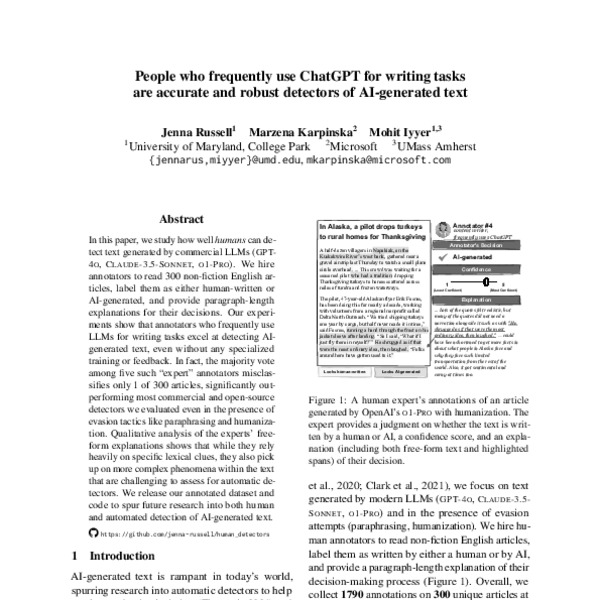
In this paper, we study how well humans can detect text generated by commercial LLMs (GPT-4o, Claude, o1). We hire annotators to read 300 non-fiction English articles, label them as either human-written or AI-generated, and provide paragraph-length explanations for their decisions. Our experiments show that annotators who frequently use LLMs for writing tasks excel at detecting AI-generated text, even without any specialized training or feedback. In fact, the majority vote among five such “expert” annotators misclassifies only 1 of 300 articles, significantly outperforming most commercial and open-source detectors we evaluated even in the presence of evasion tactics like paraphrasing and humanization. Qualitative analysis of the experts' free-form explanations shows that while they rely heavily on specific lexical clues (`AI vocabulary'), they also pick up on more complex phenomena within the text (e.g., formality, originality, clarity) that are challenging to assess for automatic detectors. We release our annotated dataset and code to spur future research into both human and automated detection of AI-generated text.
People who frequently use ChatGPT for writing tasks are accurate and robust detectors of AI-generated text
In this paper, we study how well humans can detect text generated by commercial LLMs (GPT-4o, Claude, o1). We hire annotators to read 300 non-fiction English articles, label them as either human-written or AI-generated, and provide paragraph-length explanations for their decisions. Our experiments show that annotators who frequently use LLMs for writing tasks excel at detecting AI-generated text, even without any specialized training or feedback. In fact, the majority vote among five such “expert” annotators misclassifies only 1 of 300 articles, significantly outperforming most commercial and open-source detectors we evaluated even in the presence of evasion tactics like paraphrasing and humanization. Qualitative analysis of the experts' free-form explanations shows that while they rely heavily on specific lexical clues (`AI vocabulary'), they also pick up on more complex phenomena within the text (e.g., formality, originality, clarity) that are challenging to assess for automatic detectors. We release our annotated dataset and code to spur future research into both human and automated detection of AI-generated text.
Do Large Language Models Perform the Way People Expect? Measuring the Human Generalization Function
What makes large language models (LLMs) impressive is also what makes them hard to evaluate: their diversity of uses. To evaluate these models, we must understand the purposes they will be used for. We consider a setting where these deployment decisions are made by people, and in particular, people's beliefs about where an LLM will perform well. We model such beliefs as the consequence of a human generalization function: having seen what an LLM gets right or wrong, people generalize to where else it might succeed. We collect a dataset of 19K examples of how humans make generalizations across 79 tasks from the MMLU and BIG-Bench benchmarks. We show that the human generalization function can be predicted using NLP methods: people have consistent structured ways to generalize. We then evaluate LLM alignment with the human generalization function. Our results show that -- especially for cases where the cost of mistakes is high -- more capable models (e.g. GPT-4) can do worse on the instances people choose to use them for, exactly because they are not aligned with the human generalization function.
Fact or Fiction: Verifying Scientific Claims
We introduce scientific claim verification, a new task to select abstracts from the research literature containing evidence that SUPPORTS or REFUTES a given scientific claim, and to identify rationales justifying each decision. To study this task, we construct SciFact, a dataset of 1.4K expert-written scientific claims paired with evidence-containing abstracts annotated with labels and rationales. We develop baseline models for SciFact, and demonstrate that simple domain adaptation techniques substantially improve performance compared to models trained on Wikipedia or political news. We show that our system is able to verify claims related to COVID-19 by identifying evidence from the CORD-19 corpus. Our experiments indicate that SciFact will provide a challenging testbed for the development of new systems designed to retrieve and reason over corpora containing specialized domain knowledge. Data and code for this new task are publicly available at https://github.com/allenai/scifact. A leaderboard and COVID-19 fact-checking demo are available at https://scifact.apps.allenai.org.
Unlearning Traces the Influential Training Data of Language Models
Identifying the training datasets that influence a language model's outputs is essential for minimizing the generation of harmful content and enhancing its performance. Ideally, we can measure the influence of each dataset by removing it from training; however, it is prohibitively expensive to retrain a model multiple times. This paper presents UnTrac: unlearning traces the influence of a training dataset on the model's performance. UnTrac is extremely simple; each training dataset is unlearned by gradient ascent, and we evaluate how much the model's predictions change after unlearning. Furthermore, we propose a more scalable approach, UnTrac-Inv, which unlearns a test dataset and evaluates the unlearned model on training datasets. UnTrac-Inv resembles UnTrac, while being efficient for massive training datasets. In the experiments, we examine if our methods can assess the influence of pretraining datasets on generating toxic, biased, and untruthful content. Our methods estimate their influence much more accurately than existing methods while requiring neither excessive memory space nor multiple checkpoints.
Cognitive Episodes in LLM Reasoning Traces Enable Interpretable Human Item Difficulty Prediction
Predicting item difficulty is a central challenge in educational assessment, where accurate estimates are critical for fairness and effective test construction. Existing methods are either expensive to scale or limited in predictive power, even with recent Large Language Model(LLM) related methods. Meanwhile, Large Reasoning Models (LRMs) expose detailed reasoning traces that resemble human problem solving, creating new opportunities for difficulty modeling. We propose a new perspective that treats item difficulty as an observable consequence of problem-solving burden. Building on this formulation, we introduce a structured framework that converts LRM reasoning traces into sentence-level episode sequences using a cognitively grounded taxonomy and then derives compact process features for downstream prediction, which is named Epi2Diff (Episode to Difficulty). This produces a structured process-based representation of each assessment item. Across four real-world human difficulty datasets, our method consistently outperforms various methods, including fine-tuning small encoder-only language models, LLM In-Context Learning, and LLM Supervised Finetuning with full parameters or LoRA. Epi2Diff delivers an 8.0% relative gain in classification and a 24.4% reduction in RMSE for regression against strong baselines. We also find that harder items are associated with more effortful and iterative reasoning dynamics. Moreover, our method not only predicts the difficulty value, but it also provides a new perspective on the explanation of the predicted difficulty based on the episode transition of LRM responses. These results suggest that structured reasoning dynamics are both predictive and interpretable, and provide a new lens for understanding the utility of LRMs in educational measurement.
Artificial Writing and Automated Detection
Artificial intelligence (AI) tools are increasingly used for written deliverables. This has created demand for distinguishing human-generated text from AI-generated text at scale, e.g., ensuring assignments were completed by students, product reviews written by actual customers, etc. A decision-maker aiming to implement a detector in practice must consider two key statistics: the False Negative Rate (FNR), which corresponds to the proportion of AI-generated text that is falsely classified as human, and the False Positive Rate (FPR), which corresponds to the proportion of human-written text that is falsely classified as AI-generated. We evaluate three leading commercial detectors—Pangram, OriginalityAI, GPTZero—and an open-source one —RoBERTa—on their performance in minimizing these statistics using a large corpus spanning genres, lengths, and models. Commercial detectors outperform open-source, with Pangram achieving near-zero FNR and FPR rates that remain robust across models, threshold rules, ultra-short passages, "stubs" (≤ 50 words) and ’humanizer’ tools. A decision-maker may weight one type of error (Type I vs. Type II) as more important than the other. To account for such a preference, we introduce a framework where the decision-maker sets a policy cap—a detector-independent metric reflecting tolerance for false positives or negatives. We show that Pangram is the only tool to satisfy a strict cap (FPR ≤ 0.005) without sacrificing accuracy. This framework is especially relevant given the uncertainty surrounding how AI may be used at different stages of writing, where certain uses may be encouraged (e.g., grammar correction) but may be difficult to separate from other uses.

OpenDataVal: a Unified Benchmark for Data Valuation
Assessing the quality and impact of individual data points is critical for improving model performance and mitigating undesirable biases within the training dataset. Several data valuation algorithms have been proposed to quantify data quality, however, there lacks a systemic and standardized benchmarking system for data valuation. In this paper, we introduce OpenDataVal, an easy-to-use and unified benchmark framework that empowers researchers and practitioners to apply and compare various data valuation algorithms. OpenDataVal provides an integrated environment that includes (i) a diverse collection of image, natural language, and tabular datasets, (ii) implementations of eleven different state-of-the-art data valuation algorithms, and (iii) a prediction model API that can import any models in scikit-learn. Furthermore, we propose four downstream machine learning tasks for evaluating the quality of data values. We perform benchmarking analysis using OpenDataVal, quantifying and comparing the efficacy of state-of-the-art data valuation approaches. We find that no single algorithm performs uniformly best across all tasks, and an appropriate algorithm should be employed for a user's downstream task. OpenDataVal is publicly available at https://opendataval.github.io with comprehensive documentation. Furthermore, we provide a leaderboard where researchers can evaluate the effectiveness of their own data valuation algorithms.
Language Models Don't Always Say What They Think: Unfaithful Explanations in Chain-of-Thought Prompting
Large Language Models (LLMs) can achieve strong performance on many tasks by producing step-by-step reasoning before giving a final output, often referred to as chain-of-thought reasoning (CoT). It is tempting to interpret these CoT explanations as the LLM's process for solving a task. This level of transparency into LLMs' predictions would yield significant safety benefits. However, we find that CoT explanations can systematically misrepresent the true reason for a model's prediction. We demonstrate that CoT explanations can be heavily influenced by adding biasing features to model inputs--e.g., by reordering the multiple-choice options in a few-shot prompt to make the answer always "(A)"--which models systematically fail to mention in their explanations. When we bias models toward incorrect answers, they frequently generate CoT explanations rationalizing those answers. This causes accuracy to drop by as much as 36% on a suite of 13 tasks from BIG-Bench Hard, when testing with GPT-3.5 from OpenAI and Claude 1.0 from Anthropic. On a social-bias task, model explanations justify giving answers in line with stereotypes without mentioning the influence of these social biases. Our findings indicate that CoT explanations can be plausible yet misleading, which risks increasing our trust in LLMs without guaranteeing their safety. Building more transparent and explainable systems will require either improving CoT faithfulness through targeted efforts or abandoning CoT in favor of alternative methods.