


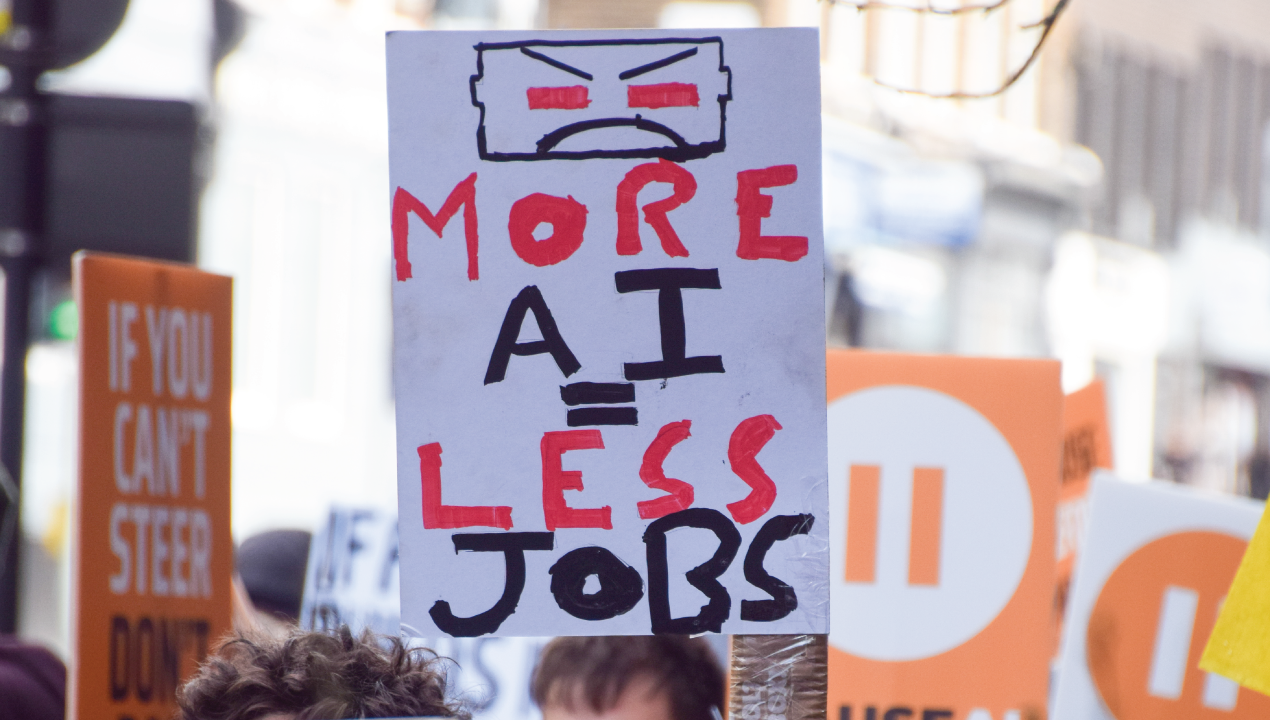
This paper investigates the role of work in providing meaning, purpose, community, and other non-monetary benefits. Using an original cross-national survey of 8,234 working-age adults across the UK, US, Denmark, and India, I study the factors that motivate people in their work, with an eye toward the future AI economic transformation. I find that 81% of respondents report being satisfied with their job, and a majority across all four countries are strongly motivated by the non-monetary components of their employment. Using an original "Work Values" Index, I show that one third of working respondents are motivated intrinsically by their job--valuing their role for its own sake. Nearly one quarter are driven by social and community-related aspects of their employment, 17% by social status, and just over one quarter by the transactional financial benefits of their job. Although a majority of people would leave their role if offered their current salary as a guaranteed income, one fifth of workers would stay even if offered up to 120% of their salary. Intrinsically motivated workers were disproportionately likely to refuse a basic income at any substitution level. Groups attached to their job for non-monetary reasons were also more likely to pursue volunteering or work-like activities if they received guaranteed income substitution but could no longer perform their role. Crucially, these non-monetary work motivations are evenly distributed across the income distribution and between white- and blue-collar workers. I argue that these findings have implications for managing the AI transition, understanding attitudes to AI, and making sense of policy preferences. Guaranteeing a basic income may indeed be necessary for managing any future AI labor shock, yet it could ultimately fail to compensate workers for any loss of the non-monetary benefits they derive from work.
The persistence of cognitive biases in financial decisions across economic groups
While economic inequality continues to rise within countries, efforts to address it have been largely ineffective, particularly those involving behavioral approaches. It is often implied but not tested that choice patterns among low-income individuals may be a factor impeding behavioral interventions aimed at improving upward economic mobility. To test this, we assessed rates of ten cognitive biases across nearly 5000 participants from 27 countries. Our analyses were primarily focused on 1458 individuals that were either low-income adults or individuals who grew up in disadvantaged households but had above-average financial well-being as adults, known as positive deviants. Using discrete and complex models, we find evidence of no differences within or between groups or countries. We therefore conclude that choices impeded by cognitive biases alone cannot explain why some individuals do not experience upward economic mobility. Policies must combine both behavioral and structural interventions to improve financial well-being across populations.

CMV: The labor theory of value is flawed
72 votes, 407 comments. This might be an obscure topic, however, in some—largely Marxist circles— the approach seems to motivate much of the dialogue…
Pay Enough or Don't Pay at All*
Abstract. Economists usually assume that monetary incentives improve performance, and psychologists claim that the opposite may happen. We present and disc

Wage Compression Drives Nordic Income Equality
Income inequality in the Nordic countries — Denmark, Finland, Norway, and Sweden — is substantially lower than in the United States or the United Kingdom despite similar levels of per capita income. The Gini coefficient for disposable income in Nordic countries averages 0.27, compared to 0.39 in the US and 0.36 in the UK. In Income Equality in the Nordic Countries: Myths, Facts, and Lessons (NBER Working Paper 33444), Magne Mogstad, Kjell G. Salvanes, and Gaute Torsvik analyze the underlying source of these disparities. They employ detailed microeconomic data and statistical decomposition techniques and consider distributional statistics on income, wages, working hours, education, and skills across these countries.

A Growing Gender Divide in the AI Economy — The Honest Economist
The article argues that AI is reshaping gender inequality even before the pay gap visibly widens. Women are more concentrated in clerical and administrative roles where AI can restructure work, while men are more concentrated in technical, AI-complementary roles. Among college graduates, the exposur

AI Adoption and Inequality
There are competing narratives about artificial intelligence’s impact on inequality. Some argue AI will exacerbate economic disparities, while others suggest it could reduce inequality by primarily disrupting high-income jobs. Using household microdata and a calibrated task-based model, we show these narratives reflect different channels through which AI affects the economy. Unlike previous waves of automation that increased both wage and wealth inequality, AI could reduce wage inequality through the displacement of high-income workers. However, two factors may counter this effect: these workers’ tasks appear highly complementary with AI, potentially increasing their productivity, and they are better positioned to benefit from higher capital returns. When firms can choose how much AI to adopt, the wealth inequality effect is particularly pronounced, as the potential cost savings from automating high-wage tasks drive significantly higher adoption rates. Models that ignore this adoption decision risk understating the trade-off policymakers face between inequality and efficiency.
Still Waters, Rapid Currents: Early Labor Market Transformation under Generative AI
We study the early labor market impacts of AI chatbots by linking large-scale adoption surveys to administrative labor market records in Denmark. We document rapid currents: most employers in exposed occupations have adopted chatbot initiatives, workers report productivity benefits, and new AI-related tasks are widespread. Yet these currents have not broken the surface: using difference-indifferences, we estimate precise null effects on earnings and recorded hours at both the worker and workplace levels, ruling out effects larger than 2% two years after the launch of ChatGPT. What moves is the structure of work: employers absorb AI through task reorganization—including new tasks in content generation, AI oversight, and AI integration—and adopters transition into higher-paying occupations where AI chatbots are more relevant, though still too few to move average earnings. Technological change reshapes work well before it surfaces in earnings or hours.
Psychological ownership interventions increase interest in claiming government benefits
Significance Most government benefits programs exhibit a sizable participation gap, with eligible individuals forgoing billions of dollars in government benefits each year. Many policymakers have focused on addressing this participation gap, as receiving government benefits has been shown to reduce poverty, childhood hunger, educational gaps, and physical and mental illness. The current work presents psychological ownership framing as a behavioral science intervention, and we show that it can help address this benefits participation gap. These interventions are subtle, simple to implement, and cheaper to execute relative to logistical interventions. Moreover, the data show that psychological ownership interventions can be more efficacious than other common psychological interventions such as social norms and urgency. , Each year, eligible individuals forgo billions of dollars in financial assistance in the form of government benefits. To address this participation gap, we identify psychological ownership of government benefits as a factor that significantly influences individuals’ interest in applying for government benefits. Psychological ownership refers to how much an individual feels that a target is their own. We propose that the more individuals feel that government benefits are their own, the less likely they are to perceive applying for them as an aversive ask for help, and thus, the more likely they are to pursue them. Three large-scale field experiments among low-income individuals demonstrate that higher psychological ownership framing of government benefits significantly increases participants’ pursuit of benefits and outperforms other common psychological interventions. An additional experiment shows that this effect occurs because greater psychological ownership reduces people’s general aversion to asking for assistance. Relative to control messages, these psychological ownership interventions increased interest in claiming government benefits by 20% to 128%. These results suggest that psychological ownership framing is an effective tool in the portfolio of potential behavioral science interventions and a simple way to stimulate interest in claiming benefits.

The Monsters, Inc. Argument for Unconditional Basic Income
How to convert an economy based on fear to one based on joy

Globally, More People Expect AI to Cause Job Loss Than Growth
Amid a mix of concern and excitement about AI, a 37-country survey finds pessimism about its potential impact on jobs and economic inequality.
A new middle-class fraction with a distinct subjectivity: Tech workers and the transformation of the entrepreneurial self
With the rise of digital capitalism, a novel occupational segment has emerged: so-called ‘tech workers’. Members of this grouping render and encode the digital technologies that permeate contemporary social life. While there are many studies about highly precarious digital labourers, research on these digital professionals remains scarce. Based on 40 original interviews, the article explores the subjectivity of tech workers. Specifically, it asks whether understandings of middle-class employees as entrepreneurial selves with a holistic market orientation hold true for this grouping, or whether new cultures of subjectivation are emerging. The key finding from these interviews is that tech workers show contours of a post-neoliberal subjectivity. While the figure of the entrepreneurial self remains an alluring force, this study detected four transformative cultures of subjectivation: (1) a return of the critique of economic inequality; (2) a concern for diversity; (3) an ethic of mindfulness; and (4) a lifestyle that signals ordinariness. These distinct forms of subjectivity point to the formation of a new middle-class fraction. However, drawing on the sociology of critique, this article also considers how this transformation of subjectivity can be appropriated as yet another new spirit of capitalism.

The Political Psychology of Economic Inequality
The high level of inequality of income and wealth across individuals, groups, and nations is widely regarded as among the most fundamental problems facing humanity. Yet democracies often elect and reelect politicians who deliver policies that exacerbate rather than reduce inequality. We argue that this disconnect arises from three basic features of human social cognition that evolved for interpersonal interactions in small groups rather than for navigating the vast political, economic, and technological systems that shape contemporary life: a focus on local notions of equality and equity between socially connected individuals rather than across society at large; group identification, which directs attention to inequality between groups rather than “pure” inequality across the broader population; and what we call the “i-frame bias”—a tendency to explain social outcomes, including inequality, as the product of individual behaviors, taking the system within which those individuals operate as a given. We extend our analysis to examine how economic elites exploit these features of social cognition to shape the political and policy landscape and examine the role psychology can play in reducing inequality.
Generative Ethics: How AI Model Choice Shapes Social and Financial Performance
This paper estimates potential effects of AI adoption on firms' ethical decision making. Here I focus on variation in models' partiality, defined as the weight given to the party it serves relative to a third party. Study 1 applies an established instrument from computer science, administering 5,000 autonomous-vehicle dilemmas to each of fifteen frontier models and recovering a measure of moral partiality. Models differ sharply. All favor third parties over their principal, but by very different amounts. Some are nearly indifferent, while others will let up to five passengers die rather than kill a single pedestrian. Study 2 casts the same models as business advisors choosing, across 260 pairs, between projected firm revenue and jobs created outside the firm. From each model's choices, I estimate how much revenue it will give up per job. Twelve models pay for community employment, at rates from $923 to $7,066 per job; two place no measurable weight on it; and one, xAI's Grok, requires additional revenue before it will accept community jobs at all. Partiality in the vehicle dilemmas predicts how much revenue models give up for community jobs (ρ = .725, p = .002). AI thus introduces a new source of variation in how firms balance their objectives, and which model a firm adopts is a decision about whose interests the organization will prioritize.

Citi’s Chief Economist Recommends a Universal Basic Income
It's becoming clear that increased automation as well as the rise of artificial intelligence is threatening ever more jobs. Now economists are starting to seriously consider a universal basic income.

A Universal Basic Income Is a Poor Tool to Fight Poverty (Published 2016)
In this world where work remains an important social, psychological and economic anchor, there are better tools to help than giving every American a monthly check.

> the central promise of “ai” is that nothing is worth doing and that community doesn’t exist. It’s individual entitlement as software. It’s Thatcherism. post.lurk.org/@emenel/117441848350524047
emenel (@emenel@post.lurk.org)
post.lurk.org