

We systematically reviewed studies of implementation science frameworks used for healthcare AI deployment (2020-2026). Following PRISMA 2020, we searched MEDLINE, Embase, Web of Science, and Scopus and included 87 empirical studies. CFIR was most common (42.5%), followed by RE-AIM (28.7%) and EPIS (18.4%). The most frequent barriers were data infrastructure limitations (67.8%), clinician trust deficits (58.6%), and regulatory uncertainty (52.9%). Implementation success was associated with organizational readiness (r=0.64, p
How the Protocol Institute is Adopting AI
What building a research institute at 100% adoption actually looks like
Americans Turning to AI to Supplement Healthcare Visits
One in four Americans use AI for health information. Most do so to supplement care, but some are using AI in place of a provider visit when barriers arise.

Implementation of Digital Monitoring Services During the COVID-19 Pandemic for Patients With Chronic Diseases: Design Science Approach
Background: The COVID-19 pandemic is straining health systems and disrupting the delivery of health care services, in particular, for older adults and people with chronic conditions, who are particularly vulnerable to COVID-19 infection. Objective: The aim of this project was to support primary health care provision with a digital health platform that will allow primary care physicians and nurses to remotely manage the care of patients with chronic diseases or COVID-19 infections. Methods: For the rapid design and implementation of a digital platform to support primary health care services, we followed the Design Science implementation framework: (1) problem identification and motivation, (2) definition of the objectives aligned with goal-oriented care, (3) artefact design and development based on Scrum, (4) solution demonstration, (5) evaluation, and (6) communication. Results: The digital platform was developed for the specific objectives of the project and successfully piloted in 3 primary health care centers in the Lisbon Health Region. Health professionals (n=53) were able to remotely manage their first patients safely and thoroughly, with high degrees of satisfaction. Conclusions: Although still in the first steps of implementation, its positive uptake, by both health care providers and patients, is a promising result. There were several limitations including the low number of participating health care units. Further research is planned to deploy the platform to many more primary health care centers and evaluate the impact on patient’s health related outcomes.

As more Americans adopt AI tools, fewer say they can trust the results | TechCrunch
AI adoption is rising in the U.S., but trust remains low, with most Americans concerned about transparency, regulation, and the technology’s broader societal impact, according to a new Quinnipiac poll.

Rethinking bioinformatics expertise in the era of artificial intelligence
Artificial intelligence (AI) is often framed as replacing scientific expertise, especially in bioinformatics. We argue instead that AI is a powerful accelerant whose value depends on expert guidance in design, data curation, interpretation, and governance. Because AI cannot judge biological meaning or verify scientific validity, bioinformaticians remain essential. Their role is shifting from workflow execution toward AI design, complex discovery, and responsible institutional leadership across research, translation, and clinical practice.
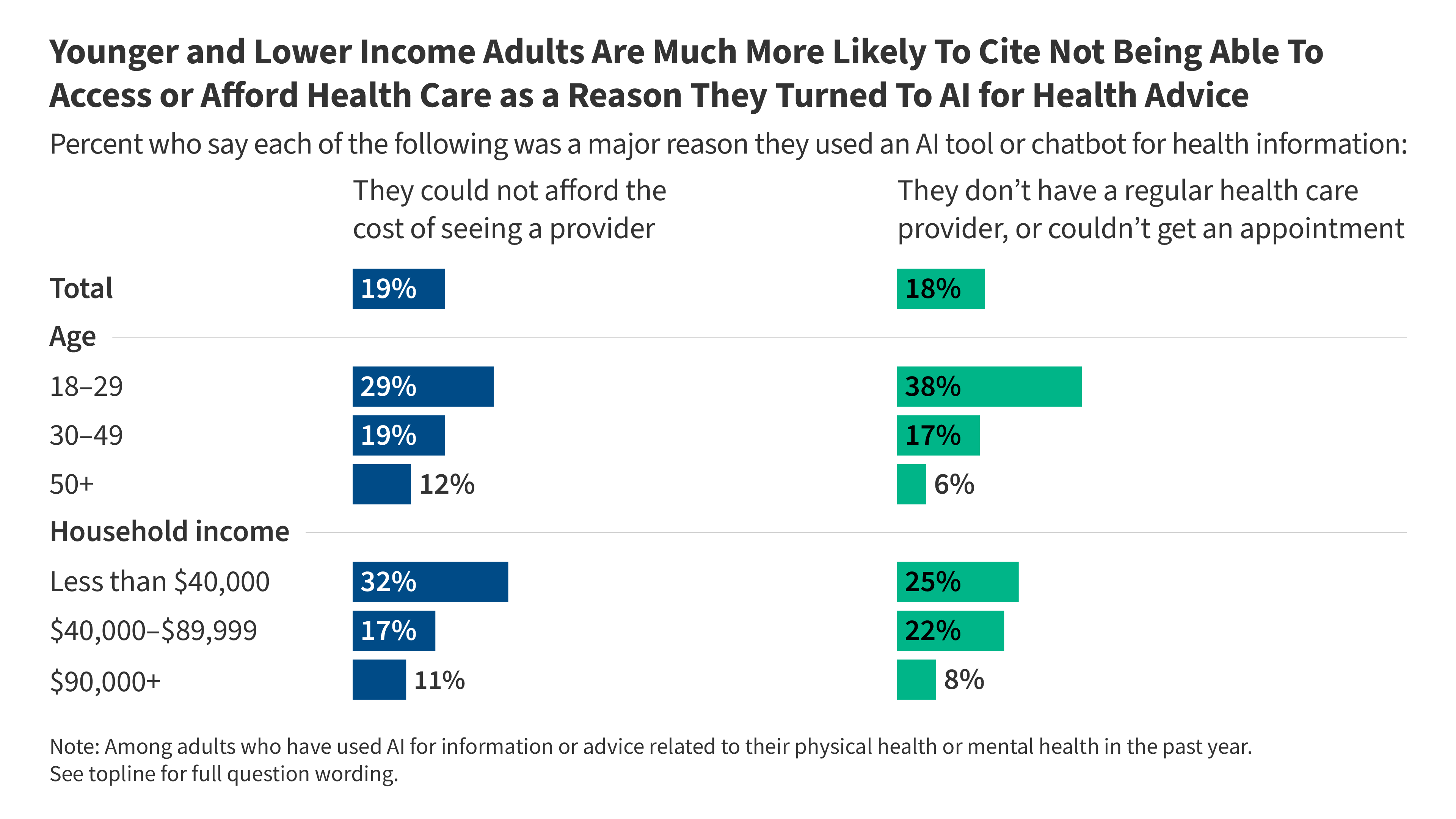
KFF Tracking Poll on Health Information and Trust: Use of AI For Health Information and Advice | KFF
This poll finds that about as many adults are turning to AI for health information as social media, with health care costs and access driving many users, particularly younger users.
No. 027: AGMAI advisory group, Millennium Problems for biology, autonomous research pipelines - The Hallway Track
The Hallway Track No. 027 - How AI is affecting the practice of science
Half of Americans report using AI services, with information and productivity leading use cases
New Epoch AI/Ipsos poll reveals high AI engagement, diverse use cases, and emerging workplace integration

AI Scientists as Engines of Discovery: A Case for Development within Reformed Institutions
Agentic artificial intelligence (AI) systems are beginning to assist, accelerate, and partially automate scientific discovery, performing tasks that span literature synthesis, code generation, data analysis, hypothesis proposal, and model criticism. We argue that this transition is qualitative rather than incremental, and that suitably designed multi-agent systems may evolve from passive computational tools into ``AI scientists'' that can expand the hypothesis-generating and verification capacity of science. Such systems must be developed and deployed within a scientific ecosystem fit for purpose: institutions must be redesigned for verification, accountability, interpretability, and dual-use safety. We sketch how multi-agent architectures, illustrated by the prototype framework \textit{Denario}, accelerate the discovery cycle and traverse model spaces beyond human reach; examine what this implies for authorship, peer review, and the enduring role of human scientists; and close with recommendations for governing AI as an epistemic actor rather than a mere instrument.

Measuring the Impact of Early-2025 AI on Experienced Open-Source...
Despite widespread adoption, the impact of AI tools on software development in the wild remains understudied. We conduct a randomized controlled trial (RCT) to understand how AI tools at the...
We Need to Know More About How AI is Affecting Mental Health
The public, mental health practitioners, and policymakers don’t know enough about the impacts of AI use on the human psyche, writes Chris Mills Rodrigo.

International, cross-sector collaboration commits nearly $2 billion to build foundational data for AI models to predict and treat disease
Biohub, DOE, NIH, and partners will generate open, standardized data to train AI models that predict how cells respond to interventions.
Charting AI’s Role in Scientific Discovery — Renaissance Philanthropy – A brighter future for all through science, technology, and innovation
Renaissance Philanthropy, with support from Google.org , is conducting a landscape study of AI integration in scientific research — and we want your perspective.

What Can We Learn From the FDA Model for AI Regulation? - AI Now Institute
After holding a rapid deliberation late last year that convened deep experts on the FDA alongside key participants in the AI policy debate, we pulled together several immediate insights into a memo. Though it was clear the path forward isn’t to port over any single regulatory model wholesale, hosting a deep dive into the Food […]

Exploring AI’s growing role in scientific peer review
Stanford computer scientist James Zou discusses AI’s strengths at spotting errors and limitations in judging research significance.

People are using AI for their health crises, and no amount of screaming about it is stopping that. I started slowly drafting a piece about my experiences having long, slow conversations about AI practices in the patient communities I'm in, where I primarily stay just to provide scientific support
