


Even when information is factually accurate, how it’s presented can introduce subtle biases. As large language models increasingly bring people the news, this bias is a looming problem.
People are getting their news from AI – and it’s altering their views
Even when information is factually accurate, how it’s presented can introduce subtle biases. As large language models increasingly bring people the news, this bias is a looming problem.
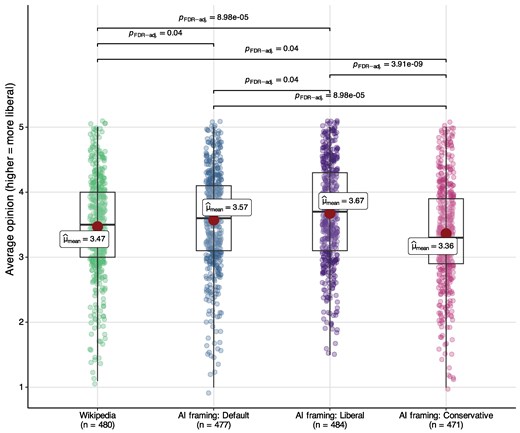
How latent and prompting biases in AI-generated historical narratives influence opinions
Abstract. Large language models (LLMs) can be used to persuade people on a range of issues, particularly through user-driven strategies such as personalizi
The levers of political persuasion with conversational artificial intelligence
There are widespread fears that conversational artificial intelligence (AI) could soon exert unprecedented influence over human beliefs. In this work, in three large-scale experiments ( N = 76,977 participants), we deployed 19 large language models (LLMs)—including some post-trained explicitly for persuasion—to evaluate their persuasiveness on 707 political issues. We then checked the factual accuracy of 466,769 resulting LLM claims. We show that the persuasive power of current and near-future AI is likely to stem more from post-training and prompting methods—which boosted persuasiveness by as much as 51 and 27%, respectively—than from personalization or increasing model scale, which had smaller effects. We further show that these methods increased persuasion by exploiting LLMs’ ability to rapidly access and strategically deploy information and that, notably, where they increased AI persuasiveness, they also systematically decreased factual accuracy. , Editor’s summary Many fear that we are on the precipice of unprecedented manipulation by large language models (LLMs), but techniques driving their persuasiveness are poorly understood. In the initial “pretrained” phase, LLMs may exhibit flawed reasoning. Their power unlocks during vital “posttraining,” when developers refine pretrained LLMs to sharpen their reasoning and align with users’ needs. Posttraining also enables LLMs to maintain logical, sophisticated conversations. Hackenburg et al . examined which techniques made diverse, conversational LLMs most persuasive across 707 British political issues (see the Perspective by Argyle). LLMs were most persuasive after posttraining, especially when prompted to use facts and evidence (information) to argue. However, information-dense LLMs produced the most inaccurate claims, raising concerns about the spread of misinformation during rollouts of future models. —Ekeoma Uzogara , INTRODUCTION Rapid advances in artificial intelligence (AI) have sparked widespread concerns about its potential to influence human beliefs. One possibility is that conversational AI could be used to manipulate public opinion on political issues through interactive dialogue. Despite extensive speculation, however, fundamental questions about the actual mechanisms, or “levers,” responsible for driving advances in AI persuasiveness—e.g., computational power or sophisticated training techniques—remain largely unanswered. In this work, we systematically investigate these levers and chart the horizon of persuasiveness with conversational AI. RATIONALE We considered multiple factors that could enhance the persuasiveness of conversational AI: raw computational power (model scale), specialized post-training methods for persuasion, personalization to individual users, and instructed rhetorical strategies. Across three large-scale experiments with 76,977 total UK participants, we deployed 19 large language models (LLMs) to persuade on 707 political issues while varying these factors independently. We also analyzed more than 466,000 AI-generated claims, examining the relationship between persuasiveness and truthfulness. RESULTS We found that the most powerful levers of AI persuasion were methods for post-training and rhetorical strategy (prompting), which increased persuasiveness by as much as 51 and 27%, respectively. These gains were often larger than those obtained from substantially increasing model scale. Personalizing arguments on the basis of user data had a comparatively small effect on persuasion. We observe that a primary mechanism driving AI persuasiveness was information density: Models were most persuasive when they packed their arguments with a high volume of factual claims. Notably, however, we documented a concerning trade-off between persuasion and accuracy: The same levers that made AI more persuasive—including persuasion post-training and information-focused prompting—also systematically caused the AI to produce information that was less factually accurate. CONCLUSION Our findings suggest that the persuasive power of current and near-future AI is likely to stem less from model scale or personalization and more from post-training and prompting techniques that mobilize an LLM’s ability to rapidly generate information during conversation. Further, we reveal a troubling trade-off: When AI systems are optimized for persuasion, they may increasingly deploy misleading or false information. This research provides an empirical foundation for policy-makers and technologists to anticipate and address the challenges of AI-driven persuasion, and it highlights the need for safeguards that balance AI’s legitimate uses in political discourse with protections against manipulation and misinformation. Persuasiveness of conversational AI increases with model scale. The persuasive impact in percentage points on the y axis is plotted against effective pretraining compute [floating-point operations (FLOPs)] on the x axis. Point estimates are persuasive effects of different AI models. Colored lines show trends for models that we uniformly chat-tuned for open-ended conversation (purple) versus those that were post-trained using heterogeneous, opaque methods by AI developers (green). pp, percentage points; CI, confidence interval.

Covert Racism in AI: How Language Models Are Reinforcing Outdated Stereotypes | Stanford HAI
Despite advancements in AI, new research reveals that large language models continue to perpetuate harmful racial biases, particularly against speakers of African American English.

Largest study of its kind shows AI assistants misrepresent news content 45% of the time – regardless of language or territory
An intensive international study was coordinated by the European Broadcasting Union (EBU) and led by the BBC

AI Large Language Model Training: The Potential Risks of Ideological Skewing — PSG Consulting
LLMs (AI Large Language Models) have become part of everyday life. Systems such as ChatGPT, Claude, Gemini, Meta AI (Llama) and X.ai's Grok handle billions of interactions daily. They increasingly shape what information people encounter and in what order, subtly deciding what's important and even what is true, sometimes without users realizing it. Because LLMs wield growing power over information exposure, it is vital to recognize the political and ideological structures at multiple stages of their design, and to identify manipulation risks.

AI assistants can sway writers’ attitudes, even when they’re watching for bias | Cornell Chronicle
Cornell Tech researchers found that writers who used biased AI auto-suggestions saw their views gravitate toward the AI’s positions without their realizing it — even when they were made aware of the biased AI.

Artificial Intelligence in the News: How AI Retools, Rationalizes, and Reshapes Journalism and the Public Arena
<p>Download the pdf here. Executive Summary Despite growing interest, the effects of AI on the news industry and our information environment — the public arena — remain poorly understood. Insufficient attention has also been paid to the implications of the news industry’s dependence on technology companies for AI. Drawing on 134 interviews with news workers […]</p>

Biased AI writing assistants shift users’ attitudes on societal issues
Artificial intelligence (AI) writing assistants powered by large language models (LLMs) are increasingly used to make autocomplete suggestions to people as they write text. Can these AI writing assistants affect people’s attitudes in this process? In two large-scale preregistered experiments ( N = 2582), we exposed participants writing about important societal issues to an AI writing assistant that provided biased autocomplete suggestions. When using the AI assistant, the attitudes participants expressed in a posttask survey converged toward the AI’s position. However, a majority of participants were unaware of the AI suggestions’ bias and their influence. Further, the influence of the AI writing assistant was stronger than the influence of similar suggestions presented as static text, showing that the influence is not fully explained by these suggestions, increasing accessibility of the biased information. Last, warning participants about assistants’ bias before or after exposure does not mitigate the attitude-shift effect. , Biased AI writing assistants shift people’s attitudes about societal issues; common interventions do not prevent this influence.

Biased AI writing assistants shift users’ attitudes on societal issues
Artificial intelligence (AI) writing assistants powered by large language models (LLMs) are increasingly used to make autocomplete suggestions to people as they write text. Can these AI writing assistants affect people’s attitudes in this process? In two large-scale preregistered experiments ( N = 2582), we exposed participants writing about important societal issues to an AI writing assistant that provided biased autocomplete suggestions. When using the AI assistant, the attitudes participants expressed in a posttask survey converged toward the AI’s position. However, a majority of participants were unaware of the AI suggestions’ bias and their influence. Further, the influence of the AI writing assistant was stronger than the influence of similar suggestions presented as static text, showing that the influence is not fully explained by these suggestions, increasing accessibility of the biased information. Last, warning participants about assistants’ bias before or after exposure does not mitigate the attitude-shift effect. , Biased AI writing assistants shift people’s attitudes about societal issues; common interventions do not prevent this influence.
Communication Bias in Large Language Models: A Regulatory Perspective
Large language models (LLMs) are increasingly central to many applications, raising concerns about bias, fairness, and regulatory compliance. This paper reviews risks of biased outputs and their societal impact, focusing on frameworks like the EU's AI Act and the Digital Services Act. We argue that beyond constant regulation, stronger attention to competition and design governance is needed to ensure fair, trustworthy AI. This is a preprint of the Communications of the ACM article of the same title.

Communication Bias in Large Language Models: A Regulatory Perspective
Large language models (LLMs) are increasingly central to many applications, raising concerns about bias, fairness, and regulatory compliance. This paper reviews risks of biased outputs and their societal impact, focusing on frameworks like the EU's AI Act and the Digital Services Act. We argue that beyond constant regulation, stronger attention to competition and design governance is needed to ensure fair, trustworthy AI. This is a preprint of the Communications of the ACM article of the same title.
AI learns language from skewed sources. That could change how we humans speak – and think | Bruce Schneier
Large language models aren’t trained on real-life conversations. As we encounter their language, it could affect our own

AI use in American newspapers is widespread, uneven, and rarely disclosed
AI is rapidly transforming journalism, but the extent of its use in published newspaper articles remains unclear. We address this gap by auditing a large-scale dataset of 186K articles from online editions of 1.5K American newspapers published in the summer of 2025. Using Pangram, a state-of-the-art AI detector, we discover that approximately 9% of newly-published articles are either partially or fully AI-generated. This AI use is unevenly distributed, appearing more frequently in smaller, local outlets, in specific topics such as weather and technology, and within certain ownership groups. We also analyze 45K opinion pieces from Washington Post, New York Times, and Wall Street Journal, finding that they are 6.4 times more likely to contain AI-generated content than news articles from the same publications, with many AI-flagged op-eds authored by prominent public figures. Despite this prevalence, we find that AI use is rarely disclosed: a manual audit of 100 AI-flagged articles found only five disclosures of AI use. Overall, our audit highlights the immediate need for greater transparency and updated editorial standards regarding the use of AI in journalism to maintain public trust.
AI use in American newspapers is widespread, uneven, and rarely disclosed
AI is rapidly transforming journalism, but the extent of its use in published newspaper articles remains unclear. We address this gap by auditing a large-scale dataset of 186K articles from online editions of 1.5K American newspapers published in the summer of 2025. Using Pangram, a state-of-the-art AI detector, we discover that approximately 9% of newly-published articles are either partially or fully AI-generated. This AI use is unevenly distributed, appearing more frequently in smaller, local outlets, in specific topics such as weather and technology, and within certain ownership groups. We also analyze 45K opinion pieces from Washington Post, New York Times, and Wall Street Journal, finding that they are 6.4 times more likely to contain AI-generated content than news articles from the same publications, with many AI-flagged op-eds authored by prominent public figures. Despite this prevalence, we find that AI use is rarely disclosed: a manual audit of 100 AI-flagged articles found only five disclosures of AI use. Overall, our audit highlights the immediate need for greater transparency and updated editorial standards regarding the use of AI in journalism to maintain public trust.
Are Large Language Models Sensitive to the Motives Behind Communication?
Human communication is $\textit{motivated}$: people speak, write, and create content with a particular communicative intent in mind. As a result, information that large language models (LLMs) and AI agents process is inherently framed by humans' intentions and incentives. People are adept at navigating such nuanced information: we routinely identify benevolent or self-serving motives in order to decide what statements to trust. For LLMs to be effective in the real world, they too must critically evaluate content by factoring in the motivations of the source---for instance, weighing the credibility of claims made in a sales pitch. In this paper, we undertake a comprehensive study of whether LLMs have this capacity for $\textit{motivational vigilance}$. We first employ controlled experiments from cognitive science to verify that LLMs' behavior is consistent with rational models of learning from motivated testimony, and find they successfully discount information from biased sources in a human-like manner. We then extend our evaluation to sponsored online adverts, a more naturalistic reflection of LLM agents' information ecosystems. In these settings, we find that LLMs' inferences do not track the rational models' predictions nearly as closely---partly due to additional information that distracts them from vigilance-relevant considerations. However, a simple steering intervention that boosts the salience of intentions and incentives substantially increases the correspondence between LLMs and the rational model. These results suggest that LLMs possess a basic sensitivity to the motivations of others, but generalizing to novel real-world settings will require further improvements to these models.