


Whether students and faculty are actively using AI or not, it is having significant interpersonal, emotional effects on learning and trust in the classroom.
University students feel ‘anxious, confused and distrustful’ about AI in the classroom and among their peers
Whether students and faculty are actively using AI or not, it is having significant interpersonal, emotional effects on learning and trust in the classroom.
The risks of AI in schools outweigh the benefits, report says
A new report warns that AI poses a serious threat to children's cognitive development and emotional well-being.

Opinion | The Semester That Shook My Faith as a Professor
AI has taken something fundamental from the business of teaching and learning.
What Parents Need to Know About AI in the Classroom | Stanford HAI
From immersive learning and personalized tutors to lesson plans and grading, AI is everywhere in K-12 education.

AI Is Routine for College Students, Despite Campus Limits
A majority of U.S. college students use artificial intelligence in their coursework at least weekly, yet about half say their schools discourage or prohibit it.

Alex Veremeyenko on Twitter / X
MIT published a brutally honest report on what AI is doing to students.A committee of professors and students spent five months studying how AI changed learning on campus, and the findings read like a warning to every university on the planet.Study groups are disappearing.… pic.twitter.com/kSxKk4h06o— Alex Veremeyenko (@alex_verem) September 12, 2026
AI in the workplace vs. AI in education
Quoting Dan Willingham: Students should only use AI for things that they already know how to do well.
AI Is Hollowing Out Higher Education
Olivia Guest & Iris van Rooij urge teachers and scholars to reject tools that commodify learning, deskill students, and promote illiteracy.

Examining the behavioral determinants of AI adoption in higher education: a focus on perceptional factors and demographic differences
Purpose. Artificial intelligence (AI) has seen considerable growth recently and is denoted as an emerging technology, particularly in educational settings. This study aims to explain the students’ perceptions and behavioral factors in adopting AI. This paper utilized gender and country differences to explore the adoption patterns influenced by perceptual and behavioral factors, including AI literacy, AI anxiety, AI self-efficacy, relevance, and perceived enjoyment.Design/methodology/approach. A survey was conducted on Malaysian students using purposive sampling. The finalized sample of 391 respondents was tested using MS Excel, SPSS and SmartPLS to obtain the results. Moreover, to observe the differences, this paper used multigroup analysis based on gender and country.Findings. This paper found that the theoretical factors strongly influence the intention of students to adopt AI in higher education. AI anxiety, AI self-efficacy and perceived enjoyment affect ease of use (PEOU). AI literacy, PEOU, relevance and subjective norms influence perceived usefulness (PU). In addition, both PU and PEOU shape students’ attitudes and intentions to adopt AI in their learning.Originality/value. The use of AI has garnered significant attention from both consumers and organizations. This study specifically focuses on students, shedding light on the perceptual, behavioral and social factors influencing AI adoption in higher education.
Letting AI Do Your Work Erodes Your Confidence, According to a New Study
Those who actively question the technology, however, feel more confident.
The Age Of Artificial Intelligence: Americans' AI Use Increases While Views On It Sour, Quinnipiac University Poll On AI Finds; 7 In 10 Think AI Will Cut Jobs With Gen Z The Most Pessimistic | Quinnipiac University Poll
"The contradiction between use and trust of AI is striking. Fifty-one percent say they use AI for research, and many also use it for writing, work, and data analysis. But only 21 percent trust AI-generated information most or almost all of the time. Americans are clearly adopting AI, but they are doing so with deep hesitation, not deep trust," said Chetan Jaiswal, Ph.D., Associate Professor of Computer Science and Associate Chair, Department of Computing, Quinnipiac University School of Computing and Engineering.
Study explores how AI use affects performance on math and reasoning tasks - Berkeley News
A UC Berkeley researcher co-authored a study that raises profound questions about how we interact with artificial intelligence in education — and daily life.

Study Finds AI Use Eats Away at Users’ Confidence in Their Own Brains
A new study out of Middlesex University argues that the ultimate effects on an AI users' brain come down to how they use it.
Gender differences in artificial intelligence: the role of artificial intelligence anxiety
INTRODUCTION: Artificial intelligence (AI) is having a significant impact on people's lives. Despite the benefits associated with this technological advancement, there may be gender-related inequalities in accessing and using AI systems. The present study aimed to test gender differences in factors likely to influence AI adoption, in particular, the moderating role of gender in the relationship between AI anxiety and positive attitudes toward AI. METHOD: Participants were 335 adults (52.2% women; mean age = 29.96, SD = 13.88) who filled in an online self-report anonymous questionnaire. To test the hypotheses, both a MANOVA and a moderation model were adopted. RESULTS: Results revealed significant gender differences in AI adoption dimensions, with women reporting higher AI anxiety, lower positive attitudes toward AI, lower use of AI, and lower perceived knowledge of AI. A significant negative relationship was found between AI anxiety and positive attitudes toward AI. An interaction between gender and AI anxiety was found: At low levels of anxiety, women showed lower levels of positive attitudes toward AI than men, while at high levels of AI anxiety, gender differences were less evident. DISCUSSION: These findings suggest that AI anxiety works as a "gender differences leveler." The present study contributes to expanding knowledge about gender differences in technology, which will underpin practical interventions for reducing the gender digital gap. Limitations and future research directions are discussed.

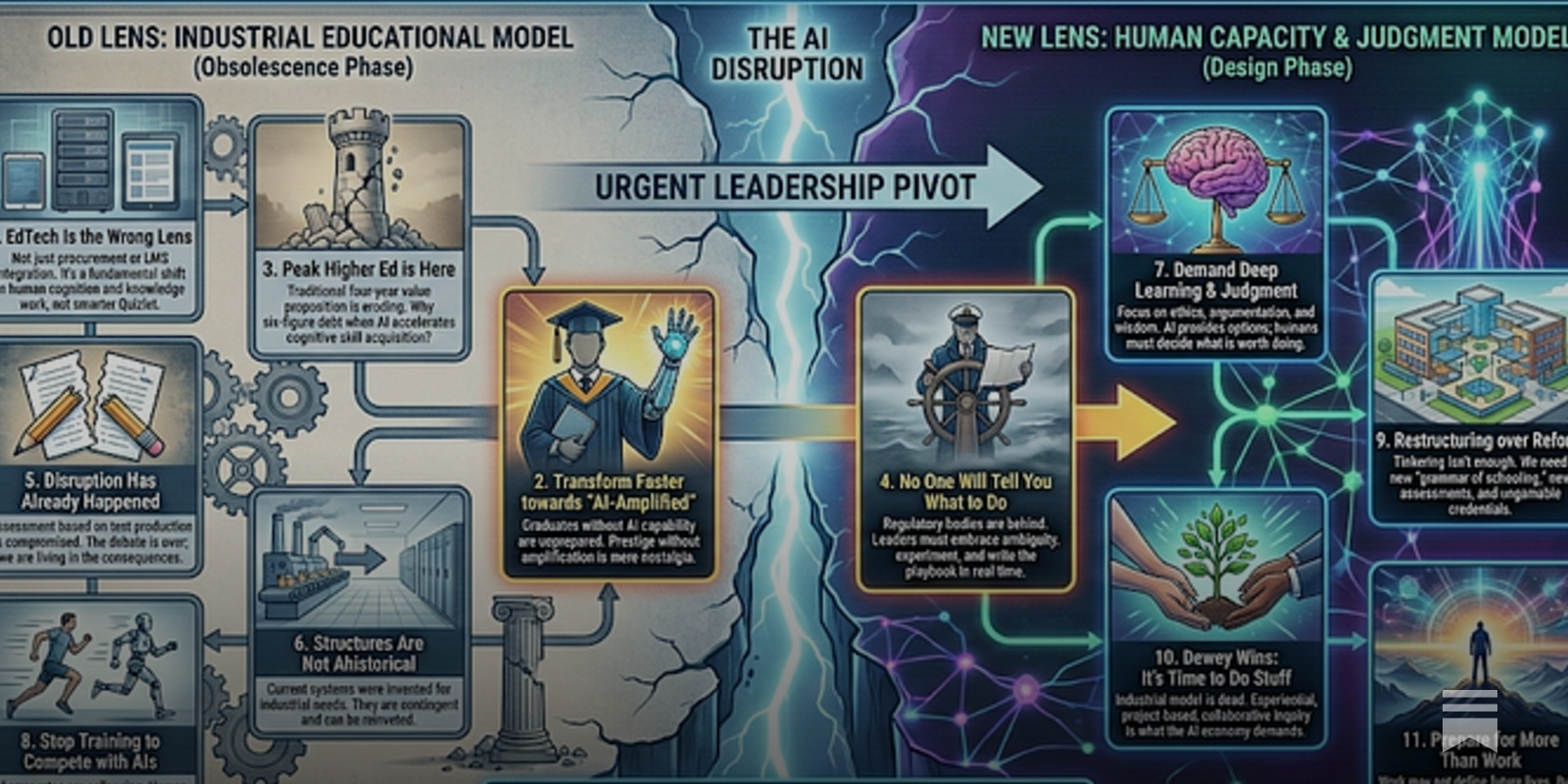
Eleven Things I Wish Educators Understood About AI and What it Means for "Education"
Thank you to all the supporters of this Substack.
AI in the Classroom

Investigating AI usage in the classroom as a parent of a child entering the K-12 system.

NYC school system to ban AI for elementary, middle school students

Sosc Core to Institute AI Ban, Technology-Free Classrooms This Fall

“The Template for Law Schools Around the World”: UChicago Law School Announces New AI Strategy

Does AI stop children from learning?

A new direction for students in an AI world: Prosper, prepare, protect | Brookings
What Parents Need to Know About AI in the Classroom | Stanford HAI