How we leveraged AI to assist users when using our filter feature.

Introducing AI Extensions Beta
Big Help or Big Brother? Auditing Tracking, Profiling, and Personalization in Generative AI Assistants
Generative AI (GenAI) browser assistants integrate powerful capabilities of GenAI in web browsers to provide rich experiences such as question answering, content summarization, and agentic navigation. These assistants, available today as browser extensions, can not only track detailed browsing activity such as search and click data, but can also autonomously perform tasks such as filling forms, raising significant privacy concerns. It is crucial to understand the design and operation of GenAI browser extensions, including how they collect, store, process, and share user data. To this end, we study their ability to profile users and personalize their responses based on explicit or inferred demographic attributes and interests of users. We perform network traffic analysis and use a novel prompting framework to audit tracking, profiling, and personalization by the ten most popular GenAI browser assistant extensions. We find that instead of relying on local in-browser models, these assistants largely depend on server-side APIs, which can be auto-invoked without explicit user interaction. When invoked, they collect and share webpage content, often the full HTML DOM and sometimes even the user's form inputs, with their first-party servers. Some assistants also share identifiers and user prompts with third-party trackers such as Google Analytics. The collection and sharing continues even if a webpage contains sensitive information such as health or personal information such as name or SSN entered in a web form. We find that several GenAI browser assistants infer demographic attributes such as age, gender, income, and interests and use this profile--which carries across browsing contexts--to personalize responses. In summary, our work shows that GenAI browser assistants can and do collect personal and sensitive information for profiling and personalization with little to no safeguards.


David Rumsey Map Collection
While browsing the collection in LUNA, click the blue chat icon in the bottom right to ask the new AI Search Assist questions in any language and get answers in that language. Read more about what you can do on the AI Search Assist page
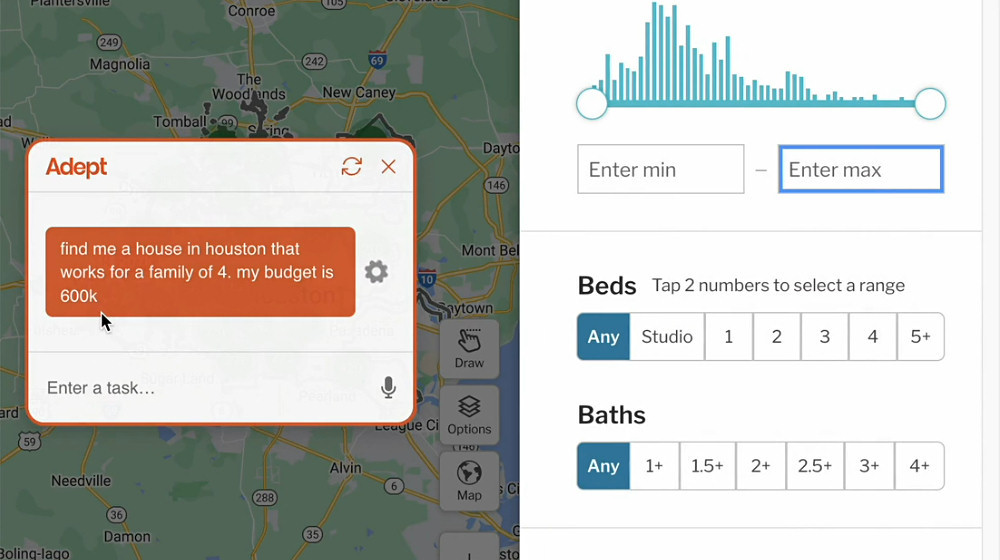
New AI assistant can browse, search, and use web apps like a human
Adept's ACT-1 has learned how to automate complex UI tasks in web apps using an AI model.
TractorBeam: Malleable AI support for the way that you read - AI in the Last Mile
Introducing TractorBeam, a browser extension to develop custom AI highlighting systems on PDFs
Search generative AI control - Search Console Help
Note: As of August 31, 2026, we’ve rolled out this control to all websites worldwide. Use the Search generative AI control to manage your site's inclusion in the following generative AI features
Download | Tiles
A local-first, collaborative AI assistant that works for you. Built with open models and decentralized protocols.

HAIM: Human-AI Music Datasets for AI Music Production Tracking Benchmark
As generative platforms such as Suno and Udio reach human-grade audio quality, the scope of AI's utility has expanded across the entire music production workflow. Beyond simple track generation, these advancements have catalyzed the adoption of AI-driven methodologies in diverse forms. These include vocal synthesis, arrangement, and professional mastering. However, current detection research remains largely confined to a binary `AI-or-human' paradigm. It fails to reflect the realities of contemporary music production workflows. In real-world production, AI tools are increasingly used to refine or master human-produced tracks, and human engineers likewise post-process AI-generated material to ensure professional quality. Moreover, users often employ adversarial tactics to bypass AI detectors, such as applying human mastering to AI-generated tracks. This creates a grey area that a simple binary classification fails to capture. In this paper, we define and investigate ``AI Music Tracking'': the challenge of identifying specific AI integration across the multifaceted spectrum of music production. To this end, we introduce HAIM, a dataset with diverse labels for stages of music production. It is designed to isolate stages of AI intervention, including hybrid production and agent-level tracking. Our evaluation of state-of-the-art detectors reveals systemic flaws. By releasing HAIM, we propose a new benchmark that shifts the field beyond binary classification toward a granular, structured evaluation of AI music.
Summarize with built-in AI | AI on Chrome | Chrome for Developers
Distill lengthy articles, complex documents, or even lively chat conversations into concise and insightful summaries.

Meilisearch: Unified Search & AI Retrieval Platform
Build lightning-fast search and AI retrieval with Meilisearch. Open-source, developer-friendly search engine trusted by 20,000+ teams worldwide.
Kagi's approach to AI in search | Kagi Blog
Kagi Search is pleased to announce the introduction of three AI features into our product offering.
Improve RAG for Your LLM Knowledge using InfraNodus and Open-WebUI, Dify, or ChatGPT
RAG, or Retrieval-Augmented Generation, is used to add additional context to AI user queries. However, one of its main problems is that it doesn't have an overview of the whole context. This is...
Beautiful UI — Crafted primitives for AI-native interfaces
A small library of extremely crafted, copy-paste components for chat agents, thinking states, human-in-the-loop approvals, and everything agents need to talk to humans beautifully.
Reflect
A beautifully minimalist note-taking app designed to mirror the way you think. Now with a native AI integration.