


Steve Newcomb and Peter d’Errico talk about their writing process, Peter’s new fiction on Substack, and the role of writing in the creation and construction of reality.
StoryScope: Investigating idiosyncrasies in AI fiction
As AI-generated fiction becomes increasingly prevalent, questions of authorship and originality are becoming central to how written work is evaluated. While most existing work in this space...

Weird Studies
Professor Phil Ford and writer J. F. Martel host a series of conversations on art and philosophy, dwelling on ideas that are hard to think and art that opens up rifts in what we are pleased to call "reality."
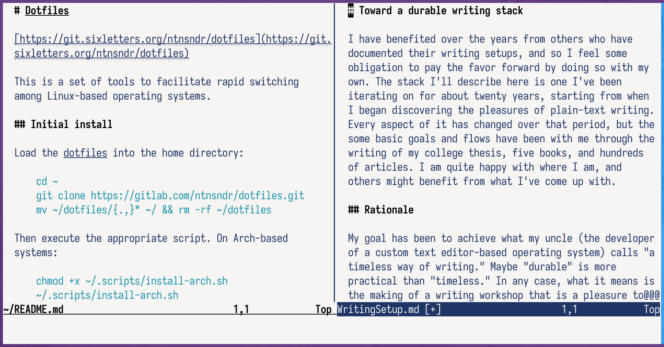
Toward a durable writing stack – Writings and rehearsals by Nathan Schneider
I have benefited over the years from others who have documented their writing setups, and so I feel some obligation to pay the favor forward by doing so with my own. The stack I’ll describe here is one I’ve been iterating on for about twenty years, starting from when I began discovering the pleasures of plain-text writing. Every aspect of it has changed over that period, but the some basic goals and flows have been with me through the writing of my college thesis, five books, and hundreds of articles. I am quite happy with where I am, and others might benefit from what I’ve come up with.
Imagination: a manifesto
One of The Millions's Most-Anticipated Books of Winter 2024 In this revelatory work, Ruha Benjamin calls on us to take imagination seriously as a site of struggle and a place of possibility for reshaping the future

The Anatomy of Story
”The Anatomy Of Story is concrete and practical without resorting to simplistic ‘Three Act Structure’ screenwriting clichés. It will be an indispensable guide to writing your first great script.” —Larry Wilson, co-writer /co-producer of Beetljuice and co-writer of The Addams Family THE ANATOMY OF STORY 22 STEPS TO BECOMING A MASTER STORYTELLER Faber & Faber launches John Truby’s The Anatomy of Story: 22 Steps to Becoming a Master Storyteller—a new Bible not just for screenwriters, but for any writer crafting the perfect story. Taking as his examples Jaws, Adventures of Huckleberry Finn, Tootsie, The Great Gatsby, The Godfather, Chinatown, and A Christmas Carol, among many others, Truby illustrates in The Anatomy of Story (Faber & Faber/Farrar, Straus and Giroux) what makes a great story and how to create that story, focusing on plot and premise, theme, characters, moral development, and crafting the kind of ending that brings readers and audiences back again and again. Additionally, Truby offers seven key story structure steps, which are the major stages of a story’s development and of the dramatic code under its surface. The Anatomy of Story is a step-by-step guide to constructing the best story possible—be it a screenplay, short story, or novel. Truby, who has taught his twenty-two-step Great Screenwriting and Genre classes to more than 20,000 students worldwide, is available to discuss: Top 10 mistakes writers make about story. Five best and worst questions about screenwriting. How the 22-step-approach is different from the 3-act structure. Five unique story elements of blockbuster films. Five best techniques of character and plot. John Truby is Hollywood’s premier story consultant and founder of Truby’s Writers Studio. He has worked as a story consultant and script doctor for Disney Studios, Sony Pictures, FOX, and HBO, among others. Booklist “ Hollywood story consultant Truby commits his vast knowledge of screenwriting and storytelling to the page in this handy guide for aspiring writers of all types. Truby delves into the setup, from basic structure to the premise and the depth behind it. From there, he moves into character, emphasizing the importance of not only the hero but also the characters in the story who aid and oppose him. Truby illustrates the importance of setting to the story and how careful plotting is needed to weave the elements of the story together. He cautions that plot is not incidental and requires careful management and timely revelations. Although most of his examples are from movies, such as Tootsie, The Godfather, and Star Wars, Truby also draws from novels and plays, and his advice is applicable not only to the hopeful screenwriter but to the aspiring novelist as well. A comprehensive guide to writing stories of all kinds, Truby’s tome is invaluable to any writer looking to put an idea to paper.” —Kristine Huntley Tweet

Manuscript — an imagined editor for research writing
A walk through an imagined product for academic writing, mocked up by Claude Design.


Ultra-Processed Minds: The End of Deep Reading and What It Costs Us
A reflection on the reading life. What formed it, what threatens it, and what remains.

In Depth: Miscellaneous
*this is a giant, everchanging collection of micellaneous tidbits about my life and career.* On The Moniker I had a habit as a kid of creating fictional enti...
Research Fiction: Storytelling, Plot and Design
As part of the Digital Library's transition to Open Access, new features for researchers are available in the Premium Edition. Click here to learn more.

Writing Is Designing By Michael J. Metts & Andy Welfle
Discover how words shape UX with Writing Is Designing. Learn to craft clear, human-centered content for apps, chatbots, and software interfaces.

