

Few among us question actions done “in the name of science” when said actions are carried out by credible groups or individuals. It goes without saying that the acquisition and expansion of knowledge is highly valued. As long as the pursuit is not directly harmful to people, it generally gets a pass. But one level deeper, what is science itself done in the name of?
Artificial intelligence and illusions of understanding in scientific research
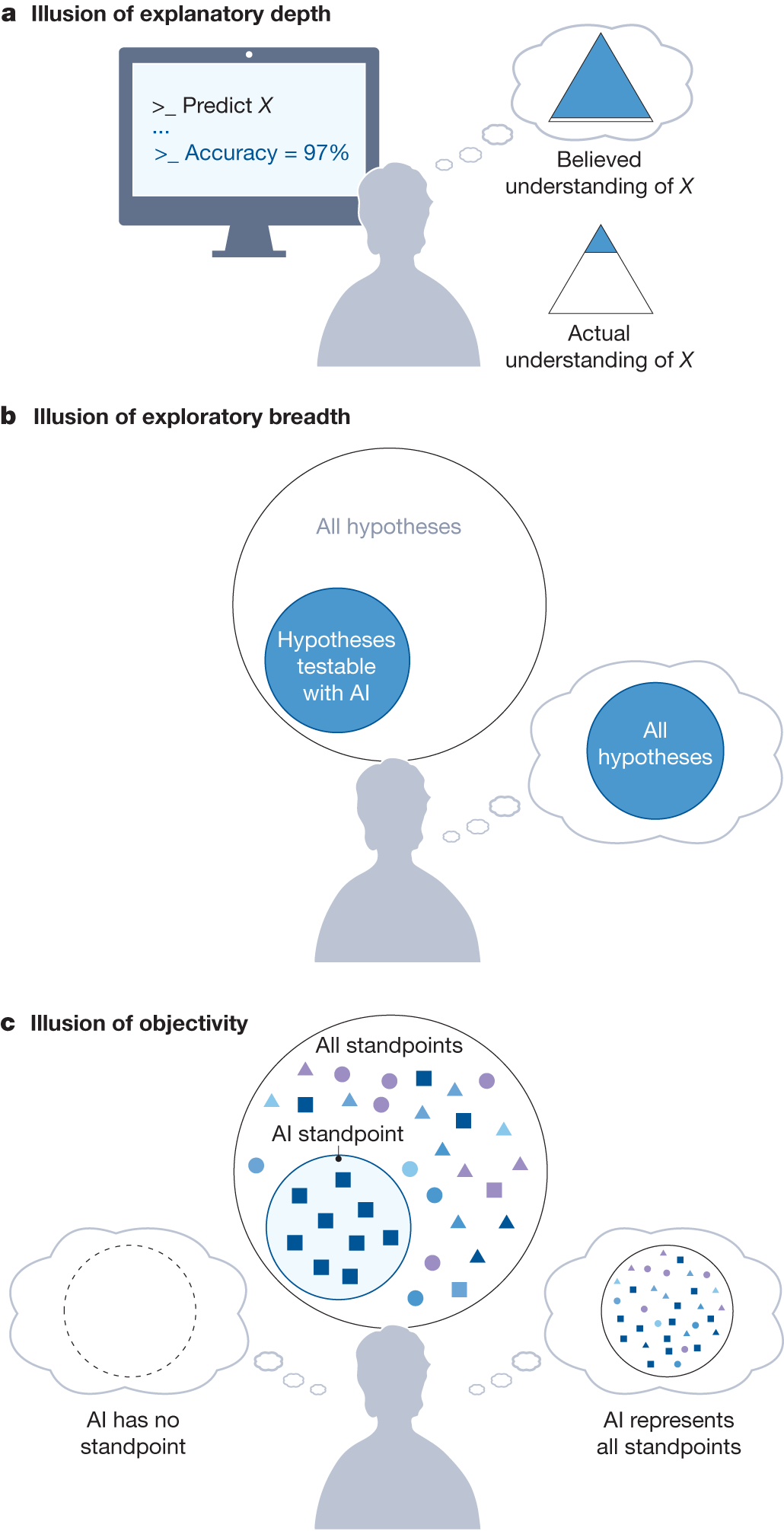
Scientists are enthusiastically imagining ways in which artificial intelligence (AI) tools might improve research. Why are AI tools so attractive and what are the risks of implementing them across the research pipeline? Here we develop a taxonomy of scientists’ visions for AI, observing that their appeal comes from promises to improve productivity and objectivity by overcoming human shortcomings. But proposed AI solutions can also exploit our cognitive limitations, making us vulnerable to illusions of understanding in which we believe we understand more about the world than we actually do. Such illusions obscure the scientific community’s ability to see the formation of scientific monocultures, in which some types of methods, questions and viewpoints come to dominate alternative approaches, making science less innovative and more vulnerable to errors. The proliferation of AI tools in science risks introducing a phase of scientific enquiry in which we produce more but understand less. By analysing the appeal of these tools, we provide a framework for advancing discussions of responsible knowledge production in the age of AI.
Rethinking AI for Science Funding
As science stands at an inflection point, how do we organize capital to shape the future of discovery?
AI has supercharged scientists—but may have shrunk science
Analysis of 41 million papers finds that although AI expands individual impact, it narrows collective scientific exploration
The Engine of Scientific Discovery: How New Methods and Tools Spark Major Breakthroughs
Abstract. How do we spark new scientific discoveries? Why do some breakthroughs seem even accidental? And most importantly, how can we accelerate them and
Where Should Science Go Next
Where Should Science Go Next? Prashant Garg, April 2026 Every researcher has to choose what to work on next. Science has formal procedures for judging answers, but no comparable procedure for comparing questions. Einstein said in 1918 at Max Planck's sixtieth birthday: "There is no logical path t...

Without a theory of intelligence
The history of science — and of progress — is a series of benefits that are direct results of new tools.
The Current Crisis: What's Happening to Science in America
What stories should we tell about scientific progress now?
In search of the mysterious fruits of basic science

AI for science needs reasoning, not just data
AI agents that can model the human process of research will accelerate discoveries in science.

Science Must Decentralize
Knowledge production doesn’t happen in a vacuum. Every great scientific breakthrough is built on prior work, and an ongoing exchange with peers in the field. That’s why we need to address the threat
Hyperproblems: New Ways of Doing and Communicating Science - Hyperproblems
Hyperproblems: Hyperproblems are scientific challenges whose scale, complexity, novelty and interdependence overwhelm traditional research models, requiring…
Many Minds: Science, AI, and illusions of understanding
AI will fundamentally transform science. It will supercharge the research process, making it faster and more efficient and broader in scope. It will make scientists themselves vastly more productive, more objective, maybe more creative. It will make many human participants—and probably some human scientists—obsolete… Or at least these are some of the claims we are hearing these days. There is no question that various AI tools could radically reshape how science is done, and how much science is done. What we stand to gain in all this is pretty clear. What we stand to lose is less obvious, but no less important. My guest today is . Molly is a Professor in the Department of Psychology and the University Center for Human Values at Princeton University. In a recent , Molly and the anthropologist presented a framework for thinking about the different roles that are being imagined for AI in science. And they argue that, when we adopt AI in these ways, we become vulnerable to certain illusions. Here, Molly and I talk about four visions of AI in science that are currently circulating: AI as an Oracle, as a Surrogate, as a Quant, and as an Arbiter. We talk about the very real problems in the scientific process that AI promises to help us solve. We consider the ethics and challenges of using Large Language Models as experimental subjects. We talk about three illusions of understanding the crop up when we uncritically adopt AI into the research pipeline—an illusion that we understand more than we actually do; an illusion that we're covering a larger swath of a research space than we actually are; and the illusion that AI makes our work more objective. We also talk about how ideas from Science and Technology Studies (or STS) can help us make sense of this AI-driven transformation that, like it or not, is already upon us. Along the way Molly and I touch on: AI therapists and AI tutors, anthropomorphism, the culture and ideology of Silicon Valley, Amazon's Mechanical Turk, fMRI, objectivity, quantification, Molly's mid-career crisis, monocultures, and the squishy parts of human experience. Without further ado, on to my conversation with Dr. Molly Crockett. Enjoy! A transcript of this episode is available . Notes and links 5:00 – For more on LLMs—and the question of whether we understand how they work—see our with Murray Shanahan. 9:00 – For the paper by Dr. Crockett and colleagues about the social/behavioral sciences and the COVID-19 pandemic, see . 11:30 – For Dr. Crockett and colleagues’ work on outrage on social media, see this . 18:00 – For a recent exchange on the prospects of using LLMs in scientific peer review, see . 20:30 – Donna Haraway’s essay, 'Situated Knowledges: The Science Question in Feminism and the Privilege of Partial Perspective’, is . See also Dr. Haraway's book, . 22:00 – For the recent essay by Henry Farrell and others on AI as a cultural technology, see . 23:00 – For a recent report on chatbots driving people to mental health crises, see . 25:30 – For the already-classic “stochastic parrots” article, see . 33:00 – For the study by Ryan Carlson and Dr. Crockett on using crowd-workers to study altruism, see . 34:00 – For more on the “illusion of explanatory depth,” see with Tania Lombrozo. 53:00 – For more about Ohio State’s plans to incorporate AI in the classroom, see . For a recent essay by Dr. Crockett on the idea of “techno-optimism,” see . Recommendations , by Adam Becker , by L. A. Paul , by Miranda Fricker Many Minds is a project of the , which is made possible by a generous grant from the John Templeton Foundation to Indiana University. The show is hosted and produced by , with help from Assistant Producer and with creative support from DISI Directors Erica Cartmill and Jacob Foster. Our artwork is by . Our transcripts are created by . Subscribe to Many Minds on Apple, Stitcher, Spotify, Pocket Casts, Google Play, or wherever you listen to podcasts. You can also now subscribe to the Many Minds newsletter ! We welcome your comments, questions, and suggestions. Feel free to email us at: manymindspodcast@gmail.com. For updates about the show, visit or follow us on Twitter () or Bluesky ().

