

[An updated treatment of some of this material appears in Chapter 2 of the Energy and Human Ambitions on a Finite Planet (free) textbook, also mirrors a 2022 article in Nature Physics..]
Milton Friedman
Blog de sciences économiques et sociales de Martin Anota. Traductions, revues de presse.
.png)

The shape of a knowledge worker
In a recent post, I threw around the term 'cognitive exponent' a bunch. Today I'd like to talk about a thing that might help us frame our investigation of what puts someone on the right side of that exponential graph.
Why the super rich are inevitable
Why some mathematicians argue the economy is designed to create a few super rich people – unless we stop it.

Ergodicity Economics – Formal economics without parallel universes
Does the way we look at a problem – over time or across an ensemble – change what we see? The main insight from Ergodicity Economics is that when ergodicity […]
The Math of Idle Games, Part II
Originally published October 28, 2016 In Part I [https://www.sirpinski.com/the-math-of-idle-games-part-i/] of this three-part series, we looked at some of the standard math behind rapid-growth idle games, primarily at the relationships between exponential and polynomial growth and some methods of
Maximum power in evolution, ecology and economics
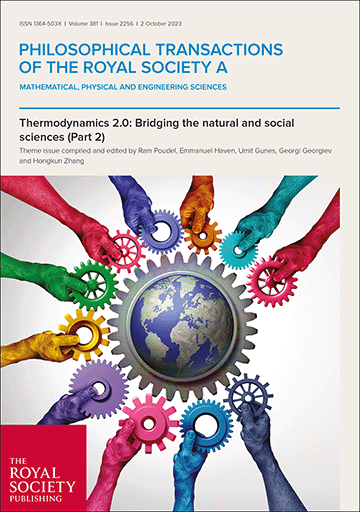
Ludwig Boltzmann suggested that natural selection was fundamentally a struggle among organisms for available energy. Alfred Lotka argued that organisms that capture and use more energy than their competition will have a selective advantage in the evolutionary process, i.e. the Darwinian notion of evolution was based on a fundamental, generalized energy principle. He extended this general principle from the energetics of a single organism or species to the energetics of entire energy pathways through ecosystems. Howard Odum and Richard Pinkerton, building on Lotka, extended this concept to ‘The maximum power principle’ and applied it to many biological and physical systems including human economies. We examine this history and how these ideas relate to concepts from other disciplines including philosophy. But there has been considerable confusion in understanding and applying these concepts which we attempt to resolve while providing various examples from routine life and discussing some unresolved issues. This article is part of the theme issue ‘Thermodynamics 2.0: Bridging the natural and social sciences (Part 2)’.
Power: A Primer for Perplexed Economists
Let's Assume an Unfettered Marketplace of Ideas! Or Actually, Let's Not.
Bataille chez Les économistes atterrés
Le collectif des Economistes atterrés, qui rassemble de nombreux économistes de gauche, traverse une crise interne. Alternatives Economiques donne la parole au…

Infinite Researchers | AI-Powered Scientific Discovery
What happens to the speed of discovery if we have infinite researchers? Explore AI experiments accelerating breakthroughs.

« Une minorité privilégiée sacrifie la planète afin de préserver ses richesses et son pouvoir »
TRIBUNE. Le rejet de l’écologie est désormais promu par des gouvernements élus démocratiquement, autoritaires voire fascisants, et soutenus par les milieux d’affaires des énergies fossiles, déplorent trois spécialistes d’écologie politique, dans une tribune au « Monde ».

Enough
This guy never had enough, is that really you?The underpinning tenet of chasing exponential growth is that anything less than “all of it” is never enough. If there’s more possible, more out there, …

Frameworks v0.2
FRAMEWORKS v0.2 Many of the thoughts in this document draw on and synthesize concepts from economics, math, physics, chemistry, biology, and psychology. Here are a handful of core concepts that are often relied on as inputs: Activation energy Behavioral economics Cognitive biases Darwinism En...

Pourquoi les économistes laissent tomber le monde face au changement climatique ?
Blog de sciences économiques et sociales de Martin Anota. Traductions, revues de presse.

Volume 384 Issue 2320 | Philosophical Transactions of the Royal Society A | The Royal Society
Influential themed journal issues across the physical mathematical and engineering sciences.

Economics for the future – Beyond the superorganism
Our environment and economy are at a crossroads. This paper attempts a cohesive narrative on how human evolved behavior, money, energy, economy and th…