

Large-scale discussions between many participants abound on the internet today, on topics ranging from political arguments to group coordination. But as these discussions grow to tens of thousands of posts, they become ever more difficult for a reader to digest. In this article, we describe a workflow called recursive summarization, implemented in our Wikum prototype, that enables a large population of readers or editors to work in small doses to refine out the main points of the discussion. More than just a single summary, our workflow produces a summary tree that enables a reader to explore distinct subtopics at multiple levels of detail based on their interests. We describe lab evaluations showing that (i) Wikum can be used more effectively than a control to quickly construct a summary tree and (ii) the summary tree is more effective than the original discussion in helping readers identify and explore the main topics.
Summarize with built-in AI | AI on Chrome | Chrome for Developers
Distill lengthy articles, complex documents, or even lively chat conversations into concise and insightful summaries.

Steps Towards an Infrastructure for Scholarly Synthesis
Sharing, reusing, and synthesizing knowledge is central to the research process, both individually, and with others. These core functions are not supported by our formal scholarly publishing infrastructure: instead of the smooth functioning of functional infrastructure, researchers resort to laborious "hacks" and workarounds to "mine" publications for what they need, and struggle to efficiently share the resulting information with others. Information scientists have proposed an alternative infrastructure based on the more appropriately granular model of a discourse graph of claims, and evidence, along with key rhetorical relationships between them. However, despite significant technical progress on standards and platforms, the predominant infrastructure remains steadfastly document-based. Drawing from infrastructure studies, we locate the current infrastructural bottlenecks in the lack of local systems that integrate discourse-centric models to augment synthesis work, from which an infrastructure for synthesis can be grown. Through 3 years of research through design and field deployment in a distributed community of hypertext notebook users, we elaborate a design vision of what can and should be built in order to grow a discourse-centric synthesis infrastructure: a thriving "installed base" of researchers authoring local, shareable discourse graphs to improve synthesis work, enhance primary research and research training, and augment collaborative research. We discuss how this design vision -- and our empirical work -- contributes steps towards a new infrastructure for synthesis, and increases HCI's capacity to advance collective intelligence and solve infrastructure-level problems.

Steps Towards an Infrastructure for Scholarly Synthesis
Sharing, reusing, and synthesizing knowledge is central to the research process, both individually, and with others. These core functions are not supported by our formal scholarly publishing infrastructure: instead of the smooth functioning of functional infrastructure, researchers resort to laborious ”hacks” and workarounds to ”mine” publications for what they need, and struggle to efficiently share the resulting information with others. Information scientists have proposed an alternative infrastructure based on the more appropriately granular model of a discourse graph of claims, and evidence, along with key rhetorical relationships between them. However, despite significant technical progress on standards and platforms, the predominant infrastructure remains steadfastly document-based. Drawing from infrastructure studies, we locate the current infrastructural bottlenecks in the lack of local systems that integrate discourse-centric models to augment synthesis work, from which an infrastructure for synthesis can be grown. Through 3 years of research through design and field deployment in a distributed community of hypertext notebook users, we elaborate a design vision of what can and should be built in order to grow a discourse-centric synthesis infrastructure: a thriving “installed base” of researchers authoring local, shareable discourse graphs to improve synthesis work, enhance primary research and research training, and augment collaborative research. We discuss how this design vision — and our empirical work — contributes steps towards a new infrastructure for synthesis, and increases HCI’s capacity to advance collective intelligence and solve infrastructure-level problems.
Chasing RATs: Tracing Reading for and as Creative Activity
Creativity research has privileged making over the interpretive labor that precedes and shapes it. We introduce Reading Activity Traces (RATs), a proposal that treats reading -- broadly defined to include navigating, interpreting, and curating media across interconnected sources -- as creative activity both for future artifacts and as a form of creation in its own right. By tracing trajectories of traversal, association, and reflection as inspectable artifacts, RATs render visible the creative work that algorithmic feeds and AI summarization increasingly compress and automate away. We illustrate this through WikiRAT, a speculative instantiation on Wikipedia, and open new ground for reflective practice, reader modeling, collective sensemaking, and understanding what is lost when human interpretation is automated -- towards designing intelligent tools that preserve it.
Metagov x Future of Science Seminar - Discourse Graphs with Matt Akamatsu
WikiKV: Schema-Evolving Path-Indexed Storage for Hierarchical Knowledge Navigation
LLM-curated hierarchical knowledge bases, namely a tree-structured wiki whose nodes summarize an underlying corpus, have become a dominant substrate for retrieval-augmented applications, yet their storage layer is still treated as an implementation detail. This workload is hierarchical, query-intensive, and continuously evolving, and no existing storage model natively captures all three properties at once. We present WikiKV, a path-indexed key-value storage model purpose-built for this workload, comprising three components: (i) a data-driven schema that bootstraps the hierarchy via Intent-Anchored Schema Induction and refines it through Continuous Evolution Operators; (ii) a consistency protocol for the path-indexed storage model that precludes partial-read observations under concurrent offline rewrites without read-path locking; and (iii) a budgeted navigation operator whose search-accelerated routing reduces the expected number of LLM-assisted descent steps from d to O(1) while preserving anytime semantics with progressively refined answers. We evaluate WikiKV through real-world deployment for the WeChat Official Account AI Assistant and benchmark it against diverse baselines on the AuthTrace dataset, where it achieves balanced low per-operator latency across four query operators against relational, graph, and FS backends, and reaches 63.2% end-to-end answer correctness, exceeding multiple RAG baselines, with the gap widening on low- and high-fan-in multi-document questions. Ablation study further confirms the effectiveness of WikiKV's components.
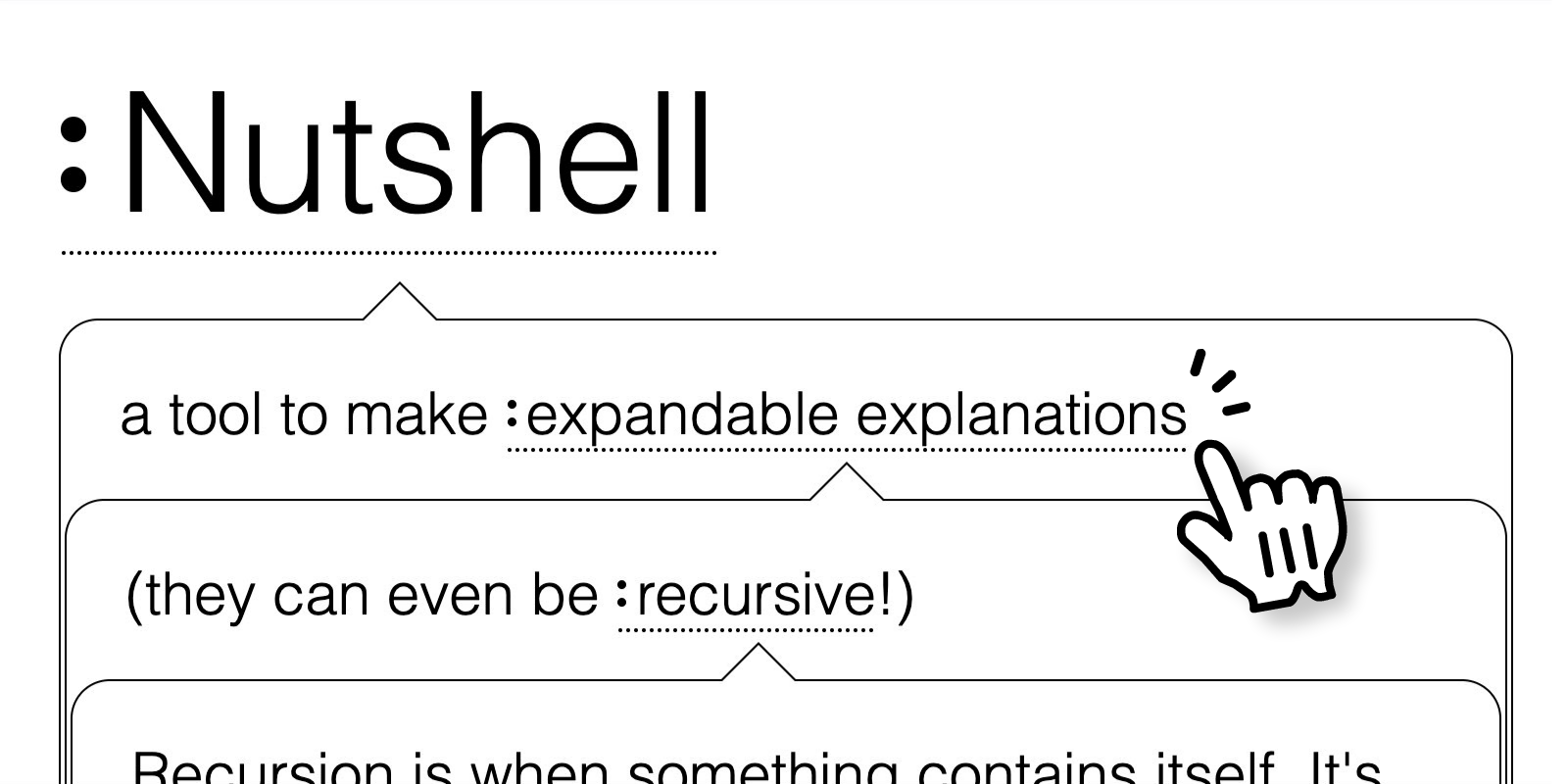
Nutshell: make expandable, embeddable explanations
a tool to let your readers dive into details
'Generative CI' through Collective Response Systems
How can many people (who may disagree) come together to answer a question or make a decision? "Collective response systems" are a type of generative collective intelligence (CI) facilitation process meant to address this challenge. They enable a form of "generative voting", where both the votes, and the choices of what to vote on, are provided by the group. Such systems overcome the traditional limitations of polling, town halls, standard voting, referendums, etc. The generative CI outputs of collective response systems can also be chained together into iterative "collective dialogues", analogously to some kinds of generative AI. Technical advances across domains including recommender systems, language models, and human-computer interaction have led to the development of innovative and scalable collective response systems. For example, Polis has been used around the world to support policy-making at different levels of government, and Remesh has been used by the UN to understand the challenges and needs of ordinary people across war-torn countries. This paper aims to develop a shared language by defining the structure, processes, properties, and principles of such systems. Collective response systems allow non-confrontational exploration of divisive issues, help identify common ground, and elicit insights from those closest to the issues. As a result, they can help overcome gridlock around conflict and governance challenges, increase trust, and develop mandates. Continued progress toward their development and adoption could help revitalize democracies, reimagine corporate governance, transform conflict, and govern powerful AI systems -- both as a complement to deeper deliberative democratic processes and as an option where deeper processes are not applicable or possible.

Inducing Sustained Creativity and Diversity in Large Language Models
We address a not-widely-recognized subset of exploratory search, where a user sets out on a typically long "search quest" for the perfect wedding dress, overlooked research topic, killer company idea, etc. The first few outputs of current large language models (LLMs) may be helpful but only as a start, since the quest requires learning the search space and evaluating many diverse and creative alternatives along the way. Although LLMs encode an impressive fraction of the world's knowledge, common decoding methods are narrowly optimized for prompts with correct answers and thus return mostly homogeneous and conventional results. Other approaches, including those designed to increase diversity across a small set of answers, start to repeat themselves long before search quest users learn enough to make final choices, or offer a uniform type of "creativity" to every user asking similar questions. We develop a novel, easy-to-implement decoding scheme that induces sustained creativity and diversity in LLMs, producing as many conceptually unique results as desired, even without access to the inner workings of an LLM's vector space. The algorithm unlocks an LLM's vast knowledge, both orthodox and heterodox, well beyond modal decoding paths. With this approach, search quest users can more quickly explore the search space and find satisfying answers.
How LLMs Distort Our Written Language
Large language models (LLMs) are used by over a billion people globally, most often to assist with writing. In this work, we demonstrate that LLMs not only alter the voice and tone of human writing but also consistently alter the intended meaning. First, we conduct a human user study to understand how people actually interact with LLMs when using them for writing. Our findings reveal that extensive LLM use led to a nearly 70% increase in essays that remained neutral in answering the topic question. Significantly more heavy LLM users reported that the writing was less creative and not in their voice. Next, using a dataset of human-written essays that was collected in 2021 before the widespread release of LLMs, we study how asking an LLM to revise the essay based on the human-written feedback in the dataset induces large changes in the resulting content and meaning. We find that even when LLMs are prompted with expert feedback and asked to only make grammar edits, they still change the text in a way that significantly alters its semantic meaning. We then examine LLM-generated text in the wild, specifically focusing on the 21% of AI-generated scientific peer reviews at a recent top AI conference. We find that LLM-generated reviews place significantly less weight on clarity and significance of the research, and assign scores that, on average, are a full point higher. These findings highlight a misalignment between the perceived benefit of AI use and an implicit, consistent effect on the semantics of human writing, motivating future work on how widespread AI writing will affect our cultural and scientific institutions.
How LLMs Distort Our Written Language
Large language models (LLMs) are used by over a billion people globally, most often to assist with writing. In this work, we demonstrate that LLMs not only alter the voice and tone of human writing but also consistently alter the intended meaning. First, we conduct a human user study to understand how people actually interact with LLMs when using them for writing. Our findings reveal that extensive LLM use led to a nearly 70% increase in essays that remained neutral in answering the topic question. Significantly more heavy LLM users reported that the writing was less creative and not in their voice. Next, using a dataset of human-written essays that was collected in 2021 before the widespread release of LLMs, we study how asking an LLM to revise the essay based on the human-written feedback in the dataset induces large changes in the resulting content and meaning. We find that even when LLMs are prompted with expert feedback and asked to only make grammar edits, they still change the text in a way that significantly alters its semantic meaning. We then examine LLM-generated text in the wild, specifically focusing on the 21% of AI-generated scientific peer reviews at a recent top AI conference. We find that LLM-generated reviews place significantly less weight on clarity and significance of the research, and assign scores that, on average, are a full point higher. These findings highlight a misalignment between the perceived benefit of AI use and an implicit, consistent effect on the semantics of human writing, motivating future work on how widespread AI writing will affect our cultural and scientific institutions.
Getting started - Docs
Discourse Graphs are a tool and ecosystem for collaborative knowledge synthesis, enabling researchers to map ideas and arguments in a modular, composable graph format.
Creative Reading: Scaffolding Reading for Transformation
However, recent work on augmenting reading largely focuses on making reading more efficient, especially in knowledge-intensive contexts where people must rapidly make sense of research papers and other complex documents (Lo et al., 2024). These systems often aim to help readers skim, summarize, and synthesize large volumes of information in order to reduce cognitive effort and accelerate document- and corpus-level sensemaking at scale (Gu et al., 2025; Lo et al., 2024; Fok et al., 2023). At one extreme, the form of reading implicitly envisioned by these systems may resemble what we call “reading to discard”: extracting the essential, actionable informational core of a document as quickly and efficiently as possible, so that the rest can be swiftly tossed aside—much like we often process inbound mail. This motivates us to ask what scaffolding approaches might resist “reading to discard,” what alternative forms of reading we might scaffold, and what alternative views and values of reading might guide the conversation.
10 Easy Ways to Enhance Your LLM Wiki or Knowledge Base