

DeepWell DTx makes digital therapeutic technology that can be integrated with media to create new approaches for treating mental and physical health conditions. Launched in 2022, DeepWell holds several patents, with 20 more pending, for transforming media into medicine. DeepWell DTx is part of NeuFluent, a venture studio developing neuroscience innovation — novel components, systems, […]
Blueprint Neurotech
The Center for Innovative NeuroTech Advancement (CINTA) & NeuroTech Harbor (NTH) announce the Cycle 6 Award Competition supported by the NIH Blueprint MedTech Program. This program is seeking collaborative projects aimed at developing emerging technologies into commercially viable, clinically focused solutions for disorders of the nervous system that are aligned with the mission and interests of the participating NIH institutes and centers.
Precision Medicine in Neuroscience: Tools, Translation, and Implementation: A Workshop
Join the web’s most supportive community of creators and get high-quality tools for hosting, sharing, and streaming videos in gorgeous HD with no ads.
Motif Neurotech — Therapeutic Brain Computer Interface For Mental Health
We're building devices to help you monitor and regulate your mental health and performance.

Inventing the future: A neuroscience research roadmap
The past decade of transformative advances in neurotechnology portends an exciting future for neuroscience. This NeuroView charts a strategic path to accelerate and integrate research discovery and speed the development of new cures for human brain disorders.

Massively Scalable Neurotechnologies
Backed by £50m, this programme sits within the Scalable Neural Interfaces opportunity space and is seeking radically new ways to deliver responsive neurotechnologies to the brain without brain surgery.
Sam Altman's Brain Chip Venture Is Mulling Gene Therapy Approach - Slashdot
Sam Altman's brain-chip venture is exploring the idea of genetically altering brain cells to make better implants. "The company, which has been referred to as Merge Labs, is looking at an approach involving gene therapy that would modify brain cells," reports Bloomberg. "In addition, an ultrasound d...

Yneuro | The startup behind Neuro ID®
Imagine a world where technology and human experience blend seamlessly. At Yneuro, we’re building that world. As pioneers in neurotechnology, we craft AI-driven software solutions that transcend global barriers. Celebrated in startup ecosystems and competitions, Yneuro is redefining digital interaction, making advanced technologies intuitive and accessible for everyone. Join us as we merge technology and human cognition, creating unprecedented possibilities.

Leading Innovation in Psychiatric Treatment | Alto Neuroscience
We leverage brain biology to develop personalized medicines, helping patients get better faster.
#neuroscience #ai #python #opensource #neuroai | Jean-Rémi King
⚡ We're happy to release NeuralSet: a fast, simple, and scalable Python framework for Neuro-AI. Already supports: 🧠 fMRI, EEG, MEG, iEEG, spikes… recordings 💬 text, 🔊 audio, ▶️ video, 🏞️ image… embeddings 📦 `pip install neuralset` 💻 Code: https://lnkd.in/eamwxBUY 📄 Paper: https://lnkd.in/epbreyDy Made possible thanks to: Hubert Banville, Katie Begany, Corentin Bel, Yohann Benchetrit, Teon Brooks, Marlène Careil, Simon Dahan, Stéphane d'Ascoli, Alexandre Défossez, Linnea Evanson, PhD, Pablo J. Diego Simón, Julien Gadonneix, Sophia Houhamdi, Shubh Khanna, Jarod Lévy, Pierre Orhan, Antoine Ratouchniak, Joséphine Raugel, Andrea Elena Santos Revilla, Alexis Thual, Lucy (Mingfang) Zhang, Jérémy RAPIN #Neuroscience #AI #Python #OpenSource #NeuroAI
NeuroNYC
As the global leader in finance, policy, art, research, and medicine, the region is well-positioned to lead neurotech. We help foster and promote the local neurotech ecosystem: clinics, companies, funders, labs, and users.

Foundation Model Predicts Brain Responses to Visual and Auditory Stimuli | Elisa Cascardi posted on the topic | LinkedIn
Thrilled to share this work with the world! Today, we're releasing a foundation model that predicts how the human brain responds to almost any sight or sound -- and replace the need for human scans to significantly fast-track neuroscience and clinical research. 🧠 With this model, we can simulate brain responses to advance our understanding of the brain -- without the need for costly human brain scans 🌐 By using improved understanding of how efficient our brains perceive the world around us, we can guide the development of more advanced AI systems 👩⚕️ With computer-simulated experimentation, we can now speedup clinical research to diagnose neurological diseases and find treatments faster We've open sourced the model and code for researchers to use and build on, and an interactive demo for you to learn more -- see below! 📄 Paper: https://lnkd.in/e7cbunJp 💻 Code: https://lnkd.in/ebwBVuJp ▶️ Demo: https://lnkd.in/eEUVxP4S 🤗 Model: https://lnkd.in/e2T8nPJP So thrilled to be a part of this team with Stéphane d'Ascoli Jean-Rémi King Jérémy RAPIN Yohann Benchetrit Teon Brooks Katelyn Begany Joséphine Raugel Hubert Banville and for the great teamwork with Diego Marcos Dominic Giardini bringing this research to life! #neuroscience #AI #aiforscience #opensource #neuroAI
#digitalbrainproject #neuroscience #artificialintelligence #openscience #callforprojects #research #ai #brain | Fondation Adolphe de Rothschild
The Rothschild Foundation Hospital is excited to launch the Digital Brain Project, a $5M collaborative research initiative to build an open source foundational model of the brain through open-access neural data. Apply by May 15th for up to $500k in funding. Help crack the neural code 👉digitalbrainproject.org Our objective is to develop a standardized, publicly available dataset of human brain recordings to accelerate fundamental research in cognitive neuroscience, AI system development, and clinical health. Our independent, multidisciplinary Scientific Committee oversees data collection, ethical review, privacy, and open science practices of our project — setting standards for large-scale brain research. The Digital Brain Project is conceived as an open collaborative infrastructure, at the intersection of neuroscience, artificial intelligence, and data science. It aims to accelerate data development, a key bottleneck to developing a foundational AI model of the human brain. Key Focus Areas: 1️⃣ Brain recording data related to visual processing, language functions and cognitive actions 2️⃣ Rigorous quality, privacy, and ethical control, along with procedures for standardizing data across sites 3️⃣ Support for teams selected by an international multidisciplinary Scientific Committee Call for applications: Research teams working in neuroscience, neuroimaging, or artificial intelligence are invited to submit their applications by May 15, 2026. Selected teams will receive up to $500k USD funding to support their work. We appreciate our Scientific Committee (Lune Bellec Anne-Marie Kermarrec Arthur Mensch Russell Poldrack Lucia Melloni Jose Alain Sahel) for their independent scientific leadership, and partners Université de Montréal and AI at Meta for collaborating on this exciting project. #DigitalBrainProject #Neuroscience #ArtificialIntelligence #OpenScience #Callforprojects #Research #AI #Brain -------------------------------------------------------------- Pierre Bourdillon Julie Boyle Elisa Cascardi Jean-Rémi King Guillaume Le Hénanff Amélie Yavchitz Julien Gottsmann Fabrice VERRIELE Charlotte Cardin-Taillia

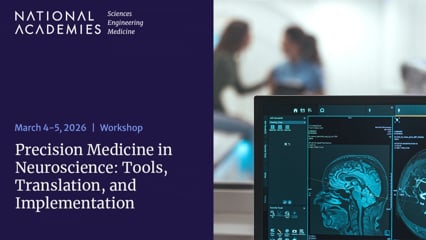
Precision Medicine in Neuroscience: Tools, Translation, and Implementation: A Workshop
Precision medicine approaches are rapidly transforming neuroscience, driven by advances in genetics, neuroimaging, biomarkers, and data science. These tools enable more refined disease classification, improved diagnosis, and treatments tailored to individual patients across neurological and psychiatric disorders. However, challenges remain in translating these advances into routine research and clinical practice. On March 4–5, the National Academies’ Forum on Neuroscience and Nervous System Disorders, in collaboration with the Forum on Drug Discovery, Development, and Translation and the Roundtable on Genomics and Precision Health, will host a workshop exploring opportunities, challenges, and strategies for integrating precision medicine into neuroscience research and care.

Brain Computer Interface Company Implants New Type of Device
Synchron’s procedure will help an ALS patient text by thinking, in a major step forward in a nascent industry, with the Brooklyn-based company recently overtaking Elon Musk’s Neuralink.

#neuroscience #ai #python #opensource #neuroai | Jean-Rémi King | 34 comments
⚡ We're happy to release NeuralSet: a fast, simple, and scalable Python framework for Neuro-AI. Already supports: 🧠 fMRI, EEG, MEG, iEEG, spikes… recordings 💬 text, 🔊 audio, ▶️ video, 🏞️ image… embeddings 📦 `pip install neuralset` 💻 Code: https://lnkd.in/eamwxBUY 📄 Paper: https://lnkd.in/epbreyDy Made possible thanks to: Hubert Banville, Katie Begany, Corentin Bel, Yohann Benchetrit, Teon Brooks, Marlène Careil, Simon Dahan, Stéphane d'Ascoli, Alexandre Défossez, Linnea Evanson, PhD, Pablo J. Diego Simón, Julien Gadonneix, Sophia Houhamdi, Shubh Khanna, Jarod Lévy, Pierre Orhan, Antoine Ratouchniak, Joséphine Raugel, Andrea Elena Santos Revilla, Alexis Thual, Lucy (Mingfang) Zhang, Jérémy RAPIN #Neuroscience #AI #Python #OpenSource #NeuroAI | 34 comments on LinkedIn