


Using data from 1.3 million credit card offer letters, we show that issuers shroud unfavorable card features via back-loading of payment terms (e.g., high defau
Rewards and Misperceived Spending: Experimental Evidence from Credit Cards
Using proprietary data, a survey, and an experiment with a major bank in China, this paper studies how credit card rewards affect perceived and actual consumer
Time to Cut Up Those Debit Cards? Effect of Payment Mode on Willingness to Spend
Financial industry data indicate that consumers increasingly prefer debit cards over credit cards, especially as a means of enforcing financial self-discipline. Given prior research suggesting that credit cards act as spending facilitating stimuli, this move toward reduced credit card use would appear to be in the right direction. Ironically, however, the same logos that were implicated in facilitating spending with credit cards are the logos that appear on debit cards. In what should serve as an eye-opener to consumers, it is found that exposure to debit card logos does result in an increased willingness to spend, similar to credit cards.
Do Payment Mechanisms Change the Way Consumers Perceive Products?
Abstract. Do payment mechanisms change the way consumers perceive products? We argue that consumers for whom credit cards (cash) have been primed focus mor
Differences in Consumer Purchase Behavior by Credit Card Payment System
Abstract. A conceptualization of the relationships between alternative payment systems and various environmental and behavioral variables, which may serve
Purchase Justifiability Drives Payment Choice: Consumers Pay with Card to Remember and Cash to Forget
AbstractAlthough consumers often have multiple payment methods at their fingertips, such as cash and credit/debit cards, prior research is silent on how consumers choose between them. We home in on a key element of purchase—purchase justifiability—that affects how consumers choose to pay. Analysis of 118,042 real-world purchases and six experiments reveals that when consumers are motivated to forget (vs. remember) a purchase because they see it as difficult (vs. easy) to justify, they have an increased preference to pay with cash (vs. card) because cards create a “paper/electronic trail” that aids memory retrieval. These payment preferences are strongest among consumers most likely to recall/track their card spending, and manifest only when card expenses are trackable. We reconcile our results with the classic effect of payment method on pain of paying and discuss implications for merchants and for financial institutions designing payment methods of the future.

Do Nudges Reduce Borrowing and Consumer Confusion in the Credit Card Market?
We study nudges that turn out to have precise null effects in reducing long‐run credit card debt. We test nudges across two field experiments covering 183,441 UK cardholders. Our first experiment studies nudges added to monthly credit card statements. Our second experiment studies letters and email nudges (separate from monthly statements) sent to cardholders who signed up to automatically pay the minimum required payment. In a follow‐up survey to our second experiment, we find that 96% of respondents underestimate the time it would take to fully repay a debt if the cardholder made only the minimum required payment. The nudges reduce this confusion, but underestimation remains overwhelmingly common.

Credit Card Debt and Consumer Payment Choice: What Can We Learn from Credit Bureau Data?
We estimate a two-stage Heckman selection model of credit card adoption and use with a unique dataset that combines administrative data from the Equifax credit bureau and self-reported data from a representative survey of consumers. Higher-income consumers carry higher credit card balances, but they tend to repay those balances each month. Credit card revolvers have lower income and are less educated. Revolvers are twice as likely to use debit cards as credit cards for payments, but they carry much higher balances on their credit cards. The high cost of paying off credit card debt likely exacerbates existing inequalities in disposable income. Unlike the mortgage market, we find no evidence for lenders’ cutoff between subprime and prime consumers in the credit card market.
Do Liquidity Constraints and Interest Rates Matter for Consumer Behavior? Evidence from Credit Card Data
Abstract. This paper utilizes a unique data set of credit card accounts to analyze how people respond to credit supply. Increases in credit limits generate
What else can your payment card do? Multifunctionality of payment modes can reduce payment transparency
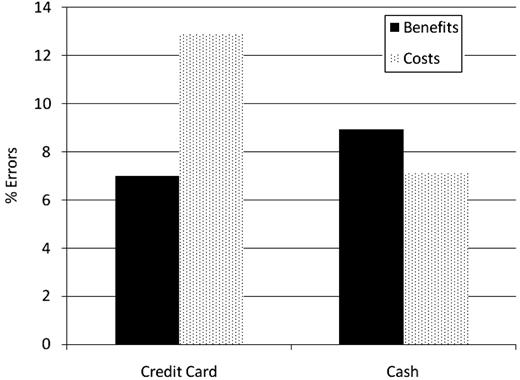
Payment modes (e.g., cash vs. credit card) vary in the transparency of the outflow of money. Smartcards (multifunctional cards), which bundle payment with non-payment functions (e.g., loyalty programs, identification, and other information functions), have become an increasingly popular payment mode. This shift toward multifunctionality in payment modes is assumed to reduce payment transparency and consequently to decrease consumers’ recall accuracy of past expenditures. We employ a field study to examine recall accuracy for recent purchases with cash, a single-function card, and a multifunctional card. We find that recall accuracy is lower when using a single- or a multifunction card than cash. We also find that it is not the multifunctionality of the card that results in a higher recall error but the individual usage patterns: A higher usage frequency of the non-payment functions results in a higher recall error.
Credit Cards as Spending Facilitating Stimuli: A Conditioning Interpretation
Abstract. Four experiments and one study were conducted to test the hypothesis that stimuli associated with spending can elicit spending responses. In all
Are Information Disclosures Effective? Evidence from the Credit Card Market
Consumer protection in financial markets in the form of information disclosure is high on government agendas, even though there is little evidence of its effectiveness. We implement a randomized control trial in the credit card market for a large population of indebted cardholders and measure the impact of Truth-in-Lending-Act-type disclosures, de-biasing warning messages and social comparison information on default, indebtedness, account closings, and credit scores. We conduct extensive external validity exercises in several banks, with different disclosures, and with actual policy mandates. We find that providing salient interest rate disclosures had no effects, while comparisons and de-biasing messages had only modest effects at best.
A Mega-Replication of the Effect of Cash Versus Card Payment on Pain of Paying: Magnitude, Behavioral Outcomes, and Moderators
Abstract We revisit the widely accepted finding that paying with cash is more painful than paying with card by conducting the first systematic mega-replication (including 13 large-scale preregistered replications; a total of 32,371 participants, 65 products, and 57 price points ranging from $1.09 to $400). The aggregate evidence reveals four insights: (1) leveraging a broad set of established paradigms, we replicate the finding that paying with cash is more psychologically painful than paying with card, even among today’s consumers who own multiple cards, digital wallets, and virtual currencies; (2) comparing two outcome variables—amount spent and willingness-to-pay (WTP), we find a more reliable and larger overall direct effect of payment method on amount spent than on WTP; (3) these direct effects of payment method on outcome variables are mediated by pain of paying; (4) the mode-of-payment effect on pain of paying (and thereby on outcome variables) is moderated by individual differences, particularly the relative frequency of using cash versus card. We outline actionable guidance and future directions for researchers and practitioners interested in examining mode-of-payment effects, and discuss the value of and suitable approaches for future theory-driven large-scale replications.

Consumer Misunderstanding of Credit Card Use, Payments, and Debt: Causes and Solutions
The authors identify several judgmental biases related to paying off credit card debt. Participants with stronger numerical skills made fewer errors, as did those who used the new statement format mandated by Congress in the CARD Act of 2009. Study 1 shows that people underestimate how long it takes to eliminate a debt when payments barely cover interest owed. Study 2 shows that less numerate people tend to underestimate the monthly payment required to pay off a debt in three years, whereas more numerate people tend to overestimate the payment. The newly revised statement required by the CARD Act substantially reduced these biases. However, even with the new statement, many people still underestimate required payments when still using the credit card. Study 3 identifies ambiguities in the revised statement that can lead to misjudgments about how much to pay on monthly bills. The authors recommend additional public policy actions to help cardholders understand the relationship between payments and debt elimination.

Borrowing on the Wrong Credit Card? Evidence from Mexico
We establish new facts about the way consumers allocate debt among their credit cards using data for a representative sample of cardholders in Mexico. We find that relative prices are weak predictors of the allocation of debt, purchases, and payments. Consumers allocate a large fraction of their debt to high-interest cards, incurring a cost of 31 percent above the minimum. Using an experiment, we find that consumers do not substitute in the price margin, although they respond to salient temporary low-interest offers. We conclude that limited attention and mental accounting best rationalize our results and discuss implications for the market.
The Impact of Credit Cards on Spending: A Field Experiment
In a field experiment, we measure the impact of payment with credit card as compared with cash on insurance company employees' spending on lunch in a cafeteria.
Revolving versus Convenience Use of Credit Cards: Evidence from U.S. Credit Bureau Data
Credit card payments and revolving debt are important for consumer theory but a key data source — credit bureau records — does not distinguish between current charges and revolving debt from the previous month. We develop a theory-based econometric methodology informed by survey evidence to estimate the likelihood a consumer is revolving each quarter. We validate our approach using a new survey linked to credit bureau data. For likely revolvers: (1) 100 percent of an increase in credit becomes an increase in debt eventually; (2) credit limit changes are half as salient as debt changes; and (3) revolving status is extremely persistent.