


We examine how local newspaper closures affect public finance outcomes for local governments. Following a newspaper closure, municipal borrowing costs increase
Financing Dies in Darkness? The Impact of Newspaper Closures on Public Finance
We examine how local newspaper closures affect public finance outcomes for local governments. Following a newspaper closure, municipal borrowing costs increase
Financing Dies in Darkness? The Impact of Newspaper Closures on Public Finance
We examine how local newspaper closures affect public finance outcomes for local governments. Following a newspaper closure, municipal borrowing costs increase
Why local US newspapers are sounding the alarm
In the past decade, hundreds of local US newspapers have closed or merged. What happens to the communities they leave behind?

Reimagining American public media: A key infrastructure for local journalism
As the state of U.S. local journalism continues to deteriorate, contributing to growing news deserts and the proliferation of mis- and disinformation, alternative models for sustaining local news are increasingly paramount. One such alternative to the failing commercial model that deserves more attention, we argue, is the American public media system. While less robust than its international counterparts, the U.S. public media system tends to be less reliant on market support, less subject to commercial pressures, and more devoted to a universal service mission. This study explores to what extent the American public media system may serve to lessen the severity of the local journalism crisis. Drawing on interviews and conversations with two dozen public media practitioners and analysts, our research examines how public media could be reimagined and repurposed to better serve local information needs. We conclude that a renewed investment in the existing system in tandem with structural reforms presents a possible pathway towards a more sustainable future for local news.
Replication Data for: Public Infrastructure and Economic Development: Evidence from Postal Systems
While postal systems have been central to statebuilding efforts around the globe, their contributions to development are largely unclear. We argue that the post office affected economic development in both the short and long terms. To test our argument, we combine original data on the cross-national distribution of postal systems from 1875 to 2007 with granular county-level data in the U.S. from 1850 to 2000. In both country- and county-level analyses, we show that the spread of postal systems affected economic outcomes and persisted over the long term. The results are robust across dependent variables, model specifications, and estimation strategies. We provide additional evidence that suggests these effects were generated by reducing transaction costs and strengthening social capital. Our findings highlight the role of public infrastructure in promoting economic growth, documenting a channel through which state institutions precede growth, and suggest that statebuilding efforts have longstanding effects on relevant communities.
Local News and National Politics
The level of journalistic resources dedicated to coverage of local politics is in a long-term decline in the US news media, with readership shifting to national outlets. We investigate whether this trend is demand- or supply-driven, exploiting a recent wave of local television station acquisitions by a conglomerate owner. Using extensive data on local news programming and viewership, we find that the ownership change led to (1) substantial increases in coverage of national politics at the expense of local politics, (2) a significant rightward shift in the ideological slant of coverage, and (3) a small decrease in viewership, all relative to the changes at other news programs airing in the same media markets. These results suggest a substantial supply-side role in the trends toward nationalization and polarization of politics news, with negative implications for accountability of local elected officials and mass polarization.

Local News and National Politics
The level of journalistic resources dedicated to coverage of local politics is in a long-term decline in the US news media, with readership shifting to national outlets. We investigate whether this trend is demand- or supply-driven, exploiting a recent wave of local television station acquisitions by a conglomerate owner. Using extensive data on local news programming and viewership, we find that the ownership change led to (1) substantial increases in coverage of national politics at the expense of local politics, (2) a significant rightward shift in the ideological slant of coverage, and (3) a small decrease in viewership, all relative to the changes at other news programs airing in the same media markets. These results suggest a substantial supply-side role in the trends toward nationalization and polarization of politics news, with negative implications for accountability of local elected officials and mass polarization.
Do Local Capital Market Conditions Affect Consumers’ Borrowing Decisions?
This paper uses detailed data from an online peer-to-peer lending intermediary to test whether local access to finance affects consumers’ willingness to pay for loans. After controlling for local economic conditions and borrower credit quality, we find that borrowers who reside in areas with good access to bank finance request loans with lower interest rates. This effect is stronger for borrowers with poor credit and those seeking small loans, suggesting that local access to finance is more important for marginal borrowers. Overall, our findings shed light on how consumers substitute between alternative sources of finance. This paper was accepted by Wei Jiang, finance.

Opinion: Losing the Local Journalism Initiative leaves communities in the dark
With more outlets vying for federal funding, why are national outlets opening up new bureaus in communities with healthy media ecosystems?

Newspapers with a partisan aim filling the void of traditional media
As independent local papers collapse, a new industry is being fueled by ideological donors seeking to further political agendas.

City Snapshots — For The People
Did you know that Las Cruces, New Mexico spends 870 times more on policing than libraries? Our new publication, Budgets Are Values, gives an overview of how 15 public library systems are funded, governed, and used by communities, and highlights the stark and indefensible contrast between funding for

Home | The Local News Research Project
The Metric Media network runs more than 1,200 local news sites. Here are some of the non-profits funding them.
<p>This is the first part of a two-part investigation. The second piece can be found here. As local news outlets across the US struggle to stay afloat, pop-up newsrooms are filling the void. Organizations with ties to political parties, special-interest groups, and lobbyists have emerged under the guise of news. One of the biggest such […]</p>

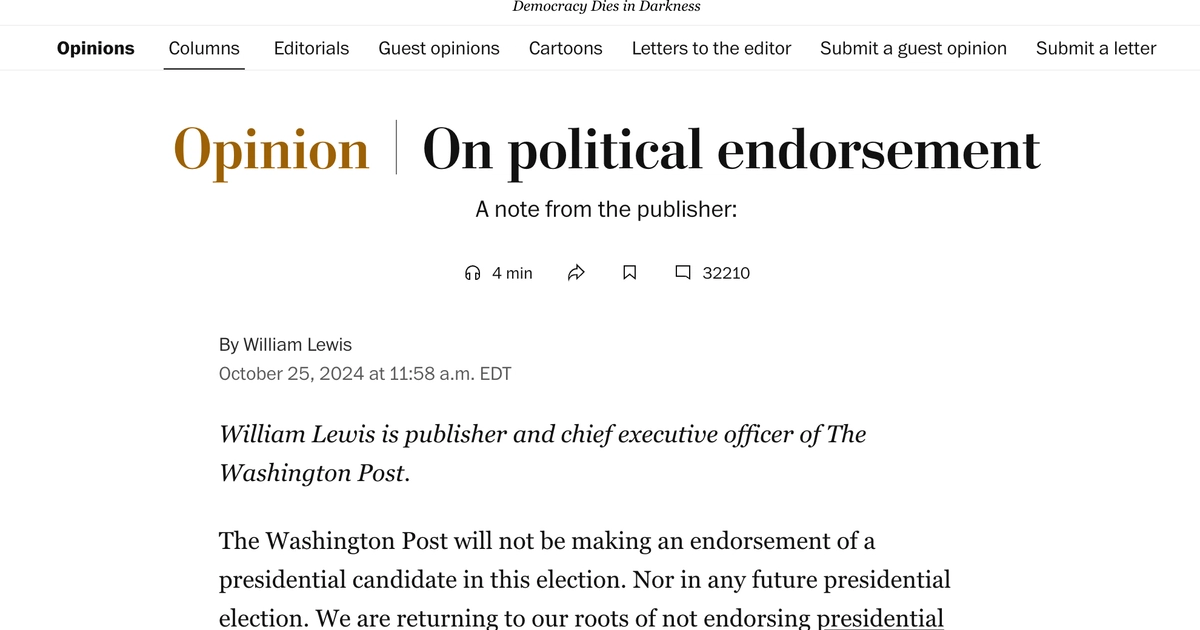
The Washington Post sold Democracy. Now it needs a new line of business.
A leading American newspaper enters a new era.
Local Journalism Directory | Media and Democracy Project
We created a directory to help you find local journalism and local news sources in your area worth reading and supporting.
