Incidental charges incurred by UK consumers on their Personal Current Account (PCA) are steep, especially for small amounts of unplanned borrowing and unpaid it
Sending Out an SMS: Automatic Enrollment Experiments for Overdraft Alerts
ABSTRACT At‐scale field experiments at major U.K. banks show that automatic enrollment into “just‐in‐time” text alerts reduces unarranged overdraft and unpaid item charges 17% to 19% and arranged overdraft charges 4% to 8%, implying annual market‐wide savings of £170 million to £240 million. Incremental benefits from “early‐warning” alerts are statistically insignificant, although economically significant effects are not ruled out. Prior to the experiments, over half of overdrafts could have been avoided by using lower‐cost liquidity available in savings and credit card accounts. Alerts help consumers achieve less than half of these potential savings.

Time to Act: A Field Experiment on Overdraft Alerts
Despite the growth of digital banking and the rapidly expanding offering of money management applications, a substantial proportion of banking customers still i
Analyzing Bank Overdraft Fees with Big Data
In 2012, consumers paid $32 billion in overdraft fees, representing the single largest source of revenue for banks from demand deposit accounts during this period. Owing to consumer attrition caused by overdraft fees and potential government regulations to reform these fees, financial institutions have become motivated to investigate their overdraft fee structures. Banks need to balance the revenue generated from overdraft fees with consumer dissatisfaction and potential churn caused by these fees. However, no empirical research has been conducted to explain consumer responses to overdraft fees or to evaluate alternative pricing strategies associated with these fees. In this research, we propose a dynamic structural model with consumer monitoring costs and dissatisfaction associated with overdraft fees. We apply the model to an enterprise-level data set of more than 500,000 accounts with a history of 450 days, providing a total of 200 million transactions. We find that consumers heavily discount the future and potentially overdraw because of impulsive spending. However, we also find that high monitoring costs hinder consumers’ effort to track their balance accurately; consequently, consumers may overdraw because of rational inattention. The large data set is necessary because of the infrequent nature of overdrafts; however, it also engenders computational challenges, which we address by using parallel computing techniques. Our policy simulations show that alternative pricing strategies may increase bank revenue and improve consumer welfare. Fixed bill schedules and overdraft waiver programs may also enhance social welfare. This paper explains consumer responses to overdraft fees and evaluates alternative pricing strategies associated with these fees. The online appendices are available at https://doi.org/10.1287/mksc.2018.1106 .

Limited and Varying Consumer Attention: Evidence from Shocks to the Salience of Bank Overdraft Fees
Abstract. We explore dynamics of limited attention in the $35 billion market for checking overdrafts, using survey content as shocks to the salience of ove
How Do Consumers Avoid Penalty Fees? Evidence from Credit Cards
Using data from multiple card issuers, we show that the most common penalty fee type incurred by credit card holders, late payment fees, declines sharply over the first few months of card life. This phenomenon is wholly due to some consumers adopting automatic payments after a late payment event, thereby insuring themselves against future late payment fees. Nonadopters, who remain on manual-only payments, experience an unchanged high likelihood of future fees, despite exhibiting ample levels of available liquidity. Our results show that heterogeneity in adopting account management features of financial products, such as automatic payments, is important for understanding who avoids financial mistakes. This paper was accepted by Gustavo Manso, finance.

Side Effects of Nudging: Evidence from a Randomized Intervention in the Credit Card Market
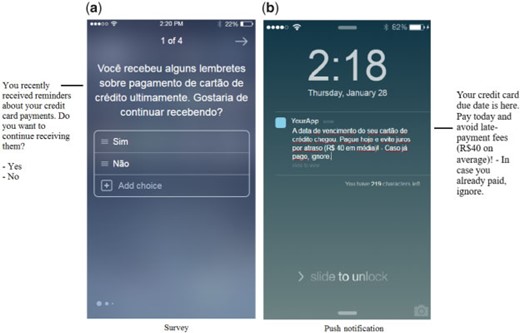
Abstract This paper studies the direct and indirect effects of nudging, by means of a field experiment with a financial management platform in Brazil. Reminders for upcoming credit card payments reduced credit card late-payment fees by 14%, but increased overdraft fees in checking accounts by 9%. The unintended effect is concentrated in users with a history of overdraft use. These users experienced a net increase of 5% in total fees, while the rest experienced savings of 15%. The results provide clear insights for nudge design: like any policy action, nudges can have side effects, and one size may not fit all.
Unshrouding: Evidence from Bank Overdrafts in Turkey
ABSTRACT Lower prices produce higher demand… or do they? A bank's direct marketing to holders of “free” checking accounts shows that a large discount on 60% APR overdrafts reduces overdraft usage, especially when bundled with a discount on debit card or autodebit transactions. In contrast, messages mentioning overdraft availability without mentioning price increase usage. Neither change persists long after the messages stop. These results do not square easily with classical models of consumer choice and firm competition. Instead, they support behavioral models where consumers underestimate and are inattentive to overdraft costs, and firms respond by shrouding overdraft prices in equilibrium.

Do Customers Learn from Experience? Evidence from Retail Banking
We study customers' adoption and subsequent switching decisions with regard to a menu of three-part tariff plans offered by a commercial bank. Using a rich panel data set covering 70,510 fee-based checking accounts over 30 months, before and after the introduction of the plans, we find that most customers adopt non-cost-minimizing plans, preferring plans with large monthly allowances and high fixed payments. Furthermore, after adoption, customers who exceed their allowances and consequently pay overage fees are more likely to switch to plans with larger allowances than customers who do not experience such fees. Notably, after switching, these overage-paying customers pay higher monthly payments than before. In contrast, switching customers who did not pay overage payments before switching pay less after switching. Our findings, unlike those of previous research on experience-based learning, suggest that the behavior of experienced customers does not converge to the predictions of neoclassical models. We propose that “overage aversion,” which is closely related to loss aversion and mental accounting, is the most plausible explanation for our findings. This paper was accepted by John List, behavioral economics.
What Do Consumers Really Pay on Their Checking and Credit Card Accounts? Explicit, Implicit, and Avoidable Costs
(May 2009)
Do Nudges Reduce Borrowing and Consumer Confusion in the Credit Card Market?
We study nudges that turn out to have precise null effects in reducing long‐run credit card debt. We test nudges across two field experiments covering 183,441 UK cardholders. Our first experiment studies nudges added to monthly credit card statements. Our second experiment studies letters and email nudges (separate from monthly statements) sent to cardholders who signed up to automatically pay the minimum required payment. In a follow‐up survey to our second experiment, we find that 96% of respondents underestimate the time it would take to fully repay a debt if the cardholder made only the minimum required payment. The nudges reduce this confusion, but underestimation remains overwhelmingly common.

Chatbots in consumer finance | Consumer Financial Protection Bureau
Many financial institutions are using advanced technologies to deploy customer service chatbots. Poorly designed chatbots can lead to customer frustration, reduced trust, and even violations under the law.
Do Liquidity Constraints and Interest Rates Matter for Consumer Behavior? Evidence from Credit Card Data
Abstract. This paper utilizes a unique data set of credit card accounts to analyze how people respond to credit supply. Increases in credit limits generate
High Risk Merchant Accounts & Payment Solutions
Our high-risk merchant account service offers competitive rates for businesses in industries such as gaming, adult entertainment, and CBD.

Disclosing the costs of co-holding liquid assets and high-interest debt has limited impact on behavior
Abstract Why do consumers simultaneously maintain low-yield liquid assets and high-interest revolving debt? This behavior, known as ``co-holding,'' affects 23\% of credit card users in our sample from a major international bank and costs the typical co-holder hundreds of dollars annually in unnecessary interest charges. Our analysis of 38 months of detailed banking records reveals that co-holding is remarkably persistent, with typical co-holders maintaining this behavior for most months observed. Our analysis also reveals that co-holding is not a static financial position: co-holders regularly deposit and withdraw from asset accounts while simultaneously making new credit card purchases. To test whether co-holding could be addressed through information disclosure, we conducted a large-scale field experiment (n = 125,328), providing clear information about co-holding behavior and its costs. Customers received targeted messages through their bank's mobile app, where they could easily transfer money from assets to pay down debt. Despite sufficient power to detect economically small effects, we found no meaningful changes in debt repayment amount, though customers did respond in other ways---making more frequent repayments and paying above required minimums. These results challenge explanations based on limited attention or information gaps and suggest that simple information disclosure, even when carefully designed and delivered through trusted channels, may not effectively address costly financial behaviors.

Debt literacy, financial experiences, and overindebtedness
We analyze a national sample of Americans with respect to their debt literacy, financial experiences, and their judgments about the extent of their indebtedness. Debt literacy is a component of broader financial understanding that measures knowledge about debt and self-assessed financial knowledge. Financial experiences are the participants’ reported experiences with traditional borrowing, alternative borrowing, and investing. Overindebtedness is a self-reported measure. Debt literacy is low, with only about one-third of the population grasping the basics of interest compounding. Even after controlling for demographics, we find a relationship between debt literacy and both financial experiences and debt loads. Individuals with lower levels of debt literacy tend to transact in high-cost manners, incurring higher fees and using high-cost borrowing. We provide a rough estimate of the national implications of debt ignorance on credit card costs by consumers. Less knowledgeable individuals also report that their debt loads are excessive or that they are unable to judge their debt position.
Information disclosure and credit card repayments: evidence from Malaysia
Purpose This study analyzes the role of information disclosure in influencing credit card repayments by focusing on three intervention methods for improving repayment decisions among credit cardholders. Design/methodology/approach This study uses the survey method to collect data. Four questionnaires are designed to identify which types of disclosure elicit better repayment decisions among credit cardholders. The participants were approached using the mall intercept method, and a total of 1,775 responses were obtained. Findings Estimations using means comparison tests show that not providing minimum payment information improves repayments. The expected benefits are not delivered by the provision of higher minimum payment information or additional information that highlights the negative effects of making the minimum repayment only. Further analysis using logit estimation reconfirms the benefit of not providing minimum payment information. However, when such information is given, low minimum payment information elicits better repayment decisions than high minimum payment information or additional information. Repayment worsens under the additional information condition compared to the high minimum payment condition. Research limitations/implications The findings of this study have a bearing on the decisions of policy makers, credit card issuers and consumers. Originality/value This paper clarifies the role of information in improving debt repayment decisions.