

Chapters — Intro, Communal computing, This presentation, Physicality — Globalization, Centrally-planned, Isolating, Private property, Surveillance, Consumption, Hidden — Summary, Outline
Computational Public Space
New_ Public
We are researchers, engineers, designers, and community leaders working together to create digital public spaces where people can thrive and connect.

Creating a Flourishing Digital Public Space for Your Local Area | Notion
A how-to guide for admins and moderators of inclusive, uplifting, and public-spirited local Facebook groups, Discord servers, subreddits, and more...

Governable spaces: a feminist agenda for platform policy
A proposal, informed by feminist theory, for a policy agenda of “governable spaces” across the domains of social media, gig economies, and network infrastructure.

New_ Public Invests in Local Online Spaces as Digital Civic Infrastru…
archived 11 Apr 2025 17:34:52 UTC


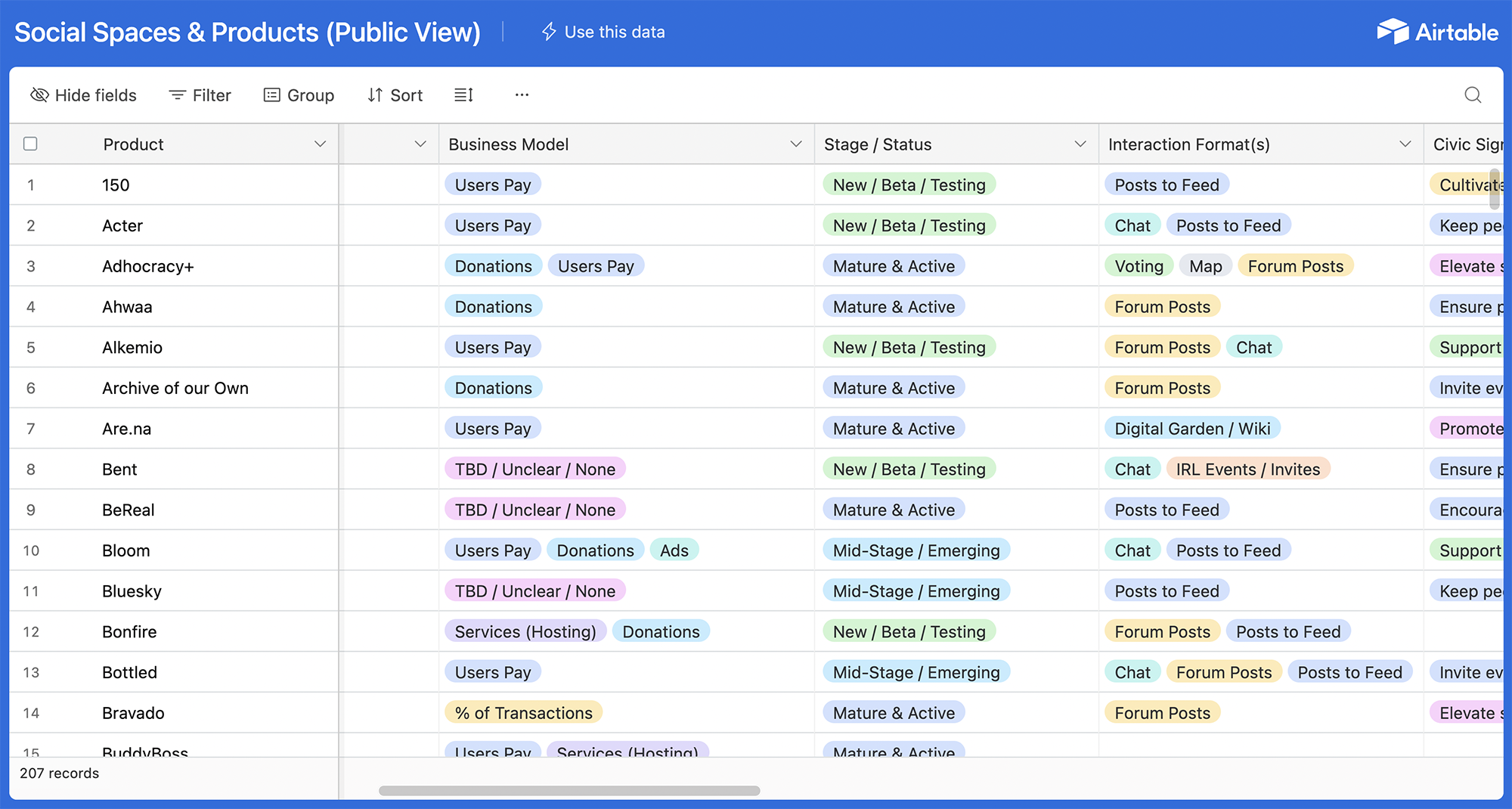
Digital Spaces Directory | New_ Public
As the social media landscape changes and a new wave of digital spaces emerges, this Directory is meant to be a resource for our field — a jumping-off-point for further exploration and research for anyone who’s interested in studying, building, stewarding, or simply using digital social platforms. We hope this will inspire creative exploration, spark new collaborations, and highlight important progress.
softer computing club
a cozy community of humans and computers on the planet earth
Human-Computer Insurrection: Notes on an Anarchist HCI
As part of the Digital Library's transition to Open Access, new features for researchers are available in the Premium Edition. Click here to learn more.

Reclaiming the Computing Commons
Hunter writes: The commodification and exploitation of nature; the enclosure of the intellectual and informational commons in medicine, agriculture, and other areas of technical knowledge; the expropriation of public space to secure profit-all define an economic system supposedly premised on freedom.
Building Digital Public Spaces for Good
A Conversation with Eli Pariser, Co-Founder and Co-Director of New_ Public
Part II: USENET — Let's Return to Public Spaces
Usenet was what the Web is missing nowadays: a genuinely public space, with unclear ownership
Governable Spaces: Democratic Design for Online Life – Writings and rehearsals by Nathan Schneider
Read the free, open access editionBuy: Amazon, Bookshop, Narrow Gauge Book Co-op, UC Press
Grand Challenges for the Convergence of Computational and Citizen Science Research Workshop Report
This report is an outcome of a Computing Community Consortium (CCC) visioning workshop on Grand Challenges for the Convergence of Computational and Citizen Science Research conducted on April 8-9, 2025, in Washington, D.C. as well as through several precursor virtual input-gathering sessions. These events brought together experts across relevant disciplines to develop a research agenda that brings to fruition the above vision on how humans and machines may team up to solve some of the world's most pressing scientific problems. Citizen science delivers measurable economic and national value. Public participation in scientific research generates millions of dollars in volunteer labor value, extends government agency capacity, and directly supports federal priorities in areas such as disaster management, public health, water, energy, workforce development, and many more. At the same time, 21st-century scientific infrastructure requirements for citizen science (from hardware and cyberinfrastructure to data and computational frameworks) mirror those for computational science more generally. The distributed, collaborative, long-term, and contextual nature of citizen science makes it a demanding real-world use case for a novel robust research infrastructure that accounts for security, privacy, resource adaptability, and transparency. In this report, we outline the key findings, future research directions, and recommendations that emerged from the April 2025 CCC Grand Challenges for the Convergence of Computational and Citizen Science Research Workshop.

Manoel Horta Ribeiro (@manoelhortaribeiro.bsky.social)
Assistant Professor @ Princeton Previously: EPFL 🇨🇭, UFMG 🇧🇷 Interests: Computational Social Science, Platforms, GenAI, Moderation

'Safety as Public Infrastructure? The Future of Moderation in the Open Social Web' Talk by Saskia Welch, Aditya Singh and Sebastian Vogelsang More info: ctalx.c-base.org/fediday-2026/talk/MGDNUN/ Click your tickets here: berlinfedi.day ⁂ […] berlin.social/@berlinfediday/11724669250279…
