

Recent work on the fundamental processes of regulation in biology (Ashby, 1956) has shown the importance of a certain quantitative relation called the law of requisite variety. After this relation had been found, we appreciated that it was related to a theorem in a world far removed from the biological—that of Shannon on the quantity of noise or error that could be removed through a correction-channel (Shannon and Weaver, 1949; theorem 10). In this paper I propose to show the relationship between the two theorems, and to indicate something of their implications for regulation, in the cybernetic sense, when the system to be regulated is extremely complex. Since the law of requisite variety uses concepts more primitive than those used by entropy, I will start by giving an account of that law.
Variety (cybernetics)
In cybernetics, the term variety denotes the total number of distinguishable elements of a set, most often the set of states, inputs, or outputs of a finite-state machine or transformation, or the binary logarithm of the same quantity.[1] Variety is used in cybernetics as an information theory that is easily related to deterministic finite automata, and less formally as a conceptual tool for thinking about organization, regulation, and stability. It is an early theory of complexity in automata, complex systems,[1]: 6  and operations research.[2]
Neural Networks Are Already Clean
A working hypothesis about neurons, generalization, and the ecology of circuits.
The Unreasonable Sufficiency of Protocols Web
The Unreasonable Sufficiency of Protocols Venkatesh Rao, Tim Beiko, Danny Ryan, Josh Stark, Trent Van Epps, and Bastian Aue 1. Introduction Complex coordination problems have an air of doomed intractability about them. We speak in fatalistic terms of economics being a “dismal” science, of sociological phenomena being dominated by the

Cryptographic Nature
I consider the many ways in which evolved information-flows are restricted and metabolic resources protected and hidden -- the thesis of living phenomena as evolutionary cryptosystems. I present the information theory of secrecy systems and discuss mechanisms acquired by evolved lineages that encrypt sensitive heritable information with random keys. I explore the idea that complexity science is a cryptographic discipline as "frozen accidents", or various forms of regularized randomness, historically encrypt adaptive dynamics.

Knowledge Networks and the Politics of Protocols
Harmony without loss of Variety; Variety without loss of Harmony.
Genetic Information: A Metaphor In Search of a Theory
John Maynard Smith has defended against philosophical criticism the view that developmental biology is the study of the expression of information encoded in the genes by natural selection. However, like other naturalistic concepts of information, this “teleosemantic” concept is equally applicable to many non-genetic factors in development. Maynard Smith also fails to show that developmental biology is concerned with teleosemantic information. Some other ways to support Maynard Smith's conclusion are considered. It is argued that on any definition of information the view that development is the expression of genetic information is misleading. Some reasons for the popularity of that view are suggested.
Functional Information: Towards Synthesis of Biosemiotics and Cybernetics
Biosemiotics and cybernetics are closely related, yet they are separated by the boundary between life and non-life: biosemiotics is focused on living organisms, whereas cybernetics is applied mostly to non-living artificial devices. However, both classes of systems are agents that perform functions necessary for reaching their goals. I propose to shift the focus of biosemiotics from living organisms to agents in general, which all belong to a pragmasphere or functional universe. Agents should be considered in the context of their hierarchy and origin because their semiosis can be inherited or induced by higher-level agents. To preserve and disseminate their functions, agents use functional information - a set of signs that encode and control their functions. It includes stable memory signs, transient messengers, and natural signs. The origin and evolution of functional information is discussed in terms of transitions between vegetative, animal, and social levels of semiosis, defined by Kull. Vegetative semiosis differs substantially from higher levels of semiosis, because signs are recognized and interpreted via direct code-based matching and are not associated with ideal representations of objects. Thus, I consider a separate classification of signs at the vegetative level that includes proto-icons, proto-indexes, and proto-symbols. Animal and social semiosis are based on classification, and modeling of objects, which represent the knowledge of agents about their body (Innenwelt) and environment (Umwelt).
Co-Creation: Systems Thinking Beyond the Machine
Complexity thinking is all the rage — in the arts and sciences. Yet, there are two different strands of thinking about complexity, which are often confounded. The first comes from cybernetics, focussing on control in complex situations. The second is ecological, aiming at sustainable participation in a reality beyond control. Their difference rests on a fundamental distinction: is complexity rooted in feedback regulation or collective co-creation? While feedback remains mechanistic, co-creation generates new spaces of possibilities. We need it to understand life and its evolution. And it empowers us to rewrite our future, to escape our mechanistic cage without abandoning scientific rigor. In this paper, we illustrate how we implement these powerful yet abstract principles through our artistic and philosophical practice.
Complexity Explorables
A collection of interactive explorable explanations of complex systems in biology, physics, mathematics, social sciences, epidemiology, ecology and other fields....
Are Biological Systems More Intelligent Than Artificial Intelligence?
Are biological self-organising systems more ``intelligent'' than artificial intelligence (AI)? If so, why? I address this question using a mathematical framework that defines intelligence in terms of adaptability. Systems are modelled as stacks of abstraction layers (\emph{Stack Theory}) and compared by how effectively they delegate agentic control down their stacks. I illustrate this using computational, biological, military, governmental, and economic systems. Contemporary AI typically relies on static, human-engineered stacks whose lower layers are fixed during deployment. Put provocatively, such systems resemble inflexible bureaucracies that adapt only top-down. Biological systems are more intelligent because they delegate adaptation. Formally, I prove a theorem (\emph{The Law of the Stack}) showing that adaptability at higher layers is bottlenecked by adaptability at lower layers. I further show that, under standard viability assumptions, maximising adaptability is equivalent to minimising variational free energy, implying that delegation is necessary for free-energy minimisation. Generalising bioelectric accounts of cancer as isolation from collective informational structures, I analyse cancer-like failure modes in non-biological systems when delegation is inadequate. This yields design principles for building robust systems via delegated control, and reframes hybrid agents (e.g. organoids or human--AI systems) as weak boundary-condition design problems in which constraints shape low-level policy spaces while preserving collective identity.
Protocol: How Control Exists after Decentralization
How Control Exists after DecentralizationIs the Internet a vast arena of unrestricted communication and freely exchanged information or a regulated, highly
The Law of Conservation of Information: Search Processes Only Redistribute Existing Information
Conservation of information sparked scientific interest once a recurring pattern was noticed in the evolutionary computing literature. In grappling with the creation of information through evolutionary algorithms, this literature consistently revealed that the information outputted by such algorithms always needed first to be programmed into them. Thus, the primary goal of this literature—to uncover how information could be created from scratch or de novo —was shown to be misconceived: the information was not created but instead shuffled around or smuggled in, implying that it already existed in some form or other. Information output in these situations therefore always presupposed a counterbalancing input of prior information. Once this pattern was seen, the next logical step was to quantify the amount of information inputted and outputted, demonstrating a consistent mathematical relation between the two. This led to the proof of a number of theorems about search. In these theorems, a baseline search with probability p of success gave way to an improved search with probability q of success. Typically p would be very small and close to zero, implying a practically impossible search (like searching for a needle in a haystack). By contrast, q would be much larger and close to one, implying an eminently doable search. The punchline of these theorems was that, as the improved search became itself the subject of a search (a search for a search , or S4S), the probability of finding it could not exceed p / q , rendering success of the improved search no more probable than success of the original baseline search, in effect filling one hole by digging another. Such conservation-of-information theorems, as they came to be called, were search-space specific, adapted to different kinds of search across a range of search spaces. There was a measure-theoretic theorem in which probability measures guided search. There were also function-theoretic and fitness-theoretic theorems where mappings into the search space as well as fitness functions on the search space respectively guided search. The key insight of this paper is that all these conservation-of-information theorems are special cases of a simple probabilistic relation based on elementary probability theory. This paper identifies the underlying rationale that makes all the previous conservation-of-information theorems work. In so doing, it provides a straightforward proof and general formulation of what may rightly be called the Law of Conservation of Information.
Lossy communication constrains iterated learning
Humans' distinctive role in the world can largely be attributed to our capacity for iterated learning, a process by which knowledge is expanded and refined over generations. A range of theories seek to explain why humans are so adept at iterated learning, many positing substantial evolutionary discontinuities in communication or cognition. Is it necessary to posit large differences in abilities between humans and other species, or could small differences in communication ability produce large differences in what a species can learn over generations? We investigate this question through a formal model based on information theory. We manipulate how much information individual learners can send each other and observe the effect on iterated learning performance. Incremental changes to the channel rate can lead to dramatic, non-linear changes to the eventual performance of the population. We complement this model with a theoretical result that describes how individual lossy communications constrain the global performance of iterated learning. Our results demonstrate that incremental, quantitative changes to communication abilities could be sufficient to explain large differences in what can be learned over many generations.
The science of consciousness does not need another theory, it needs a minimal unifying model
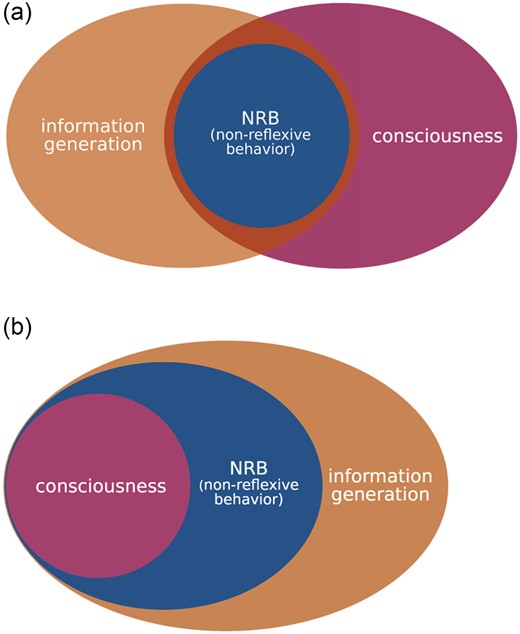
Abstract. This article discusses a hypothesis recently put forward by Kanai et al., according to which information generation constitutes a functional basi
Requisite Variety - gordonbrander.com
If a system is to be stable, the number of states of its control mechanism must be greater than or equal to the number of states in the system being controlled.