


March 22, 2021 – It’s tax season in the U.S. right now! Even though that deadline has just been pushed back to May 17, taxes are on everybody’s mind, so this is a good time to write about the topic in the context of the Safe Withdrawal Rate Series. Until now, I haven’t written all that … Continue reading Principles of Retirement Tax-Planning – SWR Series Part 44
The Safe Withdrawal Rate Series - Early Retirement Now
Discover the Safe Withdrawal Rate Series: 4% Rule, Personalized strategies, sequence risk, FIRE planning, free Google Sheet, 2025 updates.

Ten Lessons From Ten Safe Withdrawal Rate Case Studies - Early Retirement Now
Last week, we published the Tenth Safe Withdrawal Rate Study! Amazing how time flies! I did about one case study every three weeks for the last 6 months! And I could even include another one if I were to count the one I did for the ChooseFI podcast back in 2017. In fact, the ChooseFI … Continue reading Ten Lessons From Ten Safe Withdrawal Rate Case Studies

How much can we earn in retirement without paying federal income taxes? - Early Retirement Now
Update 11/22/2019: After I published a shorter version of this piece on MarketWatch and the story was picked up by Yahoo Finance as well, I got a lot more readers! Thanks, and welcome to my blog! Make sure you subscribe to be notified of future blog posts! Both on Yahoo and MarketWatch, I saw the … Continue reading How much can we earn in retirement without paying federal income taxes?

The Basics of FIRE - Early Retirement Now
March 10, 2023 – After seven years of blogging in the personal finance and FIRE community, I realize that there’s one type of post I’ve always avoided: How to explain FIRE to a complete newbie. Until now, I’ve outsourced that task and simply referred to the Links Page. But where’s a good overview, all in … Continue reading The Basics of FIRE

Misunderstanding Savings Growth: Implications for Retirement Savings Behavior
People systematically underestimate exponential growth. This article illustrates this phenomenon, its implications, and some potential interventions in the context of saving for retirement, where savings grow exponentially over long periods of time. Experiment 1 shows that a majority of participants expect savings over 40 years to grow linearly rather than exponentially, leading them to grossly underestimate their account balance at retirement. Experiment 2 demonstrates that this misunderstanding leads to underestimates of the cost of waiting to save, which makes putting off saving more attractive than it should be. Finally, Experiments 3–5 show that highlighting the exponential growth of savings motivates both college students and employees to save more for retirement. Making clear to employees the exponential growth of savings before they make crucial decisions about how much to save may be a simple and effective means of increasing retirement savings.

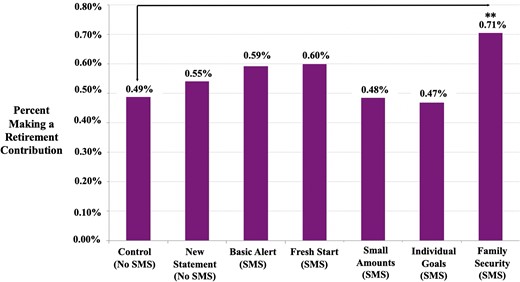
Identifying heterogeneity using recursive partitioning: evidence from SMS nudges encouraging voluntary retirement savings in Mexico
Abstract Individuals regularly struggle to save for retirement. Using a large-scale field experiment (N=97,149) in Mexico, we test the effectiveness of several behavioral interventions relative to existing policy and each other geared toward improving voluntary retirement savings contributions. We find that an intervention framing savings as a way to secure one’s family future significantly improves contribution rates. We leverage recursive partitioning techniques and identify that the overall positive treatment effect masks subpopulations where the treatment is even more effective and other groups where the treatment has a significant negative effect, decreasing contribution rates. Accounting for this variation is significant for theoretical and policy development as well as firm profitability. Our work also provides a methodological framework for how to better design, scale, and deploy behavioral interventions to maximize their effectiveness.
Tax and the Law of Market Cycles
<p>The signature development in financial regulation over the past two decades has been the macroprudential turn: the recognition that healthy financial conditi

Beyond the Status Quo: A Critical Assessment of Lifecycle Investment Advice
<div> <div> <div> We challenge two tenets of lifecycle investing: (i) diversify across stocks and bonds and (ii) <span>reduce equity allocations with

Rules of Thumb in Household Savings Decisions: Estimation Using Threshold Regression
The rules of thumb offered by financial advisors regarding how much to hold in liquid reserves vary widely and usually imply far greater sums than low-income ho
#18 Episode - Simplifying the Safe
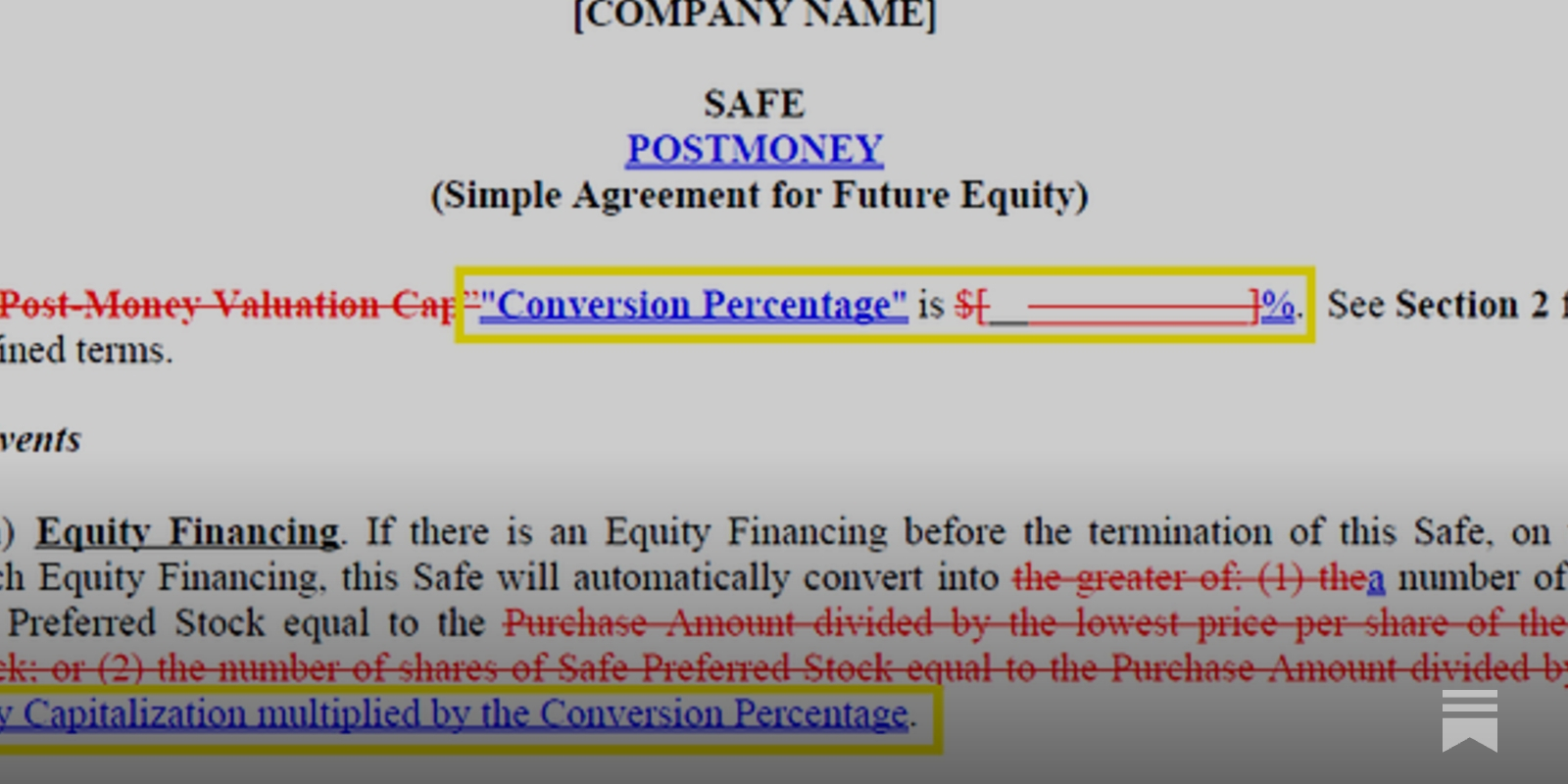
Remove the Valuation Cap and Discount. Replace it with a Conversion Percentage (%).

Save More Today or Tomorrow: The Role of Urgency in Precommitment Design
To encourage farsighted behaviors, previous research suggests that marketers should invite consumers to precommit to adopting these behaviors “later.” However, the authors propose that people will draw different inferences from different types of precommitment offers, and that these inferences can help explain when precommitment is (and is not) effective at increasing adoption of farsighted behaviors. Specifically, the authors theorize that simultaneously offering consumers the opportunity to adopt a farsighted behavior now or later (i.e., offering “simultaneous precommitment”) may signal that the behavior is not urgently recommended; however, offering consumers the opportunity to adopt that behavior immediately and then, only if they decline, inviting them to adopt it later (i.e., offering “sequential precommitment”) may signal just the opposite. In a multisite field experiment (N = 5,196), the authors find that simultaneously giving consumers the chance to increase their savings now or later reduced retirement savings. Two preregistered lab studies (N = 5,080) show that simultaneous precommitment leads people to infer that taking action is not urgently recommended, and such inferences predict less adoption of recommended behaviors. Importantly, offering sequential precommitment increases inferred urgency, predicting greater adoption. Together, this research advances knowledge about the limits and potential of precommitment.

Cashing Out Retirement Savings at Job Separation
We investigate the impact of employer matching contributions on leakage at job termination. , The U.S. government imposes a 10% penalty to discourage preretirement leakage—cash withdrawal from 401(k) retirement savings before the age of 59.5 years. In our data set with 162,360 terminating employees covered by 28 retirement plans, 41.4% of employees leaked by cashing out 401(k) savings at job separation, most draining their entire accounts. We investigate the impact of employer matching contributions on leakage at job termination. The “composition” of funds in one’s 401(k) balance matters: leakage increases with employer contribution proportion. Micropatterns in our data align more with behavioral than with economic explanations of this effect. We estimate that a 50% increase in employer/employee match rate increases leakage probability by 6.3% at job termination. However, there could be a 35.3% reduction in leakage probability if employees ignore the perceived incentive generated by the account composition effect. Approximately 60% of accumulated assets from a 50% increase in match rate leak out of the system due to the account composition effect attributable to the percentage of assets contributed by the employer. Employers with more generous matches care about their employees’ well-being in retirement, but unintentionally nudge employees to cash out when they change jobs. We highlight proposals to help employers curb avoidable leakage. History: K. Sudhir served as the senior editor and Tat Chan served as associate editor for this article. Funding: This work was supported by the Social Sciences and Humanities Research Council of Canada [Grant 435-2018-0509]. Supplemental Material: The data files and online appendices are available at https://doi.org/10.1287/mksc.2022.1404 .

The US President's new proposal to tax international students has been approved by the White House for release this week. It's an unprecedented $100,000 tax on int'l grads who stay to work after graduation on Optional Practical Training (most grads do), a crucial bridge to remaining by any channel.
