It is increasingly necessary for researchers in all fields to write computer code, and in order to reproduce research results, it is important that this code is published. We present Jupyter notebooks, a document format for publishing code, results and explanations in a form that is both readable and executable. We discuss various tools and use cases for notebook documents.
Project Jupyter
The Jupyter Notebook is a web-based interactive computing platform. The notebook combines live code, equations, narrative text, visualizations, interactive dashboards and other media.

Introducing notebook.link: The Future of Notebook Sharing
Reimagining how you share, collaborate, and run Jupyter notebooks — all in your browser.

Welcome
I also work extensively with Project Jupyter, particularly the Binder Project and Jupyter Book.

JupyterLite Officially Joins Project Jupyter!
We are thrilled to announce that JupyterLite is now an official part of Project Jupyter. This milestone marks a significant step forward for interactive computing in the browser and strengthens JupyterLite’s role within the Jupyter ecosystem.
deepnote/deepnote
Deepnote is a drop-in replacement for Jupyter with an AI-first design, sleek UI, new blocks, and native data integrations. Use Python, R, and SQL locally in your favorite IDE, then scale to Deepnote cloud for real-time collaboration, Deepnote agent, and deployable data apps. https://deepnote.com/
JupyterLite — JupyterLite 0.7.4 documentation
JupyterLite is a JupyterLab distribution that runs entirely in the browser built from the ground-up using JupyterLab components and extensions.
prime-radiant-inc/engineering-notebook
CLI tool that ingests Claude Code sessions, generates LLM summaries, and serves a browsable engineering journal
mokeyish/obsidian-code-emitter
An obsidian plugin that allows code blocks executed interactively in sandbox like jupyter notebooks. Supported language rust、kotlin、python、Javascript、TypeScript etc.

Docs as Code: The Best Guide for Technical Writers
Recently, my work has involved writing a lot of documentation and. Doing this has introduced me to...

jennings/jj-spr
The power tool for Jujutsu + GitHub workflows. Adapted from spr by @LucioFranco.
Patrick Collison on Twitter / X
I want some kind of LLM workflow tool.• Ability to manage a set of input files (Markdown or similar), plus other general-purpose context.• With real-time collaboration. (And maybe some concept of snapshots or VCS integration.)• And the ability to create/manage a inference…— Patrick Collison (@patrickc) June 6, 2026
Keynote: Bridging Gaps with Code: Transforming K12 Education with Jupyter Everywhere - I. Martinez
Linking the world's research to the code it runs on - OpenAlex blog
Research relies on software. Software written by scientists, for science, runs through the entire modern research stack: NumPy and SciPy, R and ggplot2, Jupyter, BLAST, ImageJ, AlphaFold. Yet in the scholarly record, that software is nearly invisible. Software is not usually cited formally in publications and is usually just mentioned in the text, which means […]

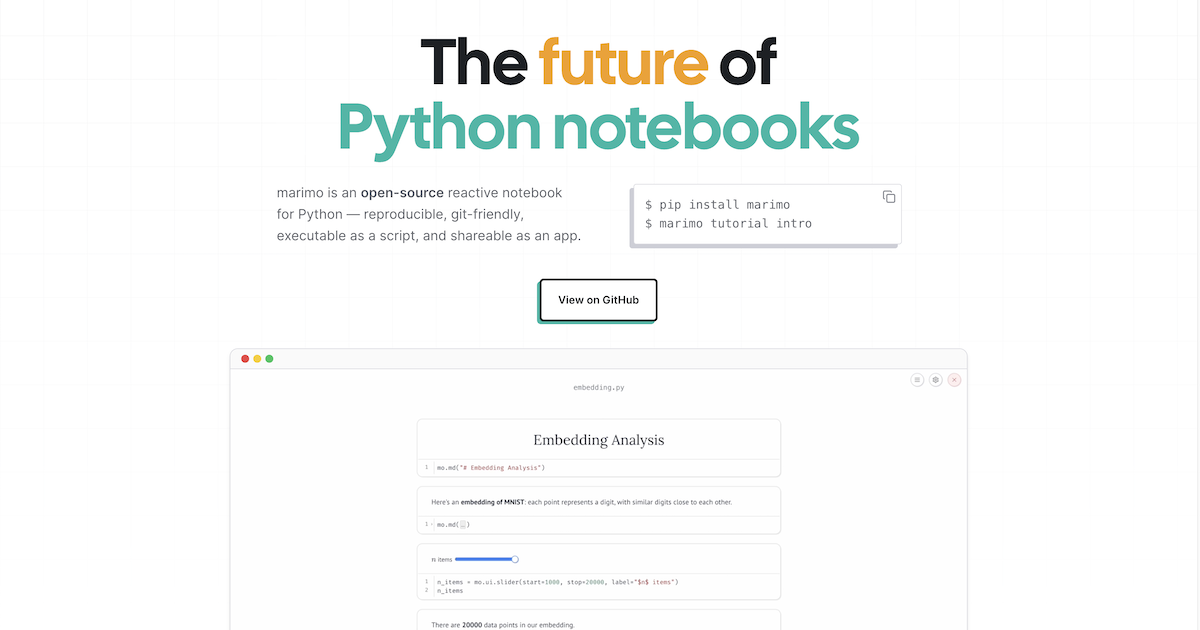
marimo | a next-generation Python notebook
Explore data and build apps seamlessly with marimo, a next-generation Python notebook.
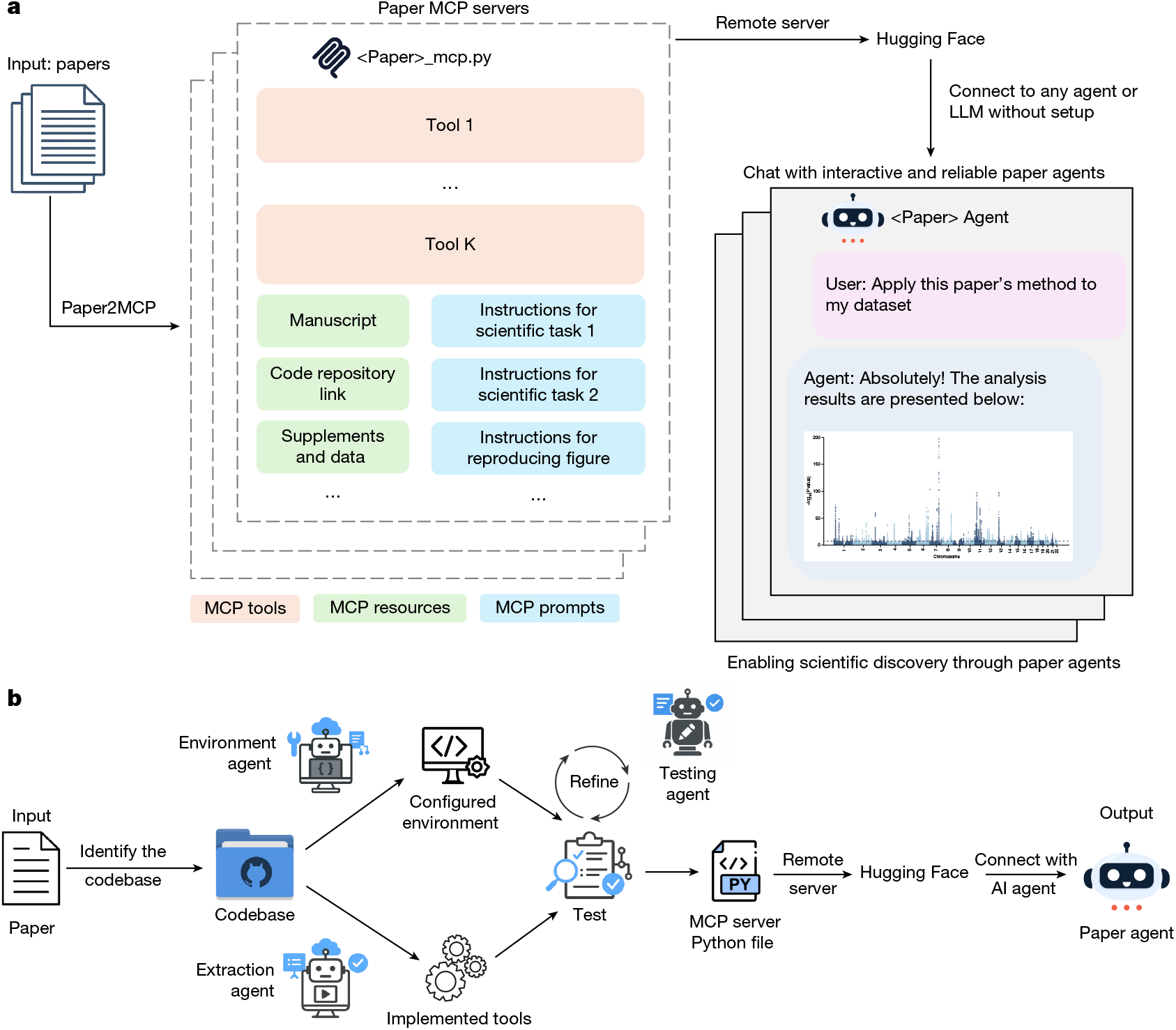
Reimagining research papers as interactive and reliable AI agents
Here we introduce Paper2Agent, an automated framework that converts research papers into artificial intelligence (AI) agents. Paper2Agent transforms research output from passive artefacts into active systems that accelerate use and discovery. Conventional research papers require readers to understand and adapt the paper’s code, data and methods to their work, creating barriers to dissemination and reuse. Paper2Agent addresses this challenge by converting a paper into an AI agent that functions as a virtual corresponding author, exposing its manuscript, supplementary materials, datasets, code and workflows as active, agent-native knowledge rather than static text. It analyses the paper and codebase using multiple agents to construct a model context protocol (MCP) server, then generates and runs tests to refine and increase robustness of the MCP. These paper MCPs can be connected to a chat agent (such as Claude Code) to carry out complex scientific queries through natural language while invoking tools and workflows from the paper. We demonstrate Paper2Agent’s effectiveness through case studies. Paper2Agent created an agent that leveraged AlphaGenome1 to interpret genomic variants and agents based on Scanpy2 and TISSUE (transcript imputation with spatial single-cell uncertainty estimation)3 to conduct single-cell and spatial transcriptomics analyses. We validate that these agents reproduce the results of the original papers and carry out novel user queries. Paper2Agent created multiple agents that collaborate to prioritize a causal gene for psoriasis. By turning static papers into interactive AI agents, Paper2Agent introduces a paradigm for knowledge dissemination and a collaborative ecosystem of AI co-scientists.