The European Commission today presented the European Technological Sovereignty Package, a set of measures to strengthen Europe\'s capacity in semiconductors, artificial intelligence (AI), cloud and open source.

EU-AI | Igor L.
The geopolitical landscape is shifting from physical borders to digital infrastructure. Here is a factual breakdown of how a $500 billion investment in "Sovereign AI" is changing global power dynamics. The Shift: From Land to "Substrate" Historically, a nation’s power was defined by its territory and legal systems (the Westphalian model). Today, power is increasingly tied to the compute substrate—the physical hardware and energy required to run AI. 1. Infrastructural Enclosure The "Sovereign Compute Coalition" (SCC) represents a massive consolidation of power. Major private entities are acquiring the three pillars of modern national strength: * Hardware: High-end AI chips (e.g., Nvidia). * Energy: The massive power grids needed to fuel them. * Data Centers: The physical "brains" of the digital economy. 2. The Rise of Technocracy As private companies own these essential tools, governments may find themselves in a position where they effectively "rent" their ability to govern. This moves decision-making power away from elected officials and toward those who control AI infrastructure. 3. Europe’s Strategic Response Europe is launching several initiatives to avoid becoming a "client state" of foreign tech providers. The strategy focuses on four main channels: * 8ra Initiative: Building a decentralized, multi-provider cloud-edge architecture to ensure data remains under European control and interoperable across borders. * ReArm Europe: A strategic defense package (presented in March 2025) aimed at boosting industrial competitiveness and reducing strategic dependencies in technology and defense. * Sovereign LLMs: Developing domestic models, such as Mistral, that are designed to align with European data privacy standards and cultural values. * Energy & Procurement: Using public procurement and new regulatory frameworks to create demand for homegrown, sustainable energy-efficient compute solutions. The goal of these moves is #DigitalSovereignty : the ability for a region to control its own digital destiny without relying exclusively on transnational monopolies. Data tells the real story. Are you following it? Follow #datanomics
EU Open Source Strategy | Shaping Europe’s digital future
The EU Open Source Strategy is a cornerstone of the Tech Sovereignty package, supporting open source ecosystems across the EU - encouraging the development and uptake of European alternatives.
Digital sovereignty can’t be bargained away
The European Commission has tools, public support and a mandate to act on Big Tech. Trading that away for short-term calm would be a costly mistake.

Funding Open Source for Digital Sovereignty
"Open Source alone won't deliver digital sovereignty. Europe must fix procurement and fund those who actually build it."

Funding Open Source for Digital Sovereignty
Open Source alone won't deliver digital sovereignty. Europe must fix procurement and fund those who actually build it.
What is a “European Alternative” to X? – Open Future
European alternatives to Big Tech platforms must go beyond sovereignty—they need decentralized models, robust safety, and public funding.
Privacy as EU Tech advantage - The LeafPlaza Blog
Online crime loves legal massive data collection, grey systems, and jurisdictional gaps. Privacy-first design can actually reduce crime exposure and build trust in digital services. It is also central to the EU's tech autonomy: build systems aligning with European rights and risk models. Do not rely on foreign platforms or copy outside practices that might go against the EU values and needs.
The EU AI Act Is Ready – Interdependent Thoughts
A final draft of the European AI Regulation is circulating (here’s an almost 900 page PDF). The coming days I will read it with curiosity.
EU's data centre expansion will fast-track profits and power for US Big Tech and investors
The global competition to ‘win’ the AI-race is driving an unparalleled expansion of large-scale data centres across the world. Cloaked in a narrative of pursuing European tech sovereignty and adopting AI widely and rapidly, the EU is now proposing to fast-track data centre development across the region in what appears to be a gift to […]
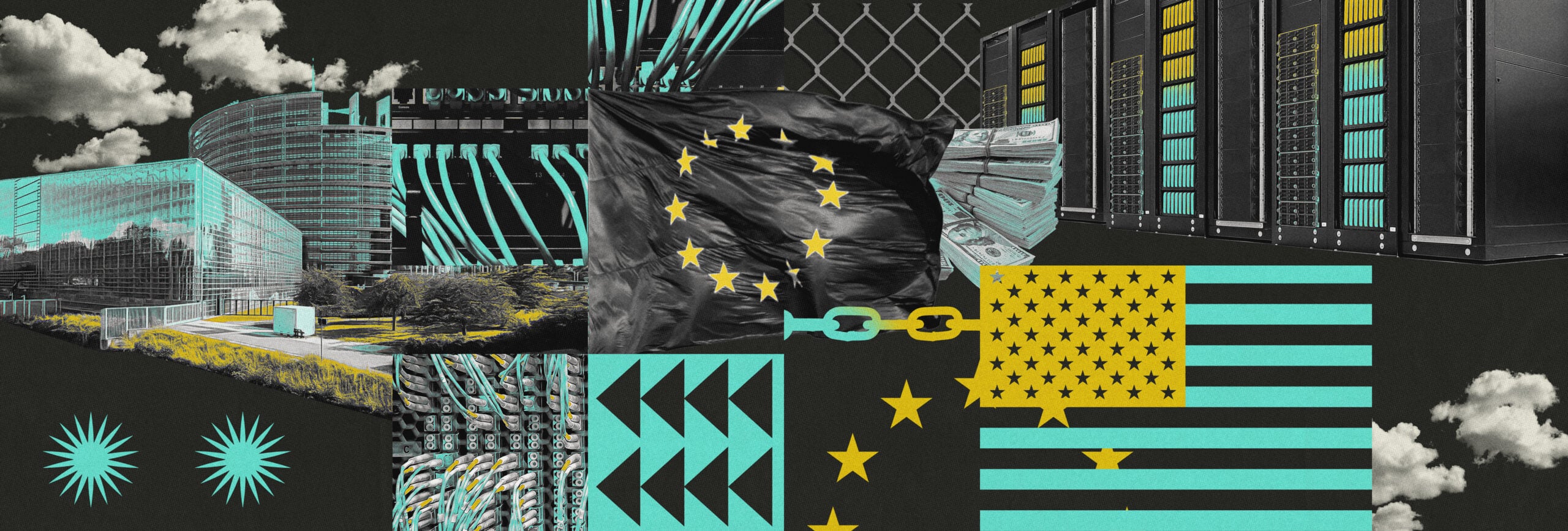
EU Wants To Break Up With US Tech
Wary of being vulnerable to the whims of foreign governments, the European Union is preparing far-reaching new moves to ditch American digital companies and Chinese chips in favour of European alternatives.

European Commission (@EUCommission@ec.social-network.europa.eu)
Attached: 1 image A strong Europe needs independent digital spaces. We believe true digital sovereignty thrives on a competitive, contestable, open ecosystem where diverse platforms co-exist. Today, we’re expanding our presence to W, the new social media. By being on W, we want to boost alternatives and support all efforts toward a decentralised web. And we continue to invest into our presence on the Fediverse!
Sovereignty and Landscape | Simon Wardley | 15 comments
X : What is digital sovereignty? Me : I was asked that question by some friends within Government at the beginning of this month. I know some have been working on the idea, which is very encouraging, but I gave my tuppence worth of a definition. "Digital sovereignty is a country's ability to make its own decisions about the technology it uses, the data it creates, and how digital systems work in service of its people rather than being forced to accept choices made by other entities. This requires continuous situational awareness of the economic and technological landscape to anticipate changes, maintain strategic advantage, and shape international digital norms. Digital sovereignty is achieved through strategic control over critical digital assets and relationships, extending from public sector systems to the broader digital ecosystem affecting citizens and economic interests." The key is choice. You are sovereign if you retain the ability to make your own decisions rather than being forced to accept the decisions of others. This doesn't mean you need to own the entire tech stack, or all the data but you do need to maintain control over critical assets and relationships. This can be achieved by many means not just by conflict with others but through co-operation and collaboration (i.e. all the forms of competition matter). You also can consciously compromise, accepting some loss of sovereignty in one space to gain sovereignty in another. Anyway, I quite like the Mike Bracken description https://lnkd.in/eFjzcAdr "Digital sovereignty is the agency and capacity of any organisation to make intelligent, informed choices to shape its digital future by design". I used to do a lot of work on sovereignty many years ago, so if you want to know more about my view and how to achieve this, well I have a series of hopefully useful but somewhat introductory posts. Sovereignty and Landscape https://lnkd.in/eku2X_Ea Societal versus Market benefit https://lnkd.in/eXxkCv-K Whose interests are you serving? https://lnkd.in/eAgHS5wc | 15 comments on LinkedIn

Digitalisation in Europe – 2025 edition - Interactive publications - Eurostat
Digital technologies are transforming the world we live and work in. They touch many different aspects of our lives, from everyday tasks like making phone calls and shopping to how businesses and public services operate. Digital transformation is one of the key priorities for the EU. The digital decade initiative sets out the EU targets that will guide digital transformation until 2030.
Digitalisation in Europe – 2025 edition - Interactive publications - Eurostat
Digital technologies are transforming the world we live and work in. They touch many different aspects of our lives, from everyday tasks like making phone calls and shopping to how businesses and public services operate. Digital transformation is one of the key priorities for the EU. The digital decade initiative sets out the EU targets that will guide digital transformation until 2030.
Building The CI Corporation — The Collective Intelligence Project
Existing financialization models have trapped us into only funding certain technologies, with a constrained set of stakeholders, outcomes, and possibilities. We need a better container in which to build the future of technology, be it satellites or space travel or AI research. Other approaches are n