


Regenerative Design: Water, Food, Energy, Lifestyle
Three Pillars Project: The Complete Framework for a Regenerative Civilization
The Three Pillars Project is a comprehensive multi-volume framework designed to provide the practical, philosophical, and institutional tools necessary to transition from an extractive economy to a regenerative civilization. This collection operates on the premise that true sustainability requires three pillars: physical tools for abundance (Pillar 1), a shift in human consciousness (Pillar 2), and ethical governance to protect them (Pillar 3). This Item contains the following files: PILLAR 1: The Practical Foundation (Engineering & Agriculture) File: The Regenerative Household Manual.pdf (From Waste to Abundance, Vol. 1) The Practitioner's Guide. A handbook for household and neighborhood resilience, detailing low-tech methods for turning waste into food, soil, and energy through mycology, aquaponics, and fermentation. File: The IBHCC Revolution.pdf (From Waste to Abundance, Vol. 2) The Industrial Guide. Details the Integrated Biomass-Hydro Combined Cascade (IBHCC), a theoretical energy architecture that utilizes waste heat, gravity, and pressure multiplication to power regional infrastructure. PILLAR 2: The Philosophical Heart (Consciousness & Spirit) File: The Ocean's Tapestry - Advance Copy.pdf A deep exploration of consciousness that weaves together ancient wisdom traditions (Eastern, Indigenous, Mystical) with modern science (Quantum Mechanics, AI) to cultivate the inner awareness necessary to wield regenerative technology responsibly. PILLAR 3: The Institutional Framework (Law & Governance) File: The Regenerative Governance Model & CAL License.pdf Introduces a new organizational structure and the Community Abundance License (CAL), a novel legal framework designed to keep regenerative innovations free for those who need them most (marginalized communities, LDCs) while preventing co-optation by extractive entities. LICENSE INFORMATION: This body of work is licensed under the Community Abundance License v1.0 - Basic Edition (CAL-1.0-Basic). Free Use: Individuals under $250k income, non-profits, and residents of UN-designated LDCs/SIDS. Standard Use: All others may use this work under Creative Commons Attribution-NonCommercial-NoDerivatives 4.0 International (CC BY-NC-ND 4.0). Prohibited: Weapons manufacturers and for-profit prisons.

Sustainability is not enough: we need regenerative cultures
By Daniel C. Wahl

Regenerative Economics - Principles
Our hope is that the Regenerative Economics materials act like a wildflower, taking root in even the smallest of cracks and spreading seeds to change the way economics is understood by young people around the world. The guiding principles: Facilitate change from the ground up: We recognise the

Regenerative Economics
Regenerative economies strengthen social and ecological systems. It's time for economics education to show us how.

Regenerative economics
Regenerative economics is an economic system that works to regenerate capital assets. In standard economic theory, one can either “regenerate” one's capital assets or consume them until the asset cannot produce a viable stream of goods and/or services. Regenerative economics accounts for and gives economic value to Earth and the Sun. Most of regenerative economics focuses on the earth and the goods and services it supplies.

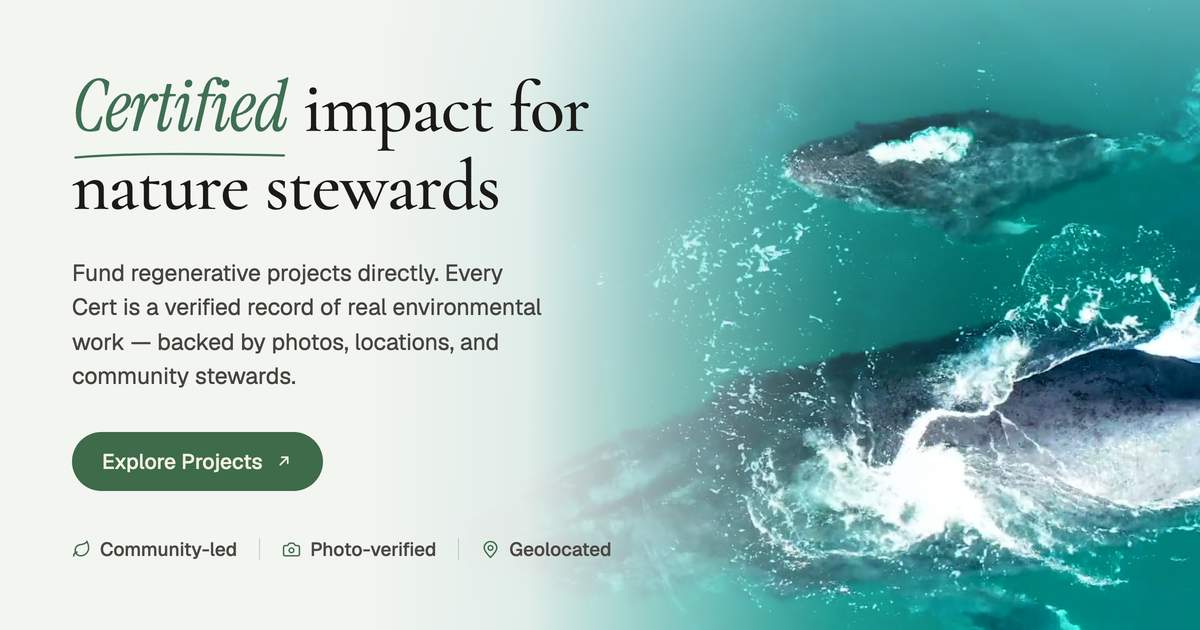
GainForest — Fund Regenerative Impact
GainForest connects funders with nature stewards doing on-ground regenerative work. Fund verified environmental impact directly.
Healthy people and planet | Stephen Brooks
What if our food systems could help heal the Earth? In Episode #336, I sit down with ethnobotanist Stephen Brooks to explore the principles of permaculture, alternative living, and the future of agriculture. The balance between humans and nature is critical to our happiness and longevity, and in this episode, we discuss how each of […]

Ecocivilization: making a world that works for all
""One of the greatest thinkers of our age" (The Guardian) presents a new way of living-one modeled on nature's design instead of capitalism's-for fans of Guns, Germs, and Steel and Doughnut Economics It has often been said that it is easier to imagine the end of the world than it is to imagine the end of capitalism-and yet that is what the historical moment urgently calls for. Climate change has reached an emergency state, inequality continues to grow, and, for many, the future has never seemed more bleak. Incremental policy improvements are no longer enough-we need a deep transformation of our current civilization to continue to survive. In Ecocivilization, leading thinker Jeremy Lent reimagines the basis of our civilization, and argues for a new global system of living, one based on life-affirming principles modeled after nature's own design. What enfolds is a robust framework incorporating Lent's own expertise, and the lived experiences of those on the ground already putting ecological civilization's core tenants into practice-justice, mutuality, diversity, and symbiosis. From the global economy to universal housing and income, from infrastructure to agriculture, every major aspect of our society could be redesigned to work together as a coherent whole, setting the conditions for all people to flourish. Ecocivilization shows how this future on a regenerated Earth is not only desirable, but entirely feasible"--

INVESTING IN REGENERATIVE AGRICULTURE AND FOOD
THE INVESTING IN REGENERATIVE AGRICULTURE AND FOOD PODCASTThrough 400+ interviews with farmers, investors, scientists, and entrepreneurs, the podcast puts the spotlight on the pioneers in the regenerative food and agriculture space to learn more on how to put our money to work to regenerate soil, people, local communities and ecosystems while making an appropriate and fair return.
Move to sustainable food systems could bring $10tn benefits a year, study finds
Existing production destroys more value than it creates due to medical and environmental costs, researchers say

Global water crisis leaves half of world food production at risk in next 25 years
Landmark review says urgent action needed to conserve resources and save ecosystems that supply fresh water

Here’s How You Can Make Meat Way More Sustainable
You can be a carnivore and an environmentalist.

A System for Sustainable FOSS
Disclaimers: This system is still a work in process. I look forward to reading (and incorporating!) y...

BBC Earth | Environment, Climate Change, AI, Food, Health, Social, & Technology
As we face the world’s greatest environmental challenges, BBC Earth brings you solutions in psychology, food, climate change, health, social trends, and technology that can make the world a more sustainable place.
BBC Earth | Environment, Climate Change, AI, Food, Health, Social, & Technology
As we face the world’s greatest environmental challenges, BBC Earth brings you solutions in psychology, food, climate change, health, social trends, and technology that can make the world a more sustainable place.