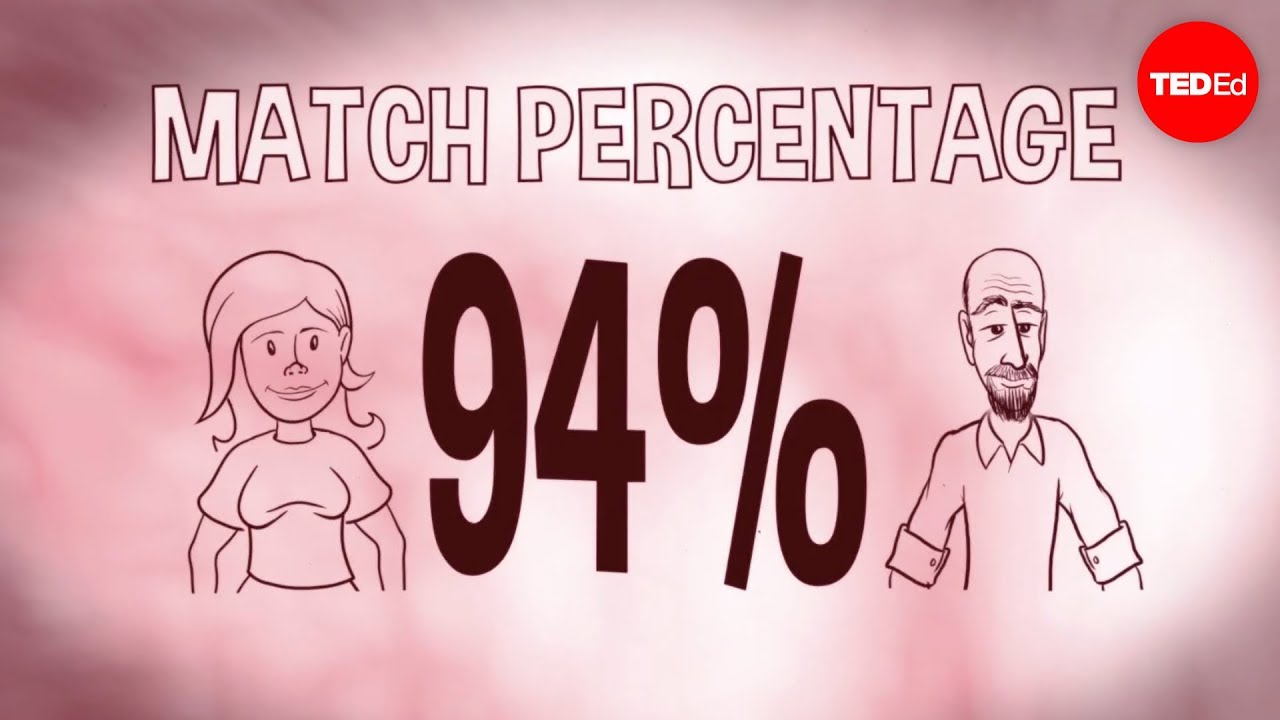
When two people join a dating website, they are matched according to shared interests and how they answer a number of personal questions. But how do sites calculate the likelihood of a successful relationship? Christian Rudder, one of the founders of popular dating site OKCupid, details the algorithm behind 'hitting it off.'
OkCupid’s Unblushing Analyst of Attraction (Published 2014)
Christian Rudder, president of the online dating service OkCupid, says websites like his should conduct more research, not less, on users’ habits.

Disintermediating your friends: How online dating in the United States displaces other ways of meeting
We present data from a nationally representative 2017 survey of American adults. For heterosexual couples in the United States, meeting online has become the most popular way couples meet, eclipsing meeting through friends for the first time around 2013. Moreover, among the couples who meet online, the proportion who have met through the mediation of third persons has declined over time. We find that Internet meeting is displacing the roles that family and friends once played in bringing couples together.

These Charts Show The Massive Role Race Plays In Online Dating
Race plays a large role when it comes to online dating, affecting the likelihood of response or reaching out across the board.


The sexy AI-powered dating app scams are here
Thousands of people have been catfished by scammers supercharged with AI.

The Weirdness of Dating/Mating: Deep Nonconsent Preference — LessWrong
Every time I see someone mention statistics on nonconsent kink online, someone else is surprised by how common it is. So let’s start with some statis…

What really happens inside a dating app
I have been working inside a dating app for a few months and there are a lot of interesting things. This article is going to be without any structure as there are many things to say. I will mostly ignore homosexual interactions. Not because they don't exist, just because it …

Models for Trust Inference in Social Networks
Interpersonal trust between any two people in social networks is hard to gauge, and even harder to infer, given that these two people are not connected by an immediate social link, such as friendship or acquaintanceship. In order to be able to make accurate inferences for an arbitrary tuple of people in a given social environment, we present an approach, named Appleseed, that is based on mechanics taken from neuropsychology, known as spreading activation models. Compelling in its simplicity, we relate the concept to trust propagation and evaluation in an intuitive fashion. While Appleseed works very well when paths between two arbitrary people in the network can be established, no inference of trust is possible when this is not the case. To this end, we present several algorithms for inferring trust that go beyond network structure and demonstrate their accuracy in real social networks. We also show how these algorithms can be augmented with additional data that may be available in some contexts.

An Experimental New Dating Site Matches Singles Based on Their Browser Histories - Slashdot
A dating site launched last week by Belgian artist Dries Depoorter matches potential partners based on their internet browsing histories rather than curated profiles or photos. Browser Dating requires users to download a Chrome or Firefox extension that exports and uploads their recent search data, ...

Not My Type | Stanford University Press
In the world of online dating, race-based discrimination is not only tolerated, but encouraged as part of a pervasive belief that it is simply a neutral, personal choice about one's romantic partner. Indeed, it is so much a part of our inherited wisdom about dating and romance that it actually directs the algorithmic infrastructures of most major online dating platforms, such that they openly reproduce racist and sexist hierarchies.

New psychology research shows how your mindset can alter the way you perceive prospective romantic partners
A successful pursuit of mating partners depends on targeting potential partners who are not only perceived as desirable, but also as partners who will

siwek (@siwek@social.tooinconsistent.com)
@_elena@mastodon.social It seems they are calculating "engagement" which I'm assuming is likes + reposts + comments and then show it as number of comments.
Polymarket on Twitter / X
JUST IN: AI dating startup Ditto reveals 160,000+ students have signed up for its app that automatically picks their match & sends them a fully planned date itinerary.— Polymarket (@Polymarket) August 22, 2026
My Brief OkCupid Affair With a World Champion Magic: The Gathering Player
This story sounds mean. It's about a girl judging a boy because he's a nerd (like so many of us!) that she met on OkCupid. But that's the point: Judging

Bridgy
Connects your web site to social media. Likes, reposts, mentions, cross-posting, and more...