

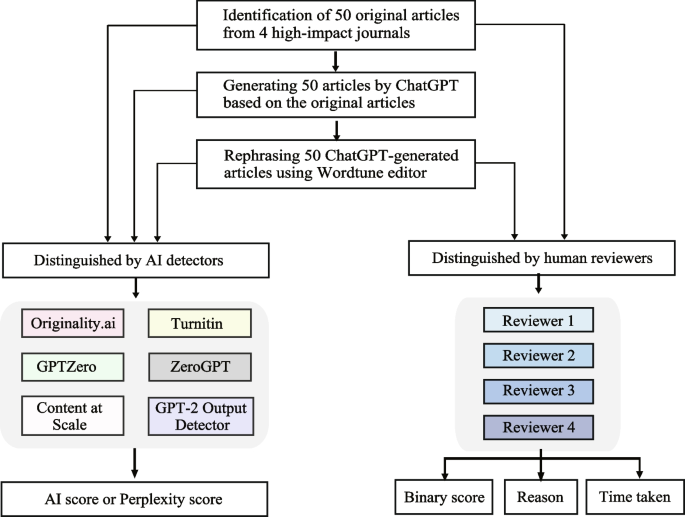
The application of artificial intelligence (AI) in academic writing has raised concerns regarding accuracy, ethics, and scientific rigour. Some AI content detectors may not accurately identify AI-generated texts, especially those that have undergone paraphrasing. Therefore, there is a pressing need for efficacious approaches or guidelines to govern AI usage in specific disciplines.
On the use of AI in our newsroom — The European Correspondent
Journalists may use artificial intelligence where it handles mechanical work to let journalists focus on creative aspects. This entails: transcription, spelling checks, translation with human review, data analysis, quick research prompts, structuring raw thoughts.

AI Use in The Scholarly Kitchen - The Scholarly Kitchen
Some thoughts on the reader response the Scholarly Kitchen has seen regarding AI use by authors, a recent Nature News article on the efficacy of AI detection tools, and why it's important to keep experimenting to figure out what's ethically acceptable.

God Damn AI is making me dumb
It's so god damn tempting to use AI to write. Whether it is articles, code, or documents. I feel like using AI is diminishing my ability to write myself. ...

People who frequently use ChatGPT for writing tasks are accurate and robust detectors of AI-generated text
In this paper, we study how well humans can detect text generated by commercial LLMs (GPT-4o, Claude, o1). We hire annotators to read 300 non-fiction English articles, label them as either human-written or AI-generated, and provide paragraph-length explanations for their decisions. Our experiments show that annotators who frequently use LLMs for writing tasks excel at detecting AI-generated text, even without any specialized training or feedback. In fact, the majority vote among five such “expert” annotators misclassifies only 1 of 300 articles, significantly outperforming most commercial and open-source detectors we evaluated even in the presence of evasion tactics like paraphrasing and humanization. Qualitative analysis of the experts' free-form explanations shows that while they rely heavily on specific lexical clues (`AI vocabulary'), they also pick up on more complex phenomena within the text (e.g., formality, originality, clarity) that are challenging to assess for automatic detectors. We release our annotated dataset and code to spur future research into both human and automated detection of AI-generated text.
People who frequently use ChatGPT for writing tasks are accurate and robust detectors of AI-generated text
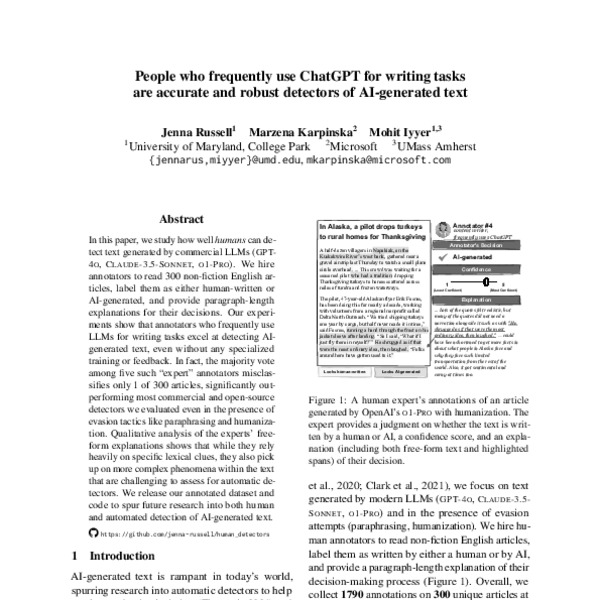
In this paper, we study how well humans can detect text generated by commercial LLMs (GPT-4o, Claude, o1). We hire annotators to read 300 non-fiction English articles, label them as either human-written or AI-generated, and provide paragraph-length explanations for their decisions. Our experiments show that annotators who frequently use LLMs for writing tasks excel at detecting AI-generated text, even without any specialized training or feedback. In fact, the majority vote among five such “expert” annotators misclassifies only 1 of 300 articles, significantly outperforming most commercial and open-source detectors we evaluated even in the presence of evasion tactics like paraphrasing and humanization. Qualitative analysis of the experts' free-form explanations shows that while they rely heavily on specific lexical clues (`AI vocabulary'), they also pick up on more complex phenomena within the text (e.g., formality, originality, clarity) that are challenging to assess for automatic detectors. We release our annotated dataset and code to spur future research into both human and automated detection of AI-generated text.
How easy is it to spot AI writing?
With AI writing becoming increasingly commonplace, how can we spot it and what difference does it make?

Company Offering ‘100% Human-Written, Never AI’ Medical Research Is Entirely AI
Research Gold's team of human methodologists are either AI generated or using the identity of real people without their permission

Company Offering ‘100% Human-Written, Never AI’ Medical Research Is Entirely AI
Research Gold's team of human methodologists are either AI generated or using the identity of real people without their permission
StoryScope: Investigating idiosyncrasies in AI fiction
As AI-generated fiction becomes increasingly prevalent, questions of authorship and originality are becoming central to how written work is evaluated. While most existing work in this space...

The only reason you’ll ever need not to write with AI — The Carlson Lab
Over the last year, our lab has been developing a policy on AI use. To do this, we did three main things: We read a lot of academic publications and tech news. We set up an #ai channel on our lab Slack to share news, experiences, and memes. We had several long and grueling lab meetings talk

Can AI Detectors Be Trusted?
Society has always trusted editors, teachers, peer reviewers, and readers to set acceptable standards for writing. In the past, the biggest challenge was detecting plagiarism and cracking down on other forms of cheating. Now, AI detectors are rewriting the script: they assign a score based on the likelihood that the text was created by a human or a large language model (LLM).

The artificial intelligence disclosure penalty: Humans persistently devalue AI-generated creative writing.
How do authors want to use AI for review?
A survey of researchers who compared AI-generated scientific reviews with journal-agnostic human peer review reveals that they overwhelmingly prefer using AI as a self-checking tool before submission rather than as a replacement for human reviewers. It encourages an “author-centric” model in which AI helps researchers improve their manuscripts before they are reviewed by their peers.

Illicit Use of AI by Philosophers Refereeing for Journals - Daily Nous
In 2024, a study found that “7–17% of the sentences in the reviews [of computer science manuscripts] were written by LLMs”. It was only a […]
