


This was originally titled “I miss when computers were fun”. But in the course of writing it, I discovered that there is a reason computers became less fun, a dark thread woven through a number of events in recent history. Let me back up a bit.
triumph of the nerds
Computer: A History of the Information Machine
Computer: A History of the Information Machine is a history of computing written by Martin Campbell-Kelly and William Aspray first published in 1996. It follows the history of "information machines" from Charles Babbage's difference engine through Herman Hollerith's tabulating machines to the invention of the modern electronic digital computer. A revised 2nd edition published in 2004 included new material on the Internet and World Wide Web, while the updated 3rd edition published in 2013 includes contributions from historians Nathan Ensmenger and Jeffrey Yost. The 3rd edition extends the story to include recent phenomena such as social networking and revises the discussion of early history to reflect new insights from the literature.

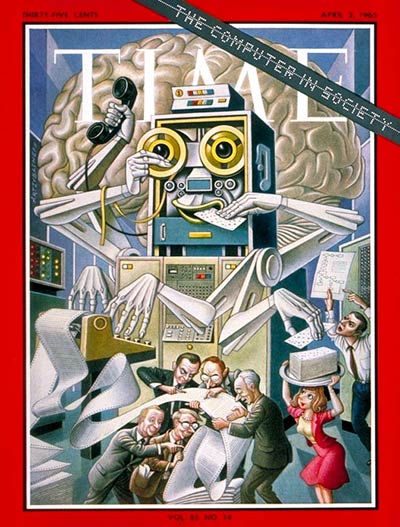
TIME Magazine Cover: Computer in Society - Apr. 2, 1965
TIME Magazine Cover: Computer in Society
Hackers: Heroes of the Computer Revolution
A mere fifteen years ago, computer nerds were seen as m…

The International Research Conference in the History of Computing at Los Alamos, 1976
When the Internet Was a Place - Front Porch Republic
Not too long ago, the internet was a place you visited. The family desktop sat in its designated closet or back office. In schools, there were rooms filled with computers blinking in tandem, waiting for your class to arrive and hop online. You had to purposefully arrive at the internet, and when done, you left […]

Feeling of Computing
Feeling of Computing is an online community with a welcoming, cooperative, and revolutionary spirit. We are unified in the belief that the computer is tragically less humane than it could be. There’s a world of possibilities that get more beautiful the further away from the norm you go. We’re here to explore this world together, to discuss ideas about theory and practice, and to champion and support our members’ research and development efforts to reimagine the computer.
IBM's "Man & Computer" (1967)

AI Slop and the End of Knowledge
As an early fan of the internet, I was amazed that all the knowledge of the world was becoming available to everyone, everywhere, all the time. But things have changed.

The Curse of Xanadu
It was the most radical computer dream of the hacker era. Ted Nelson's Xanadu project was supposed to be the universal, democratic hypertext library that would help human life evolve into an entirely new form.
The Social Meaning of the Personal Computer: Or, Why the Personal Computer Revolution Was No Revolution
This essay presents a processual model of the personal computing movement that depicts the PC's birth within the context of complex and often contradictory social strategies, each of which used the meaning of computer technology in a distinctive way. It suggests that innovators are constrained by such processes to depict new artifacts in culturally meaningful ways, so that it is difficult for them to conceive of their technologies in radical terms. The rhetoric of "revolution" aside, innovators found it expedient to draw from the stock of meanings at hand as they created new meaning-frameworks for their artifacts. The result is that the new artifacts did not express a coherent or effective political vision and failed to have the intended social effects. This study implies that new technologies frequently reproduce existing social and meaning systems; if they do bring about social change, the changes may differ from those intended by the innovators.
