

eLife works to improve research communication through open science and open technology innovation
eLife Pathways home page
Moving beyond legacy publishing requires interoperable open-source infrastructure. With Wellcome’s support, we are evolving eLife’s technology to anchor a collaborative network, partnering with the open science community to reshape the communication and assessment of global research.
eLife receives Wellcome boost to build open publishing ecosystem
The new investment will back development of collaborative publishing tools and services for the benefit of the global scholarly community.
What is open communication?
Open source collaboration requires open communication, they say. Just what is open communication, exactly? Drawing on past research [1], here are the four principles that make communication open. O…

Center for Open Science
At the Center for Open Science, our mission is to increase openness, integrity, and reproducibility of scholarly research. Promoting these practices within the research funding and publishing communities accelerates scientific progress

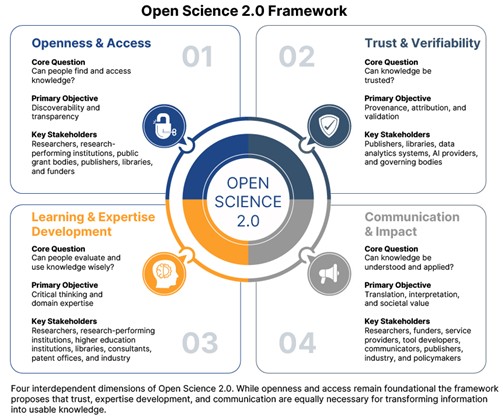
Open Science 2.0: Building Understanding in an AI-Mediated World - The Scholarly Kitchen
Open Science 2.0 must focus not only on access, but also on trust, interpretation, learning, and effective communication. The challenge facing the scholarly publishing ecosystem is ensuring that what is open is also trustworthy, understandable, and genuinely useful.
Open Science Network
Reclaim scientific discourse with federated digital spaces where researchers shape their own conversations, data, and collaborations

eLife Pathways Joins CAIROS
eLife Pathways is joining the CAIROS network, a cooperative federation dedicated to building open and sustainable research commons.
Reframing “Open Source AI” with Meredith Whittaker: AI Impact Summit 2026

On open-science research labs on discord and online , and getting more people.
Introducing the Open Exchange Architecture
Scientific communication still privileges narrative over utility, while the data, code, protocols, and computation that underpin modern research are pushed into hard-to-access supplements. Rowan Cockett introduces the Open Exchange Architecture (OXA), an emerging, community-driven standard designed to unbundle research from its paper-shaped container and expose the rich evidence underneath it.
Elicit: AI for scientific research
Use AI to search, summarize, extract data from, and chat with over 125 million papers. Used by over 2 million researchers in academia and industry.
Frontiers In Research webinar on changes in science communication, the role of social media, and new infrastructure/tools - tomorrow (7/18) at 2 pm ET Looking forward to chatting with @ronentk.me & @joelchan86.bsky.social luma.com/7l18yyg4

Frontiers In Research: Open Science · Zoom · Luma
luma.com@scios.tech is an exciting initiative at the intersection of open science and open source. Welcome to the Atmosphere! 👋

scios.tech

