


elle's hypertext stuff
Amelia Wattenberger 🪷 on Twitter / X
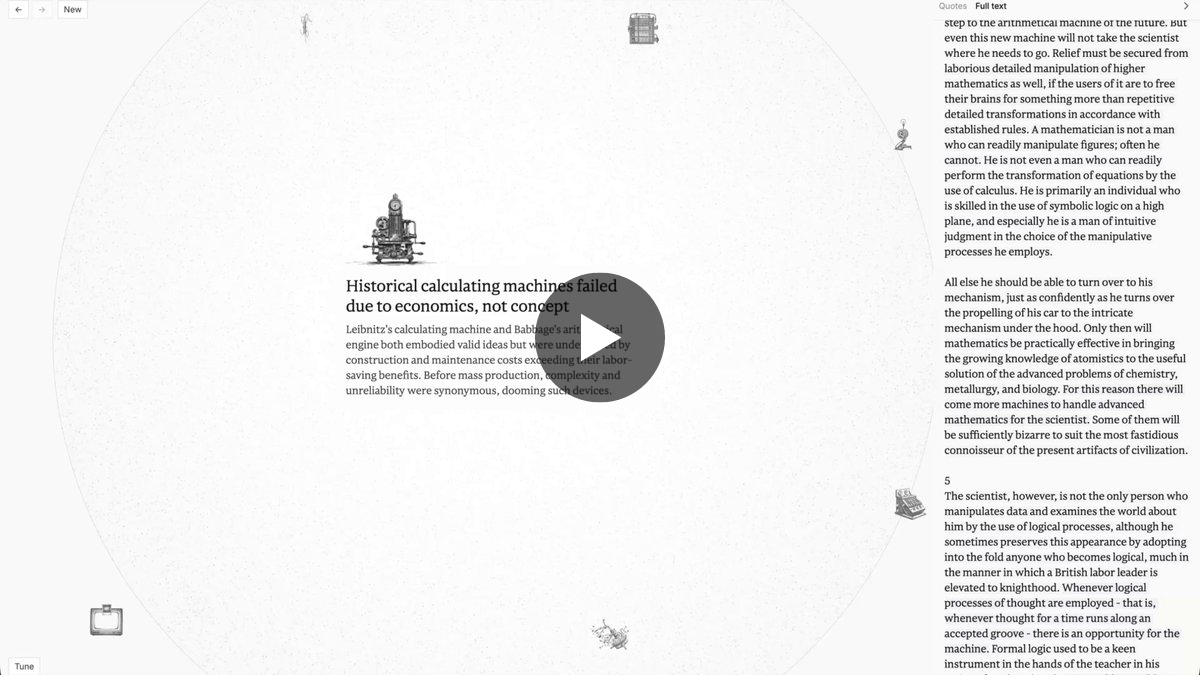
exploring ways we can "step back" from text/code and make sense of it,the way do in maps or how we can "fit more" in our visual system, it just gets smaller and decreases resolution.here's a fun one: extract the main concepts and throw them on a sphere, keep spinning to go… pic.twitter.com/yzh42EcBTe— Amelia Wattenberger 🪷 (@Wattenberger) July 6, 2026
Nadia Eghbal, Re: Writing Hypertext
My digichat with @nayafia---an essential writer (*imho*) of texts, notes and wonderful roundups.

No Longer No Sense of an Ending
This is my first feature piece on Contents Magazine, about harnessing the properties of hypertext and the Web for superior reader experiences and business results.

homepages.news — News Homepages documentation
An open-source archive that gathers, saves, shares and analyzes news homepages

The Subversive Hyperlink
Writing about the big beautiful mess that is making things for the world wide web.
localghost
Sophie builds fun things out of HTML, CSS & JavaScript, and writes blog posts about tech and mental health.

A Text Renaissance
There is a renaissance underway in online text as a medium. The Four Horsemen of this emerging Textopia are: Roam , a hypertext publishing platform best…

A new app, HyperTexting, turns the open web into a scrollable social media-like feed | TechCrunch
HyperTexting's new app aims to make the open web feel more like social media by turning websites, blogs, newsletters, and podcasts into a scrollable feed, while also making it easier to post to your own website.

A new app, HyperTexting, turns the open web into a scrollable social media-like feed | TechCrunch
HyperTexting's new app aims to make the open web feel more like social media by turning websites, blogs, newsletters, and podcasts into a scrollable feed, while also making it easier to post to your own website.

What the ephemerality of the Web means for your hyperlinks
Hyperlinks are a powerful tool for journalists and their readers. Diving deep into the context of an article is just a click away. But hyperlinks are a double-edged sword; for all of the internet’s boundlessness, what’s found on the Web can also be modified, moved, or entirely vanished. The fragility of the Web poses an […]


Erin Kissane's small internet website
The latest entries posted on Erin Kissane's small internet website
social hypertext

http gave us hypertext. atproto gives us social hypertext.
A new app, HyperTexting, turns the open web into a scrollable social media-like feed | TechCrunch

marking off AI slop / seo spam pages experimenting with collective action on the whole internet
HTTP gave us hypertext, atproto gives us "social hypertext"

Building on some of @chrisshank.com's work, what if we had browsers that were atproto-native? orange link = in your PDS green link = in the…