


The millenarianism and manifest destiny of AI and techno-futurism.
Making God · EmilyGorcenski.com
The millenarianism and manifest destiny of AI and techno-futurism.
AI as Christian Heresy
A pocket history of the rise of artificial intelligence, and some strategies for resistance.

Negative Capabilities: Investigating Apophasis in AI Text-to-Image Models
Through a case study of images generated by Swedish artist Steph Maj Swanson using an AI text-to-image (T2I) model, this article explores the strategy of negative weight prompting in T2I models as a phenomenon of apophasis. Apophasis is a linguistic strategy commonly deployed in texts of mystical theology to express the ineffability of God through negative concepts. In this article, a comparison of apophatic strategies in mystical texts and T2I models is engaged to highlight the mutual benefit of theorising AI with the help of religious theory and concepts. With this, the article builds on previous work on the New Visibility of Religion, enchantment, and post-secularism—especially the research of Beth Singler on religious continuities in representations of AI. Recent work on AI prompt engineering, computational linguistics, and computational geometry is invoked to explain the linguistic processes of T2I models. Poststructuralist semiotics is then employed to theorise the search for the Transcendental Signified in apophatic theology. The article concludes that linguistic theology can help to elucidate technological use cases, subsequently arguing for further dialogue between scholars in artificial intelligence and religious studies, and for a revaluation of religion in the technological sphere.

Secularization Comes for the Religion of Technology: Or, how to make sense of techno-optimist manifestos, the Open Ai/Altman affair, EA/e-acc movements, and the general sense of cultural stagnation
The Convivial Society: Vol. 5, No. 3

Belief, Values, Bias, and Agency: Development of and Entanglement with "Artificial Intelligence"
Contemporary research into the values, bias, and prejudices within "Artificial Intelligence" tends to operate in a crux of scholarship in computer science and engineering, sociology, philosophy, and science and technology studies (STS). Even so, getting the STEM fields to recognize and accept the importance of certain kinds of knowledge— the social, experiential kinds of knowledge— remains an ongoing struggle. Similarly, religious scholarship is still very often missing from these conversations because many in the STEM fields and the general public feel that religion and technoscientific investigations are and should be separate fields of inquiry. Here I demonstrate that experiential knowledge and religious, even occult beliefs are always already embedded within and crucial to understanding the sociotechnical imaginaries animating many technologies, particularly in the areas of "AI." In fact, it is precisely the unwillingness of many to confront these facts which allow for both the problems of prejudice embedded in algorithmic systems, and for the hype-laden marketing of the corporations and agencies developing them. This same hype then intentionally obfuscates the actions of both the systems and the people who create them, while confounding and oppressing those most often made subject to them. Further, I highlight a crucial continuity between bigotry and systemic social projects (eugenics, transhumanism, and "supercrip" narratives), revealing their foundation in white supremacist colonialist myths of whose and which kinds of lives count as "truly human." We will examine how these myths become embedded into the religious practices, technologies, and social frameworks in and out of which "AI" and algorithms are developed, employing a composite theoretical lens made from tools such as intersectionality, ritual theory, intersubjectivity, daemonology, postphenomenology, standpoint epistemology, and more. This theoretical apparatus recontextualizes our understanding of how mythologies and rituals of professionalization, disciplinarity, and dominant epistemological hierarchies animate concepts such as knowledge formation, expertise, and even what counts as knowledge. This recontextualization is then deployed to suggest remedies for research, public policy, and general paths forward in "AI." By engaging in both the magico-religious valences and the lived experiential expertise of marginalized people, these systems can be better understood, and their harms anticipated and curtailed.
Can Religions Be Reborn? | Over The Mountains to Civilizational Renewal #9
Silicon Valley's New Religion: Peter Thiel's Tech Apocalypse
A strange essay reveals how Silicon Valley elites are creating an apocalyptic techno-religion to rule the future of civilization
The Same Old Fantasies Behind AI and New Technology
A review of Adam Becker, “More Everything Forever: AI Overlords, Space Empires, and Silicon Valley’s Crusade to Control the Fate of Humanity” (Basic Books, 2025).

The Age of Wonders and Terrors
Twenty years ago, when the idea of AI taking over the world in our lifetimes still struck most of us as the unconstrained fantasy of those who knew too much science fiction and too little science, …

In Tech We Trust - Second Renaissance
The god-like authority of technology in the modern age – and what it means to set a wiser course

Machine god metaphors eat your brain
There are other ways of thinking about AI
AI Priests & Occultism
It's all fun and games until you reinvent Himmler's Wewelsburg.
The guru of the AI apocalypse
Eliezer Yudkowsky is confusing a very human obsession with death and a very modern fear of a techno-deity
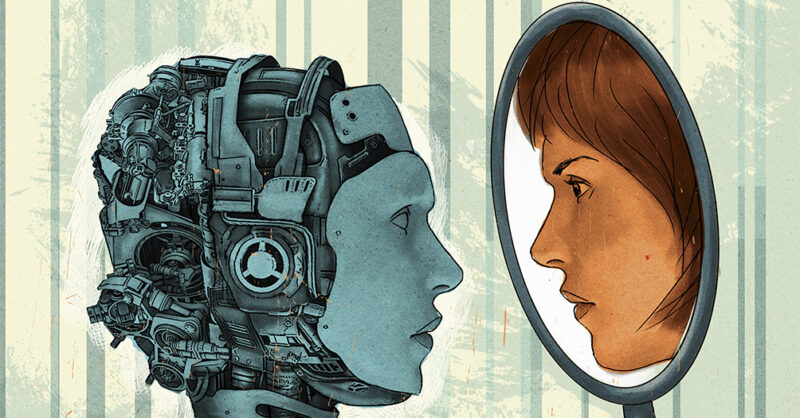
Import AI 462: Superpersuasion; self-sustaining AI; paths to ASI
How religious are beliefs in the singularity?

The Ascendancy of the Scientific Dictatorship: An Examination of Epistemic Autocracy, from the 19th to the 21st Century
A. In the past, the elite manipulated the population through a more mystical belief system. In particular, there was the institution of Sun worship (typified by deities such as Osiris and Set). However, as antiquity gave way to modern history, this system of control began to lose its effectiveness. During the sixteenth century, the ruling class managed to co-opt a relatively new methodology of truth discernment...science. Over the years, they would contaminate this institution with their own virulent strains of thought...metaphysical naturalism, radical empiricism, Malthusianism, Darwinism, behaviorism, radical environmentalism, etc. Many of these paradigms were derivative of their own occult doctrines, thinly veiled to appear as objective science. All of these concepts correlate in some way and, at some point, coalesce. Together, they are gradually paving the way for the re-introduction of the hidden god of the Ancient Mysteries.