

In his final years, already heavily plagued by mental decline, Nietzsche began to believe that he was in fact Polish, not German, and was quoted as saying, "I am a pure-blooded Polish nobleman, without a single drop of bad blood, certainly not German blood".[20][21] In defiance of nationalist doctrines, he claimed that he and Germany were great only because of "Polish blood in their veins",[22] and that he would "[have] all anti-semites shot." Nietzsche died long before Hitler's reign, and it was partly Nietzsche's sister Elisabeth Förster-Nietzsche who manipulated her brother's words to accommodate the worldview of herself and her husband, Bernhard Förster, a prominent German nationalist and antisemite.[23] Förster founded the Deutscher Volksverein (German People's League) in 1881 with Max Liebermann von Sonnenberg.[24]
Übermensch | Social Sciences and Humanities | Research Starters | EBSCO Research
<p>The concept of "Übermensch," introduced by German philosopher Friedrich Nietzsche in his 1880s work "Thus Spoke Zarathustra," describes an evolved form of humanity that transcends conventional human limitations and societal norms, particularly those imposed by religious structures. Translated as "overman" or "superman," the term represents an ideal that Nietzsche believed humanity should strive toward, emphasizing self-overcoming and the rejection of outdated moral frameworks. The Übermensch is often illustrated through metaphorical transformations, such as that of a camel, which bears the weight of traditional values, into a lion, which challenges those values, and ultimately into a child, symbolizing new beginnings and creativity.</p> <p>Interpretations of the Übermensch vary significantly—some view it as a physical evolution, while others see it as a mental or philosophical transformation. The concept has also been misappropriated in modern contexts; notably, the Nazis distorted Nietzsche’s ideas to justify their racial superiority agenda, despite Nietzsche himself being a critic of nationalism and anti-Semitism. The ambiguity in translation and interpretation has led to ongoing debates about the true meaning and implications of Nietzsche's Übermensch, with scholars exploring its relevance in discussions of personal autonomy, artistic freedom, and the potential for human evolution.</p>

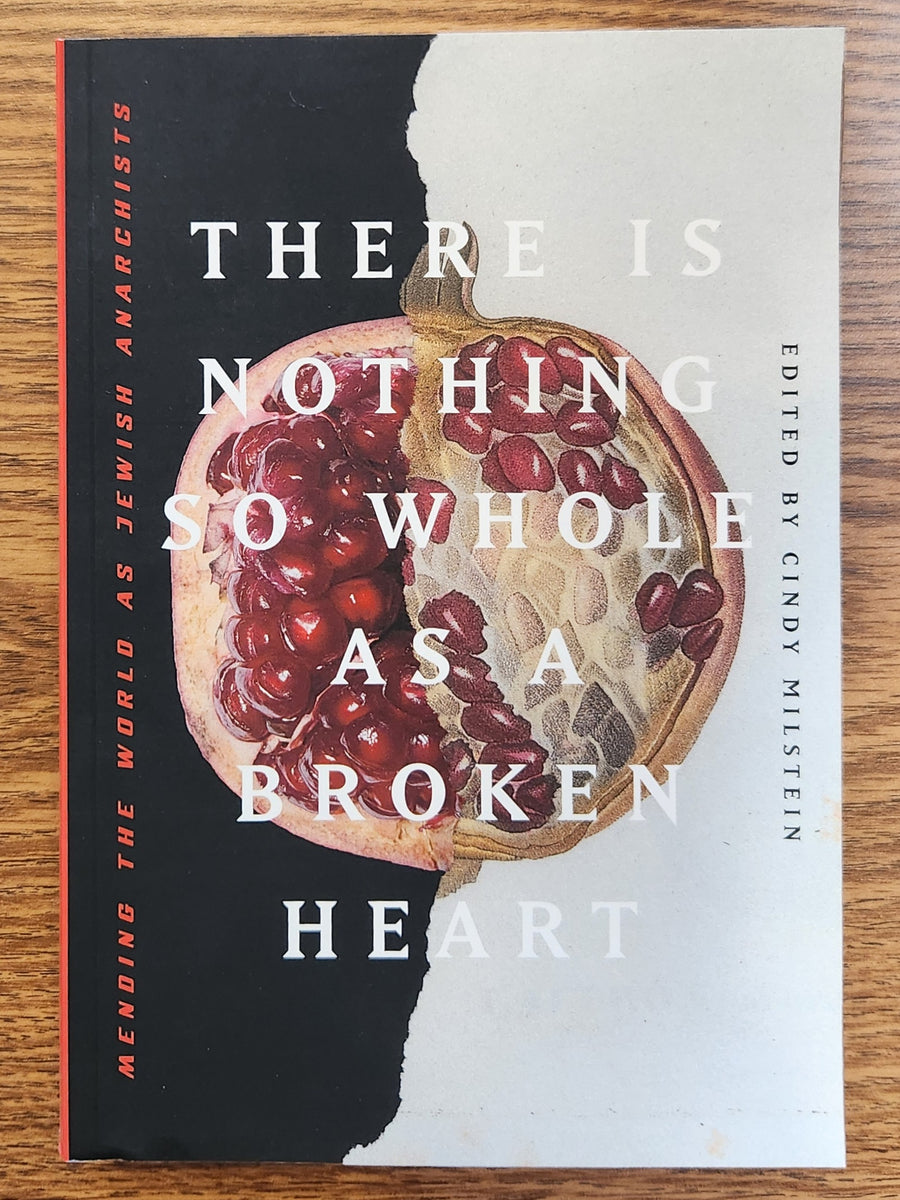
There Is Nothing So Whole as a Broken Heart
By Cindy Milstein Published by AK Press, 2021 392 pages, paperback The contemporary renewal of Jewish anarchism draws on a history of enslavement, displacement, white supremacy, and genocide as well as ancestral resistance, strength, imagination, and humor—wisdom that is sorely needed today. Through stories at once poetic and poignant, There Is Nothing So Whole as a Broken Heart offers a powerful elixir for all who rebel against systemic violence and injustice. The contemporary renewal of Jewish anarchism draws on a history of suffering, ranging from enslavement and displacement to white nationalism and genocide. Yet it also pulls from ancestral resistance, strength, imagination, and humor—all qualities, and wisdom, sorely needed today. These essays, many written from feminist and queer perspectives, journey into past and contemporary trauma in ways that are humanizing and healing. They build bridges from bittersweet grief to rebellion and joy. And via concrete illustrations of how Jewish anarchists lovingly transform their own ritual, cultural, and political practices, they clearly illuminate the path toward mending ourselves and the world. Praise for There Is Nothing So Whole as a Broken Heart... "There Is Nothing So Whole as a Broken Heart is a breathtaking kaddish to everyone living the revolutionary vision that Jewish radicals dreamed was possible. It drives to the heart of a tradition that we must rediscover, a story that is simultaneously particular and universal: we can survive if we do it together." —Shane Burley, author of Why We Fight: Essays on Fascism, Resistance, and Surviving the Apocalypse "In this moment of resurgent fascism and authoritarianism, the foundational relationship between antisemitism and anti-Blackness is more stark and apparent than ever. The vibrancy of this collection articulates not only a foundation for solidarity in shared struggles against white supremacy but also the vast imaginaries and world-making potential in the diversity of Jewish cultural expression and radical—specifically anarchist—thought. As a Black anarchist, I could not be more grateful for the generosity, vulnerabilities, and fierce, unwavering love for humanity shared within these pages." —Zoé Samudzi, coauthor of As Black as Resistance: Finding the Conditions for Liberation “The texts collected here are striking in their literary richness and emotional openness, awakening both pain and solace, insights and further questions . . . A highly rewarding reading experience that will appeal well beyond the Jewishanarchist intersection.” —Uri Gordon, co-editor of The Routledge Handbook of Radical Politics "There Is Nothing So Whole as a Broken Heart offers an ardent new archive of Jewish anarchism. These voices expand a defiant tradition: they speak of the disruptiveness of care, the labor of grief, and the pleasures of survival. As fascism and antisemitism rise, these poets, rabbis, and organizers urgently reach for another world through this one." —AE Torres, author of Horizons Blossom, Borders Vanish: Anarchism and Yiddish Literature "This book asks how modern generations of Jewish anarchists are wrestling with rising fascism, white supremacy, and antisemitism, and lifts up the specific cultural tools we bring to the work of mending (or maybe reimagining) the ever-shattering world. Today the book is a mirror; tomorrow, a new window into the archive of Jewish anarchists throughout history." —Ezra Berkley Nepon, author of Justice, Justice Shall You Pursue: A History of New Jewish Agenda "As leftist Jewish thought and organizing today witnesses a resurgence, this collection provides an important document of its anarchist current." —Treyf Podcast “A poem and a love note, a prayer song and a protest, an attempt to mend a burning world with the best of Jewish, anarchist, and Jewish anarchist traditions.” —Dan Berger, author of Captive Nation: Black Prison Organizing in the Civil Rights Era "There is Nothing So Whole as a Broken Heart is a powerful celebration of ritual—both Jewish and anarchist."—Gabriel Moshenska for Jewish Socialist
The weird time Nazis made common cause with black nationalists
The black nationalist Nation of Islam and the American Nazi Party didn't have a lot in common, but they did believe in staying as far away from each other's race as…

Israel: What Went Wrong?
A leading Israeli American scholar of the Holocaust explores and explains his native country's intensifying turn toward violence and exclusion.The distinguished historian Omer Bartov was born on a kibbutz, grew up in Tel Aviv, and served in the Israel Defense Forces during the Yom Kippur War. He went on to become a leading scholar of the German army and the Holocaust, before turning his attention to his native country.In Israel: What Went Wrong?, Bartov sketches the tragic transformation of Zionism, a movement that sought to emancipate European Jewry from oppression, into a state ideology of ethno-nationalism. How is it possible, he asks, that a state founded in the immediate aftermath of the Holocaust, an event that gave legitimacy to a national home for the Jews, stands credibly accused of perpetrating large-scale war crimes? How do we come to terms with the fact that Israel’s war of destruction is being conducted with the support, laced with denial and indifference, of so many of its Jewish citizens?Tracing the roots of the violent events currently unfolding in Israel and the occupied territories, Bartov tracks his country's moral tribulations and considers the origins of Zionism, the intertwining of Israel’s independence with Palestinian displacement, the politics of the Holocaust, controversies over the term "genocide," and the uncertain future. The result is a searing and urgent critique that addresses today’s debates over Zionism and the future of Israel with rigor and depth.
The Authoritarian Personality
This hugely influential study on the psychology of authoritarianism was written in answer to Hitler’s Germany—and now rings more relevant than ever as fascism and anti-Semitism sweep across America.What makes a fascist? Are there character traits that make someone more likely to vote for the far right? The Authoritarian Personality is not only one of the most significant works of social psychology ever written, it also marks a milestone in the development of Adorno’s thought, showing him grappling with the problem of fascism and the reasons for Europe’s turn to reaction. Over half a century later, and with the rise of right-wing populism and the reemergence of the far-right in recent years, this hugely influential study remains as insightful and relevant as ever.This new edition includes an introduction by Frankfurt School scholar Peter E. Gordon and contains the first-ever publication of Adorno’s subsequent critical notes on the project.“Adorno and his colleagues could easily have been describing Alex Jones’s paranoid InfoWars rants or the racist views expressed by many Trump supporters.” —New York Times
Katalog der Deutschen Nationalbibliothek
Paul Feyerabend
Paul Feyerabend (b.1924, d.1994), having studied science at theUniversity of Vienna, moved into philosophy for his doctoral thesis,made a name for himself both as an expositor and (later) as a critic ofKarl Popper's “critical rationalism”, and went on to becomeone of the twentieth century's most famous philosophers of science. Animaginative maverick, he became a critic of philosophy of scienceitself, particularly of “rationalist” attempts to lay downor discover rules of scientific method.


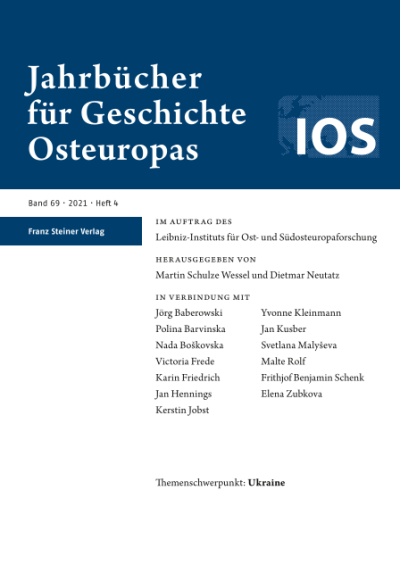
Sollte der Krieg Russlands gegen die Ukraine die Epistemologie der Osteuropäischen Geschichte verändern und wenn ja, wie?
The short article argues for revitalizing historical research to questions of the longue durée and, in analogy to the New Imperial History, considers the emergence of a New National History possible. Above all, the article calls for a continued decolonialisation of Russian history and, in this context, also for a strengthening of the Ukraine and Belarus focus in research, teaching and language mediation as well as in the form of a German Historical Institute in Kyiv.
Epstein and the Capitalist Conspiracy
Naomi Klein discusses what to do with a narrative that mirrors the worst anti-Jewish theories and the importance of holding our depraved elites…

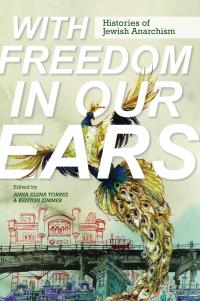
With Freedom in Our Ears
Contributors bring to light the presence and persistence of Jewish anarchism throughout histories of radical labor, women's studies, political theory, multilingual literature, and ethnic studies.
In Medias Res: Peter Sloterdijk's Spherological Poetics of Being | JSTOR
In recent years, Peter Sloterdijk has become one of Germany's most influential thinkers. His diverse body of work includes a Heideggerian project to think…
The Real Stakes, and Real Story, of Peter Thiel’s Antichrist Obsession
Thirty years ago, a peace-loving Austrian theologian spoke to Peter Thiel about the apocalyptic theories of Nazi jurist Carl Schmitt. They’ve been a road map for the billionaire ever since.

The great German polymath Johann Wolfgang von Goethe was born #onthisday in 1749. As well as penning novels, poetry, criticism, and dramas, he also wrote various scientific treatises, including his 1810 book Zur Farbenlehre (Theory of Colours): publicdomainreview.org/essay/black-on-black #OTD
The great German polymath Johann Wolfgang von Goethe was born #onthisday in 1749. As well as penning novels, poetry, criticism, and dramas, he also wrote various scientific treatises, including his 1810 book Zur Farbenlehre (Theory of Colours): publicdomainreview.org/essay/black-on-black #OTD
