


"A Mathematical Theory of Communication" is an article by mathematician Claude Shannon published in Bell System Technical Journal in 1948. It was renamed The Mathematical Theory of Communication in the 1949 book of the same name, a small but significant title change after realizing the generality of this work. It has tens of thousands of citations, being one of the most influential and cited scientific papers of all time, as it gave rise to the field of information theory, with Scientific American referring to the paper as the "Magna Carta of the Information Age", while the electrical engineer Robert G. Gallager called the paper a "blueprint for the digital era". Historian James Gleick rated the paper as the most important development of 1948, placing the transistor second in the same time period, with Gleick emphasizing that the paper by Shannon was "even more profound and more fundamental" than the transistor.
Computer: A History of the Information Machine
Computer: A History of the Information Machine is a history of computing written by Martin Campbell-Kelly and William Aspray first published in 1996. It follows the history of "information machines" from Charles Babbage's difference engine through Herman Hollerith's tabulating machines to the invention of the modern electronic digital computer. A revised 2nd edition published in 2004 included new material on the Internet and World Wide Web, while the updated 3rd edition published in 2013 includes contributions from historians Nathan Ensmenger and Jeffrey Yost. The 3rd edition extends the story to include recent phenomena such as social networking and revises the discussion of early history to reflect new insights from the literature.

The Mythos of the Electronic Revolution
JAMES W. CAREY, JOHN J. QUIRK, The Mythos of the Electronic Revolution, The American Scholar, Vol. 39, No. 2 (Spring, 1970), pp. 219-241
The Mythos of the Electronic Revolution
JAMES W. CAREY, JOHN J. QUIRK, The Mythos of the Electronic Revolution, The American Scholar, Vol. 39, No. 3 (Summer, 1970), pp. 395-424
You and Your Research
Transcription of the Bell Communications Research Colloquium Seminar 7 March 1986
When did Computer Science Theory Get so Hard?
I posted on When did Math get so hard? a commenter pointed out that one can also ask When did Computer Science Theory Get so Hard? For t...
Tony Feng on Twitter / X
I am a mathematician but I avoided commenting on this because the problems are (far) outside my domain. Even if I sat down to read the technical details (which I have not), it would be hard to appreciate the context of prior work, etc. But I've gotten enough sense of things… https://t.co/VZzosBYFto— Tony Feng (@tonylfeng) August 5, 2026
The Nature of Technology: What It Is and How It Evolves
Leading scientific theorist W. Brian Arthur puts forth …

Theory Beyond Theorems and Proofs: A Guest Post
Scott’s foreword: I’m extremely grateful to my brilliant colleagues, Pravesh Kothari, Raghu Meka, and Prasad Raghavendra, for sharing the guest post below about how theoretical computer…

Weizenbaum examines computers and society - The Tech
An article from the Tuesday, April 9, 1985 issue of The Tech - MIT's oldest and largest newspaper and the first newspaper published on the Internet.
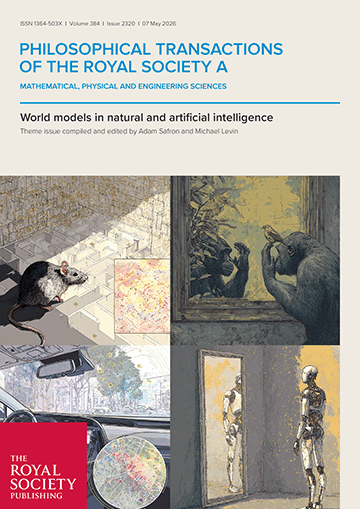
Volume 384 Issue 2320 | Philosophical Transactions of the Royal Society A | The Royal Society
Influential themed journal issues across the physical mathematical and engineering sciences.
Speculations on the Future of the Scientific Method
The following essay was published 20 years ago (January, 2006) on my blog The Technium. I edited the intro here, but the speculations are basically unchanged.

The Periodic Table of Cognition
I’ve been studying the early history of electricity’s discovery as a map for our current discovery of artificial intelligence. The smartest people alive back then, including Isaac Newton, who may have been the smartest person who ever lived, had confident … Continue reading →
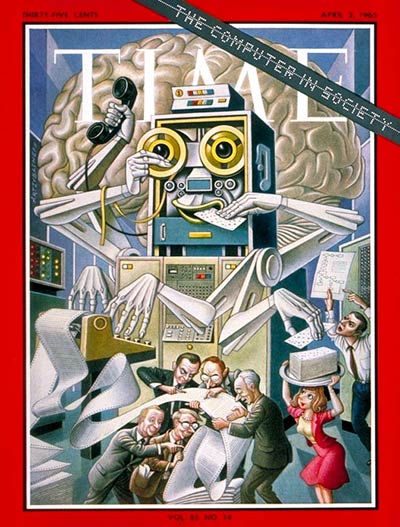
TIME Magazine Cover: Computer in Society - Apr. 2, 1965
TIME Magazine Cover: Computer in Society
Technological

Posts about the future of the internet, AI, and anything technological. Hence the name.
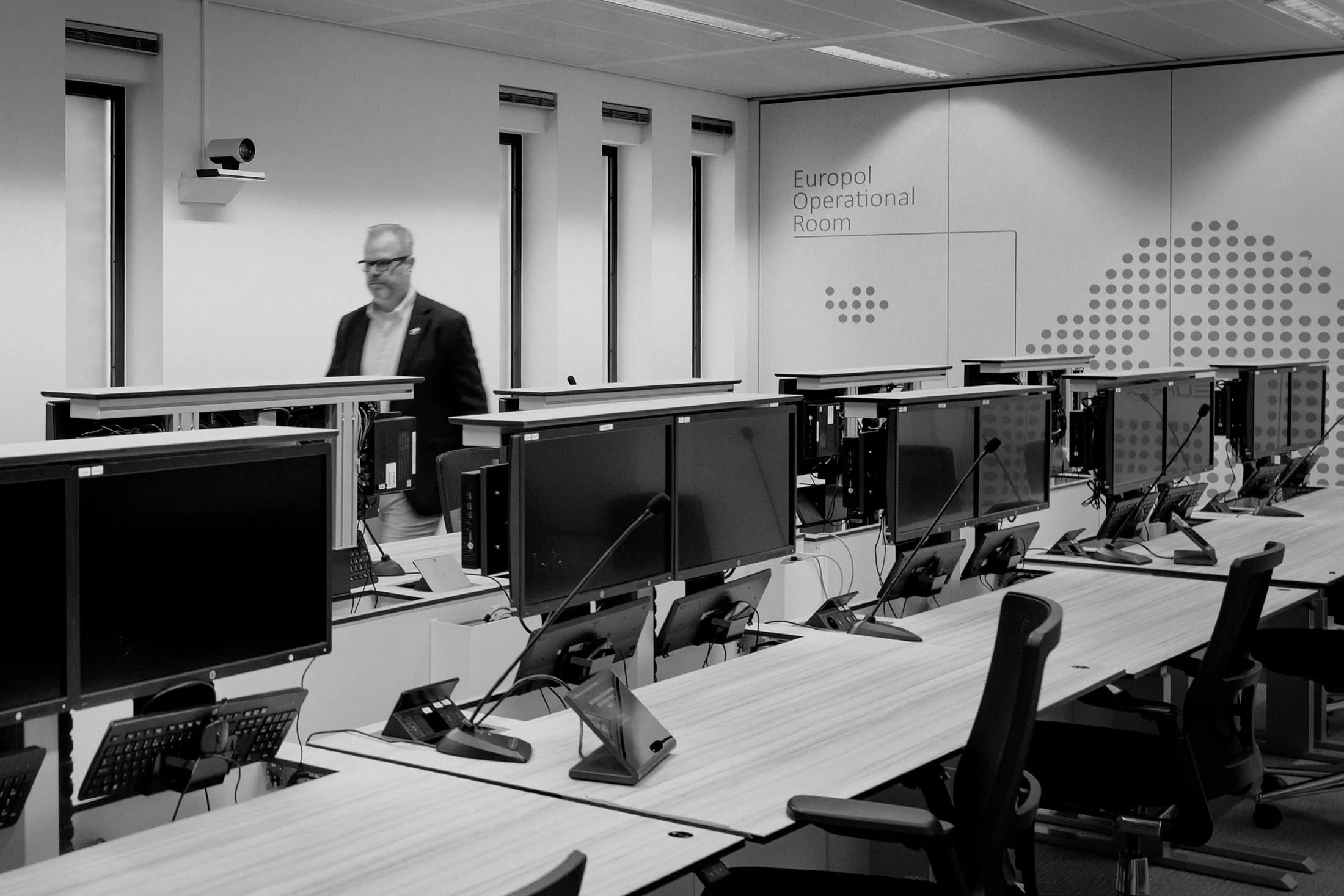
Child Predators Turn to Open-Source AI to Make Unlimited Illegal Images

Mac Users Reclaim 12GB+ of Storage With Apple Intelligence Removal Tool
‘Doom Loop’: OpenAI and Microsoft Admits LLMs Are Destroying the Web and Built on Theft

Cory Doctorow: AI’s big beasts aren’t really scared of their products. They’re scared of their competition
How AI Chatbots Are 'Deskilling' Human Empathy
Pluralistic: The Claude Delusion (21 Sep 2026) – Pluralistic: Daily links from Cory Doctorow
