


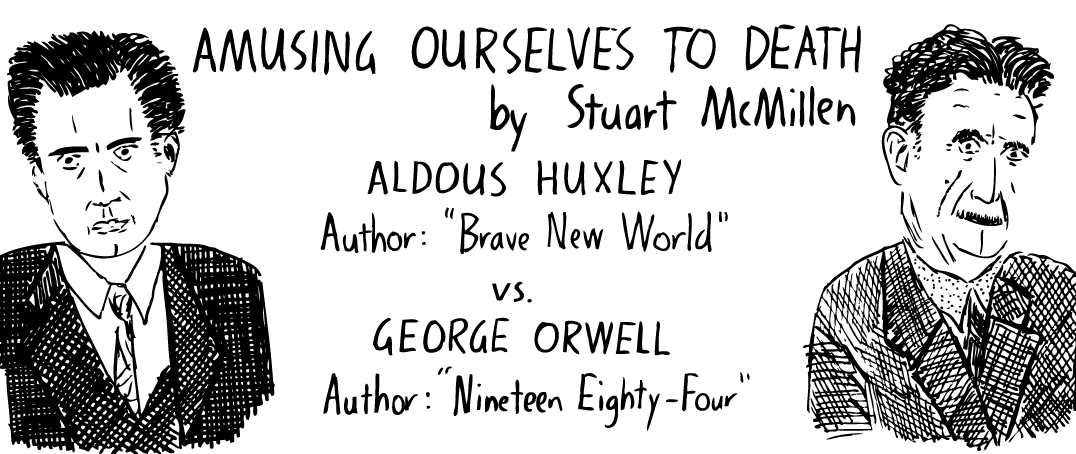
Amusing Ourselves to Death: Public Discourse in the Age of Show Business (1985) is a book by American sociologist and mass media scholar Neil Postman. In 2005, Postman's son Andrew reissued the book in a 20th anniversary edition.
Amusing Ourselves to Death comics reflections - Stuart McMillen blog
Why was the Amusing Ourselves to Death comic by Neil Postman removed from the internet by cartoonist Stuart McMillen? Reflective essay on this comic.
Brett Scott (@brettscott)
Marshall McLuhan is famous for his observation that the form of a communication technology can shape our mind and society The age of the printed book, for example, carried with it a particular way of being. Regardless of the differing content of different books, all books required a particular mindset in which a thread is followed from the beginning to the end through an arc I feel the age of social media is like the age of a ripped up book, as if we were surrounded by torn shards and shreds of paper floating like confetti around us. We grab for them, hoping for some tiny insight, but not having any way of knowing where it fits in the overarching narrative This note is one such shard. You can toss it away now

Are We Having Too Much Fun?
In 1985, Neil Postman observed an America imprisoned by its own need for amusement. He was, it turns out, extremely prescient.

It's the (Democracy-Poisoning) Golden Age of Free Speech
At a time when anyone can broadcast live or post their thoughts to a social network, we should be living in a utopia of public discourse. We're not.

The obsolescence of man, vol I , part 2: The world as phantom and as matrix: philosophical considerations on radio and television - Günther Anders
The first complete English translation of a remarkable 1956 essay about television from Vol. I of The Obsolescence of Man by Günther Anders, who—using phenomenological analyses, excerpts from his diaries and reflections on daily life—depicts a capitalist world that manufactures a warped “mass-man” by imposing nonparticipation, consumption of images, artificial “needs” (“drug addiction is the model for today’s needs”), separation, “conditioning”, an eternal present, commodified leisure and the dissolution of the individual in vapid mass produced roles, in a text that in many ways anticipates the theory of the “spectacle” of Guy Debord and the situationists.
Everyone is a Strategist and No One is a Writer
From politics to culture, we face a crisis of cleverness and a society addicted to marketing
Preparing for the Creator Economy Apocalypse (with Chris Gethard)
Fast Capitalism | Mavs Open Press Open Access Journals | University of Texas at Arlington
Fast Capitalism is an academic journal aimed at describing the current moment of capitalism. We publish peer reviewed scholarship and essays about the impact of rapid information and communication technologies on self, society and culture in the 21st century. Our authors examine how heretofore distinct social institutions, such as work and family, education and entertainment, have blurred to the point of near identity in an accelerated, post-Fordist stage of capitalism. This makes it difficult for people to shield themselves from subordination and surveillance. The working day has expanded; there is little down time anymore. People can 'office' anywhere, using laptops and cells to stay in touch. But these invasive technologies that tether us to capital and control can also help us resist these tendencies. People use the Internet as a public sphere in which they express and enlighten themselves and organize others; information technologies afford connection, mitigate isolation, and even make way for social movements. We are convinced that the best way to study an accelerated media culture and its various political economies and existential meanings is dialectically, with nuance, avoiding sheer condemnation and ebullient celebration. We seek to shape these new technologies and social structures in democratic ways. We look at technology, Artificial Intelligence (AI), global flows, political economy, culture and cultural studies, social theory, political theory, intersectionality, and the envionrment.
Jason Arday: We Must Rage – Rage Against the Journalism of Cruelty
The death of the academic shows the casual conversion of humiliation into entertainment by a media running on monetised hate and cruelty

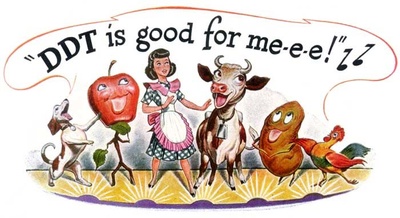
What Were We Thinking? The Top 10 Most Dangerous Ads
Often the criticism of vintage ads focuses on their inherent sexism, racism, or other displays of social prejudices, which we find laughable today, despit...
Writings and rehearsals by Nathan Schneider
Welcome. I’m a professor of media studies at the University of Colorado Boulder, where I direct the Media Economies Design Lab and teach and learn from our students. I’ve written a book each on online democracy, cooperative enterprise, the Occupy movement, and God, and I’ve edited ones about solidarity economies, crypto, and co-ops. Reporting articles for both magazines and academic journals keeps my notebooks filled. Working with others to build a democratic economy keeps me accountable.
The Player and the Played
In an age when capitalism feels like an unwinnable game, extreme reactionary ideas and politics are on the rise. The Hunger Games, Game of Thrones, Squid Gam...

Measuring The Health of Our Public Conversations - Cortico
By Deb Roy, Eugene Yi, Russell Stevens Published: March 1, 2018 The Internet and social media have transformed modern society in many positive ways by connecting us to the world’s information, enabling social connections that transcend space and time, and giving everyone a voice. Within this transformation, social media have become an essential part of
What corporate thrillers tell us about the '90s economy
PLUS: Has Forum Brain crossed the gender divide?
prosocial media

Prosocial Media


Improving social media for democratic discourse
BridgEU: new project to study how recommendation systems can reduce polarization | SynoSys
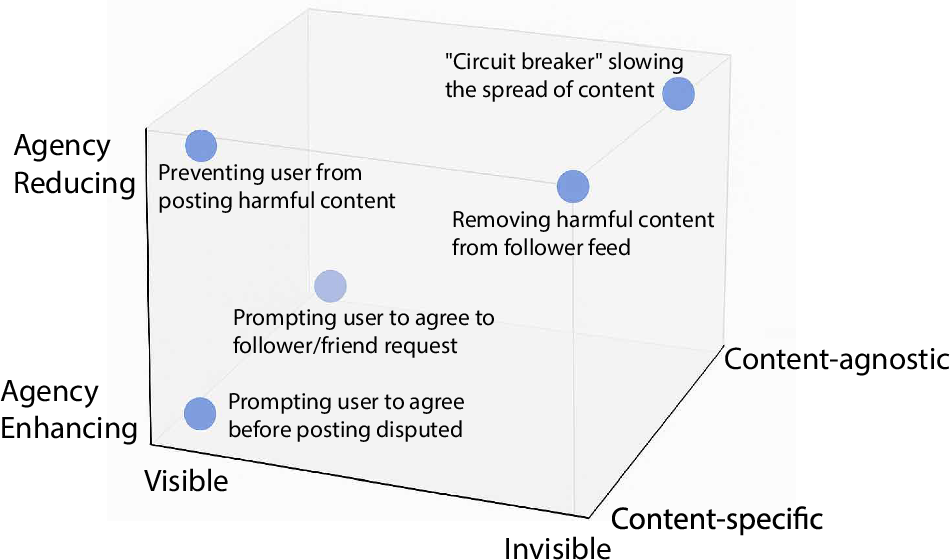
The case against efficiency: friction in social media

Eurosky is collaborating with SPRIND to test a non-toxic algorithm for the first time - Eurosky
Mu for democracy - Erlend’s notes
social-protocols/jabble
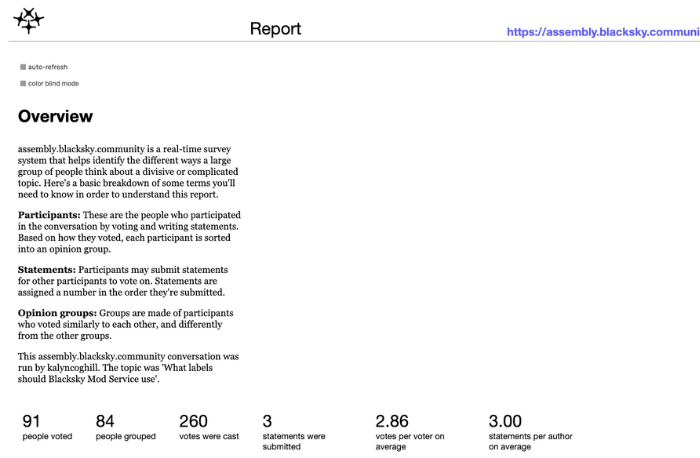
What Happens When You Have a Choice? : A Breakdown of The People's Assembly and Blacksky's Vision for Democratic Tooling

Introducing Discussions - a new way to have conversations on Blacksky 🗣️ Now you can create a dynamic poll right from the post composer in…

Sparkable

What Does Constructive Mean?

MySky Social | Jonathan Stray | Substack
Prosocial Media