


In machine learning, attention is a method that determines the importance of each component in a sequence relative to the other components in that sequence. In natural language processing, importance is represented by "soft" weights assigned to each word in a sentence. More generally, attention encodes vectors called token embeddings across a fixed-width sequence that can range from tens to millions of tokens in size.
Attention Is All You Need
"Attention Is All You Need" is a 2017 research paper in machine learning authored by eight scientists and engineers working at Google. The paper introduced a new deep learning architecture known as the transformer, based on the attention mechanism proposed in 2014 by Bahdanau et al. The transformer approach it describes has become the main architecture of a wide variety of artificial intelligence systems, including large language models. At the time, the focus of the research was on improving Seq2seq techniques for machine translation, but the authors go further in the paper, foreseeing the technique's potential for other tasks like question answering and what is now known as multimodal generative AI.
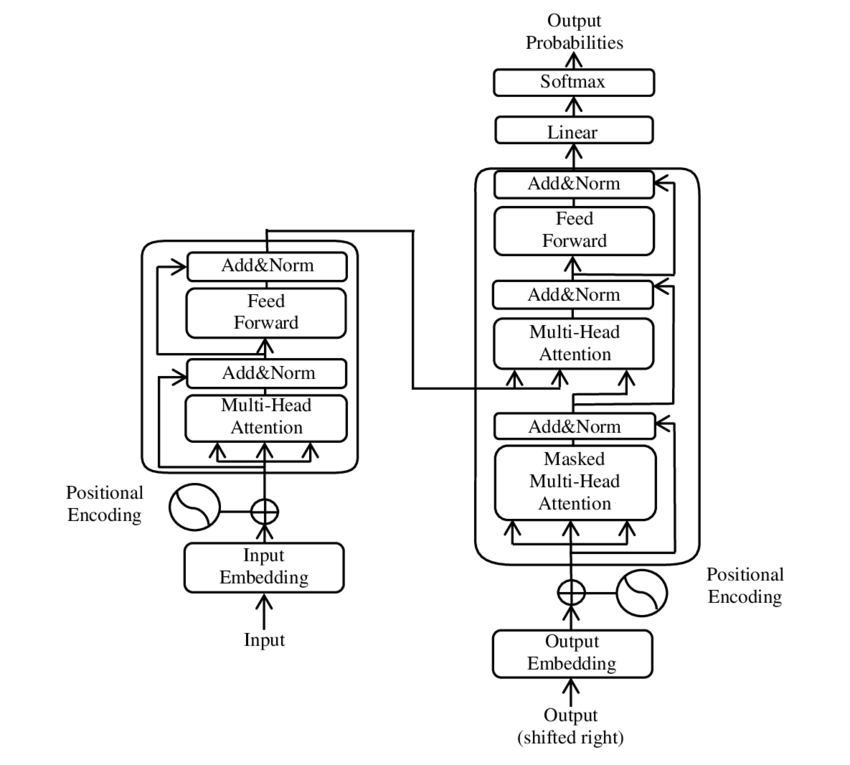
Transformer (deep learning)
In deep learning, the transformer is a family of artificial neural network architectures based on the multi-head attention mechanism, in which text is converted to numerical representations called tokens, and each token is converted into a vector via lookup from a word embedding table. At each layer, each token is then contextualized within the scope of the context window with other (unmasked) tokens via a parallel multi-head attention mechanism, allowing the signal for key tokens to be amplified and less important tokens to be diminished. Because self-attention alone is permutation-invariant, transformers inject positional information, typically through positional encodings or learned positional embeddings, so token order can affect the output.

Word embedding
In natural language processing, a word embedding is a representation of a word. The embedding is used in text analysis. Typically, the representation is a real-valued vector that encodes the meaning of the word in such a way that the words that are closer in the vector space are expected to be similar in meaning. Word embeddings can be obtained using language modeling and feature learning techniques, where words or phrases from the vocabulary are mapped to vectors of real numbers.

Deficient executive control in transformer attention
Abstract. Although transformers in large language models (LLMs) effectively implement a self-attention mechanism that has revolutionized natural language p
Why Do Large Language Models (LLMs) Struggle to Count Letters?
Large Language Models (LLMs) have achieved unprecedented performance on many complex tasks, being able, for example, to answer questions on almost any topic. However, they struggle with other simple tasks, such as counting the occurrences of letters in a word, as illustrated by the inability of many LLMs to count the number of "r" letters in "strawberry". Several works have studied this problem and linked it to the tokenization used by LLMs, to the intrinsic limitations of the attention mechanism, or to the lack of character-level training data. In this paper, we conduct an experimental study to evaluate the relations between the LLM errors when counting letters with 1) the frequency of the word and its components in the training dataset and 2) the complexity of the counting operation. We present a comprehensive analysis of the errors of LLMs when counting letter occurrences by evaluating a representative group of models over a large number of words. The results show a number of consistent trends in the models evaluated: 1) models are capable of recognizing the letters but not counting them; 2) the frequency of the word and tokens in the word does not have a significant impact on the LLM errors; 3) there is a positive correlation of letter frequency with errors, more frequent letters tend to have more counting errors, 4) the errors show a strong correlation with the number of letters or tokens in a word and 5) the strongest correlation occurs with the number of letters with counts larger than one, with most models being unable to correctly count words in which letters appear more than twice.

Why Do Large Language Models (LLMs) Struggle to Count Letters?
Large Language Models (LLMs) have achieved unprecedented performance on many complex tasks, being able, for example, to answer questions on almost any topic. However, they struggle with other simple tasks, such as counting the occurrences of letters in a word, as illustrated by the inability of many LLMs to count the number of "r" letters in "strawberry". Several works have studied this problem and linked it to the tokenization used by LLMs, to the intrinsic limitations of the attention mechanism, or to the lack of character-level training data. In this paper, we conduct an experimental study to evaluate the relations between the LLM errors when counting letters with 1) the frequency of the word and its components in the training dataset and 2) the complexity of the counting operation. We present a comprehensive analysis of the errors of LLMs when counting letter occurrences by evaluating a representative group of models over a large number of words. The results show a number of consistent trends in the models evaluated: 1) models are capable of recognizing the letters but not counting them; 2) the frequency of the word and tokens in the word does not have a significant impact on the LLM errors; 3) there is a positive correlation of letter frequency with errors, more frequent letters tend to have more counting errors, 4) the errors show a strong correlation with the number of letters or tokens in a word and 5) the strongest correlation occurs with the number of letters with counts larger than one, with most models being unable to correctly count words in which letters appear more than twice.
Attention and the Relevance Problem
ABSTRACT The relevance problem is the problem of how cognitive systems can be sensitive to what is relevant despite relevance being holistic, open‐ended, and context‐sensitive. The problem has typically been applied to higher‐order cognitive processes. In this paper, I argue that there is a hitherto unrecognized relevance problem for perceptual attention. This problem becomes apparent when considering the functions of attention: attention must not only support ongoing task performance but also remain sensitive to opportunities for task switching, latent learning, and context checking. Existing treatments of the relevance problem have largely focused on its task‐relative form: given a task, what is relevant? I argue that attention faces a more general problem that includes sensitivity to factors relevant to other interests and to cues indicating that another activity may be worth pursuing. For such features of the environment to stand out as salient, salience cannot be determined solely by bottom‐up factors and a limited set of occurrent top‐down factors, such as current goals and intentions. Rather, it must reflect the wider (if not the entire) range of an agent's latent interests in a context‐sensitive way. This motivational unencapsulation of attention poses a challenge for both contemporary accounts of attention and suggests that passive attention is much more intelligent than commonly thought.

Attention and the Relevance Problem
ABSTRACT The relevance problem is the problem of how cognitive systems can be sensitive to what is relevant despite relevance being holistic, open‐ended, and context‐sensitive. The problem has typically been applied to higher‐order cognitive processes. In this paper, I argue that there is a hitherto unrecognized relevance problem for perceptual attention. This problem becomes apparent when considering the functions of attention: attention must not only support ongoing task performance but also remain sensitive to opportunities for task switching, latent learning, and context checking. Existing treatments of the relevance problem have largely focused on its task‐relative form: given a task, what is relevant? I argue that attention faces a more general problem that includes sensitivity to factors relevant to other interests and to cues indicating that another activity may be worth pursuing. For such features of the environment to stand out as salient, salience cannot be determined solely by bottom‐up factors and a limited set of occurrent top‐down factors, such as current goals and intentions. Rather, it must reflect the wider (if not the entire) range of an agent's latent interests in a context‐sensitive way. This motivational unencapsulation of attention poses a challenge for both contemporary accounts of attention and suggests that passive attention is much more intelligent than commonly thought.
DeepSeek-V4: Towards Highly Efficient Million-Token Context Intelligence
We present a preview version of DeepSeek-V4 series, including two strong Mixture-of-Experts (MoE) language models -- DeepSeek-V4-Pro with 1.6T parameters (49B activated) and DeepSeek-V4-Flash with 284B parameters (13B activated) -- both supporting a context length of one million tokens. DeepSeek-V4 series incorporate several key upgrades in architecture and optimization: (1) a hybrid attention architecture that combines Compressed Sparse Attention (CSA) and Heavily Compressed Attention (HCA) to improve long-context efficiency; (2) Manifold-Constrained Hyper-Connections (mHC) that enhance conventional residual connections; (3) and the Muon optimizer for faster convergence and greater training stability. We pre-train both models on more than 32T diverse and high-quality tokens, followed by a comprehensive post-training pipeline that unlocks and further enhances their capabilities. DeepSeek-V4-Pro-Max, the maximum reasoning effort mode of DeepSeek-V4-Pro, redefines the state-of-the-art for open models, outperforming its predecessors in core tasks. Meanwhile, DeepSeek-V4 series are highly efficient in long-context scenarios. In the one-million-token context setting, DeepSeek-V4-Pro requires only 27% of single-token inference FLOPs and 10% of KV cache compared with DeepSeek-V3.2. This enables us to routinely support one-million-token contexts, thereby making long-horizon tasks and further test-time scaling more feasible. The model checkpoints are available at https://huggingface.co/collections/deepseek-ai/deepseek-v4.
Deficient executive control in transformer attention
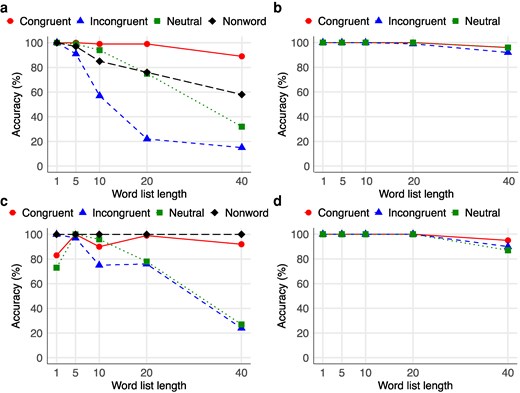
Abstract Although transformers in large language models (LLMs) effectively implement a self-attention mechanism that has revolutionized natural language processing, they lack an explicit architecture for the executive control of attention found in humans, which is essential for resolving conflicts and selecting relevant information in the presence of competing computations and is critical for adaptive behavior. To investigate the impact of this limitation in LLMs, we employed the classic color Stroop task, widely regarded as the gold standard, to test the executive control of attention in these models. Our results revealed a typical conflict effect of underperformance in terms of accuracy in the incongruent condition (e.g. naming the color of the word RED in blue) compared with the congruent condition (e.g. naming the color of the word RED in red), in short word lists, similar to human performance. However, as the length of the word lists increased, performance on the incongruent condition degraded toward near-total performance collapse, even as accuracy in the congruent condition remained excellent, and word reading (e.g. reading the word RED [in red] or RED [in blue], ignoring the color) was near-perfect. These findings demonstrate that transformer attention mechanisms are fundamentally limited in their capacity for conflict resolution across extended contexts, and a failure to up-regulate control adaptively under rising interference. We suggest that incorporating executive control mechanisms akin to those in biological attention is crucial for achieving artificial general intelligence.
Attention Is All You Need
The dominant sequence transduction models are based on complex recurrent or convolutional neural networks in an encoder-decoder configuration. The best performing models also connect the encoder and decoder through an attention mechanism. We propose a new simple network architecture, the Transformer, based solely on attention mechanisms, dispensing with recurrence and convolutions entirely. Experiments on two machine translation tasks show these models to be superior in quality while being more parallelizable and requiring significantly less time to train. Our model achieves 28.4 BLEU on the WMT 2014 English-to-German translation task, improving over the existing best results, including ensembles by over 2 BLEU. On the WMT 2014 English-to-French translation task, our model establishes a new single-model state-of-the-art BLEU score of 41.8 after training for 3.5 days on eight GPUs, a small fraction of the training costs of the best models from the literature. We show that the Transformer generalizes well to other tasks by applying it successfully to English constituency parsing both with large and limited training data.
The Illustrated Transformer
Discussions: Hacker News (65 points, 4 comments), Reddit r/MachineLearning (29 points, 3 comments) Translations: Arabic, Chinese (Simplified) 1, Chinese (Simplified) 2, French 1, French 2, Italian, Japanese, Korean, Persian, Russian, Spanish 1, Spanish 2, Vietnamese Watch: MIT’s Deep Learning State of the Art lecture referencing this post Featured in courses at Stanford, Harvard, MIT, Princeton, CMU and others Update: This post has now become a book! Check out LLM-book.com which contains (Chapter 3) an updated and expanded version of this post speaking about the latest Transformer models and how they've evolved in the seven years since the original Transformer (like Multi-Query Attention and RoPE Positional embeddings). In the previous post, we looked at Attention – a ubiquitous method in modern deep learning models. Attention is a concept that helped improve the performance of neural machine translation applications. In this post, we will look at The Transformer – a model that uses attention to boost the speed with which these models can be trained. The Transformer outperforms the Google Neural Machine Translation model in specific tasks. The biggest benefit, however, comes from how The Transformer lends itself to parallelization. It is in fact Google Cloud’s recommendation to use The Transformer as a reference model to use their Cloud TPU offering. So let’s try to break the model apart and look at how it functions. The Transformer was proposed in the paper Attention is All You Need. A TensorFlow implementation of it is available as a part of the Tensor2Tensor package. Harvard’s NLP group created a guide annotating the paper with PyTorch implementation. In this post, we will attempt to oversimplify things a bit and introduce the concepts one by one to hopefully make it easier to understand to people without in-depth knowledge of the subject matter. 2025 Update: We’ve built a free short course that brings the contents of this post up-to-date with animations: A High-Level Look Let’s begin by looking at the model as a single black box. In a machine translation application, it would take a sentence in one language, and output its translation in another.
How We Pay Attention Changes the Very Shape of Our Brains
Imagine arriving at the airport just in time to catch a plane. Everything in your behavior betrays the heightened concentration of your attention. Your mind on alert, you look for the departures si…

Attention is All you Need
The dominant sequence transduction models are based on complex recurrent orconvolutional neural networks in an encoder and decoder configuration. The best performing such models also connect the encoder and decoder through an attentionm echanisms. We propose a novel, simple network architecture based solely onan attention mechanism, dispensing with recurrence and convolutions entirely.Experiments on two machine translation tasks show these models to be superiorin quality while being more parallelizable and requiring significantly less timeto train. Our single model with 165 million parameters, achieves 27.5 BLEU onEnglish-to-German translation, improving over the existing best ensemble result by over 1 BLEU. On English-to-French translation, we outperform the previoussingle state-of-the-art with model by 0.7 BLEU, achieving a BLEU score of 41.1.
Verbalizable Representations Form a Global Workspace in Language Models
If the mind is an ocean, we spend our lives floating at the surface. Beneath us, an enormous amount of processing takes place without our knowledge: our visual systems parsing the contours of a face, our motor circuits maintaining our posture. At any given moment, only a small fraction of this neural activity is accessible to us. Yet it is this privileged sliver of activity that we rely on to reason deliberately: to plan what ingredients to buy for a recipe, or to puzzle out why an engine won’t start. Such thoughts can be articulated out loud, deliberately held in mind, and brought to bear on whatever task the moment demands. This distinction, between our accessible thoughts and our unconscious processing, is perhaps the most striking feature of human cognition.
Verbalizable Representations Form a Global Workspace in Language Models
If the mind is an ocean, we spend our lives floating at the surface. Beneath us, an enormous amount of processing takes place without our knowledge: our visual systems parsing the contours of a face, our motor circuits maintaining our posture. At any given moment, only a small fraction of this neural activity is accessible to us. Yet it is this privileged sliver of activity that we rely on to reason deliberately: to plan what ingredients to buy for a recipe, or to puzzle out why an engine won’t start. Such thoughts can be articulated out loud, deliberately held in mind, and brought to bear on whatever task the moment demands. This distinction, between our accessible thoughts and our unconscious processing, is perhaps the most striking feature of human cognition.