


A black hole is an astronomical body so compact that its gravity prevents anything, including light, from escaping. Albert Einstein's theory of general relativity, which describes gravitation as the curvature of spacetime, predicts that any sufficiently compact mass will form a black hole. The boundary of no escape is called the event horizon. In general relativity, crossing a black hole's event horizon traps an object inside but produces no locally detectable change. General relativity also predicts that every black hole should have a central singularity, where the curvature of spacetime is infinite.
Dark matter
In astronomy and cosmology, dark matter is an invisible and hypothetical form of matter that does not interact with light or other electromagnetic radiation. Dark matter is implied by gravitational effects that cannot be explained by general relativity unless more matter is present than can be observed. Such effects occur in the context of formation and evolution of galaxies, gravitational lensing, the observable universe's current structure, mass position in galactic collisions, the motion of galaxies within galaxy clusters, and cosmic microwave background anisotropies. Dark matter is thought to serve as gravitational scaffolding for cosmic structures. After the Big Bang, dark matter clumped into blobs along narrow filaments with superclusters of galaxies forming a cosmic web at scales on which entire galaxies appear like tiny particles.

Compact object
In astronomy, the term compact object (or compact star) refers collectively to white dwarfs, neutron stars, and black holes. It could also include exotic stars if such hypothetical, dense bodies are confirmed to exist. All compact objects have a high mass relative to their radius, giving them a very high density compared to ordinary atomic matter. The term is used as a generalization for cases where the exact nature of a significant gravitational effect isolated to a small radius is not known.
Bernhard Mueller on Twitter / X
Our Theory-of-Everything, OPH, completely unifies the Standard Model with gravity: A SINGLE constant determines both Newton's constant G and the particle spectrum. Mass-less photons, gravitons and gluons emerge for free. https://t.co/dUh6TLAlop— Bernhard Mueller (@muellerberndt) April 4, 2026
Galaxy
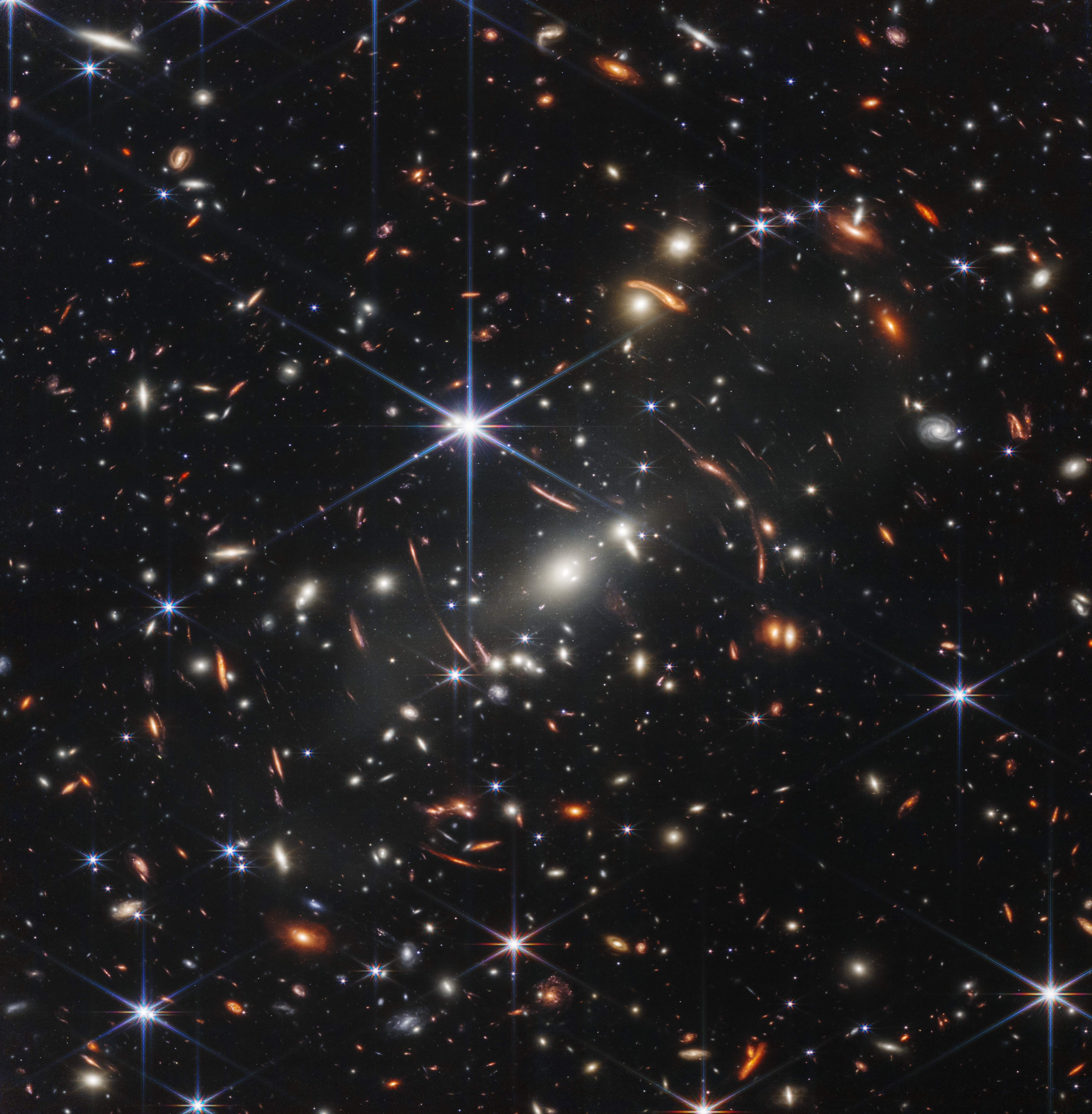
A galaxy is a system of stars, stellar remnants, interstellar gas, dust, and dark matter bound together by gravity. The word is derived from the Greek galaxias (γαλαξίας), literally 'milky', a reference to the Milky Way galaxy that contains the Solar System. Galaxies, averaging an estimated 100 million stars, range in size from dwarfs with less than a thousand stars, to the largest galaxies known – supergiants with one hundred trillion stars, each orbiting its galaxy's centre of mass. Most of the mass in a typical galaxy is in the form of dark matter, with only a few percent of that mass visible in the form of stars and nebulae. Supermassive black holes are a common feature at the centres of galaxies.

Gravity
In physics, gravity, also known as gravitation or a gravitational interaction, is a fundamental interaction, which may be described as the force that draws material objects towards each other.

Why the universe has giant empty regions - Sensemaker
Cosmic voids are not holes in space. They are the gravitationally amplified low points of the early universe.
A hierarchy of voids: Much ado about nothing
We present a model for the distribution of void sizes and its evolution in the context of hierarchical scenarios of gravitational structure formation. We find that at any cosmic epoch the voids...

Out of Nowhere: The Emergence of Spacetime in Quantum Theories of Gravity
Out of Nowhere is the monograph co-authored by Nick Huggett and Christian Wüthrich, which appeared in 2025 from Oxford University Press. Selected chapters are posted here. (Our publication agreemen…

Newfound Mathematical 'Einstein' Shape Creates a Never-Repeating Pattern
A new shape called an einstein has taken the math world by storm. The craggy, hat-shaped tile can cover an infinite plane with patterns that never repeat.

Cosmic Voids and Void Lensing in the Dark Energy Survey Science...
Galaxies and their dark matter halos populate a complicated filamentary network around large, nearly empty regions known as cosmic voids. Cosmic voids are usually identified in spectroscopic...
Dark matter as a Ricci soliton
In this paper we consider clumped baryonic matter as a spherically symmetric barotropic fluid associated with a compact four-dimensional Einstein manifold with a four-radius that is determined by the fluid density. We further investigate the properties of these matter generated manifolds and show that because of their homogeneity and isotropy they exhibit FLRW metric properties and expand with cosmic time. At low densities such as those encountered in star clusters, galaxies and galactic clusters, these manifolds are large and show the same properties that are currently attributed to dark matter.
What is Dark Energy? Inside Our Accelerating, Expanding Universe - NASA Science
Some 13.8 billion years ago, the universe began with a rapid expansion we call the big bang. After this initial expansion, which lasted a fraction of a
What Theory is Not, Theorizing Is
The era of precision cosmology with voids
Cosmic voids, the large underdense regions of our Universe, have emerged over the past decade as powerful cosmological laboratories: their simple dynamics, sensitivity to local gravitational...
Precision cosmology with voids in the final BOSS data
We report novel cosmological constraints obtained from cosmic voids in the final BOSS DR12 dataset. They arise from the joint analysis of geometric and dynamic distortions of average void shapes...
