

Corporatization is the process of transforming and restructuring state assets, government agencies, public organizations, or municipal organizations into corporations.[1][2][3][4] It involves the adoption and application of business management practices and the separation of ownership from management through the creation of a joint-stock or shareholding structure for the organization.[2] The result of corporatization is the creation of state-owned corporations (or corporations at other government levels, such as municipally owned corporations) where the government retains a majority ownership of the corporation's stock.[1][5] Corporatization is undertaken to improve efficiency of an organization, to commercialize its operations, to introduce corporate and business management techniques to public functions, or as a precursor to partial or full privatization.
The corporation—a return to origins?
This paper contributes to contemporary debates in political theory about the power of business corporations by offering a genealogy of the corporation through the lens of a series of historical mutations of the corporate form. Originally, there were two corporate forms, both non-profit: member corporations (today's associations) and property corporations (today's charitable foundations). The contemporary business corporation arguably is a hybrid of both of these original forms, introducing unique commercial features (shares with profit distribution rights that are transferable). These commercial features are largely responsible for the corporation's extractive nature, that is, its tendency to prey on non-shareholder interests. The future of the corporation may well lie in a partial return to the two original non-profit forms. Two corporate forms developed in the nineteenth century can provide the format for such a return: cooperatives (which reinforce the idea of membership) and foundation-owned companies. The cooperative structure is a halfway house between a business corporation and a member corporation (association), and in a parallel fashion, a foundation-owned company is a halfway house between a business corporation and a property corporation (foundation). If we want to reduce corporations’ extractive nature, facilitating the spread of cooperatives and foundation-owned companies seems the way forward.

THEY WILL REPLACE U.S.: AI AND THE HALLUCINATIONS OF CORPORATIONS
ABSTRACT: I address AI as a manifestation of the corporate form in U.S. culture, and as it relates to the dreams of (or ascribed to) fascism and corporations. The merger of state and corporate power represents the trajectory of the corporation—to take over the state; elide accountability, empathy, transparency and (human) agency; and trade places with (and finally eliminate) people. The merger of state and corporate AI—a final stage of corporate speech, networking, and legal ontology—facilitates the takeover of human personhood by corporate personhood, and I trace the effects of that process in the systemic inversion of norms. Corporate personhood is part of a zero-sum game in which rights, speech, and identities are appropriated from people. When AI technology is grafted onto political systems and social media, the ensuing hallucinations are nightmares. The corporation always has been a posthuman simulacrum of persons, and its AI, in its wake, dreams of eliminating workers and people altogether.
Democratic Ownership Funds: Creating Shared Wealth and Power
Recent decades have seen a rapid and little-discussed transformation in corporate ownership structure, with vital consequences for company behaviour and inequality.

The Corporation’s Neoliberal Soul? | Human Rights after Corporate Personhood
Human Rights after Corporate Personhood offers a rich overview of current debates, and seeks to transcend the "outrage response" often found in public discourse and corporate legal theory. Through ...

Denizen
What is stakeholder capitalism? What is required to truly instantiate stakeholder decision making in the governance of companies?
Democratizing AI Companies — The Collective Intelligence Project
As AI reshapes society, the companies behind these technologies face a critical challenge: how to build corporate governance structures that prioritize public benefit over profit maximization;.

The Organization of Government in Metropolitan Areas: A Theoretical Inquiry
Allusions to the “problem of metropolitan government” are often made in characterizing the difficulties supposed to arise because a metropolitan region is a legal non-entity. From this point of view, the people of a metropolitan region have no general instrumentality of government available to deal directly with the range of problems which they share in common. Rather there is a multiplicity of federal and state governmental agencies, counties, cities, and special districts that govern within a metropolitan region.This view assumes that the multiplicity of political units in a metropolitan area is essentially a pathological phenomenon. The diagnosis asserts that there are too many governments and not enough government. The symptoms are described as “duplication of functions” and “overlapping jurisdictions.” Autonomous units of government, acting in their own behalf, are considered incapable of resolving the diverse problems of the wider metropolitan community. The political topography of the metropolis is called a “crazy-quilt pattern” and its organization is said to be an “organized chaos.” The prescription is reorganization into larger units—to provide “a general metropolitan framework” for gathering up the various functions of government. A political system with a single dominant center for making decisions is viewed as the ideal model for the organization of metropolitan government. “Gargantua” is one name for it.

Company as a Commons
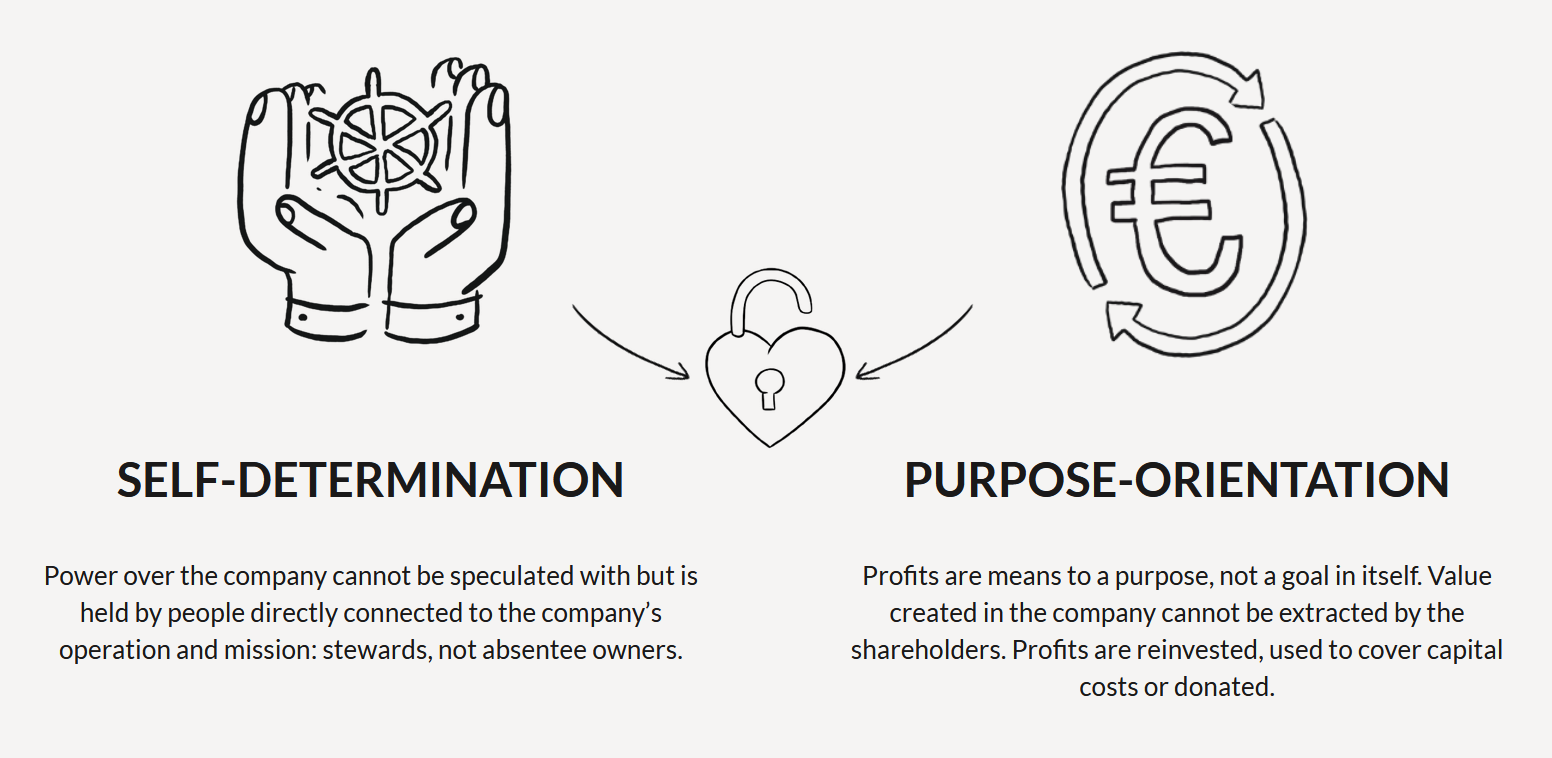
What if excess wealth derived from business couldn't be privatized? Through the levers of steward-ownership, companies can protect their purpose-oriented long term mission from the maligned incentives of absentee stakeholders.
Project Interlay | Post-Appitalism
Weaving a post-appitalist future. Decomposing the data silos of capitalist business models.

Steward-ownership
Steward-ownership structures a company's ownership in a way that separates economic rights (related to money) from voting rights (related to decision-making power).[1] Steward-ownership is considered an alternative to shareholder primacy models.[2] Steward-ownership can be implemented using different legal forms depending on the type of company and jurisdiction.[3]
How to form a Delaware corporation (C corp) | Stripe
Here’s a quick guide to forming a Delaware C corp, including the process, benefits, and other important factors businesses should consider.

A Tale of Two Theories (of Coordination)
Leveraging and Deleveraging Toward Thick Sovereignty
REINVENTING ORGANIZATIONS
Based on three years of research, the book Reinventing Organizations describes the emergence of a new management paradigm, a radically more soulful, purposeful and powerful ways to structure and run businesses and non-profits, schools and hospitals.

Worker Cooperative Business Development Initiative
Learn how to start a worker cooperative or convert an existing business into one.
The first post for WTF is here: "Decentralization: Huh?" In this article I discuss what 'decentralization' means as a concept as well as how it can be used to protect us from corporate overreach wtf.samclemente.me/decentralization-huh-t22nqge

Decentralization: Huh? - What The Function!?
wtf.samclemente.meAnd I did an episode where I explain what I'm interested in -- orgs that have some 1) form of sharing, 2) some transparency about their finances, 3) a non-growth goal in the form of knowing when they are sufficient, and 4) #multisolving. buzzsprout.com/2396702/episodes/16595444-the…

The Four Factors for Organizations - Future Mending Radio
www.buzzsprout.com
