

In data analysis, cosine similarity is a measure of similarity between two non-zero vectors defined in an inner product space. Cosine similarity is the cosine of the angle between the vectors; that is, it is the dot product of the vectors divided by the product of their lengths. It follows that the cosine similarity does not depend on the magnitudes of the vectors, but only on their angle. The cosine similarity always belongs to the interval [ − 1 , + 1 ] . {\displaystyle [-1,+1].} For example, two proportional vectors have a cosine similarity of +1, two orthogonal vectors have a similarity of 0, and two opposite vectors have a similarity of −1. In some contexts, the component values of the vectors cannot be negative, in which case the cosine similarity is bounded in [ 0 , 1 ] {\displaystyle [0,1]} .
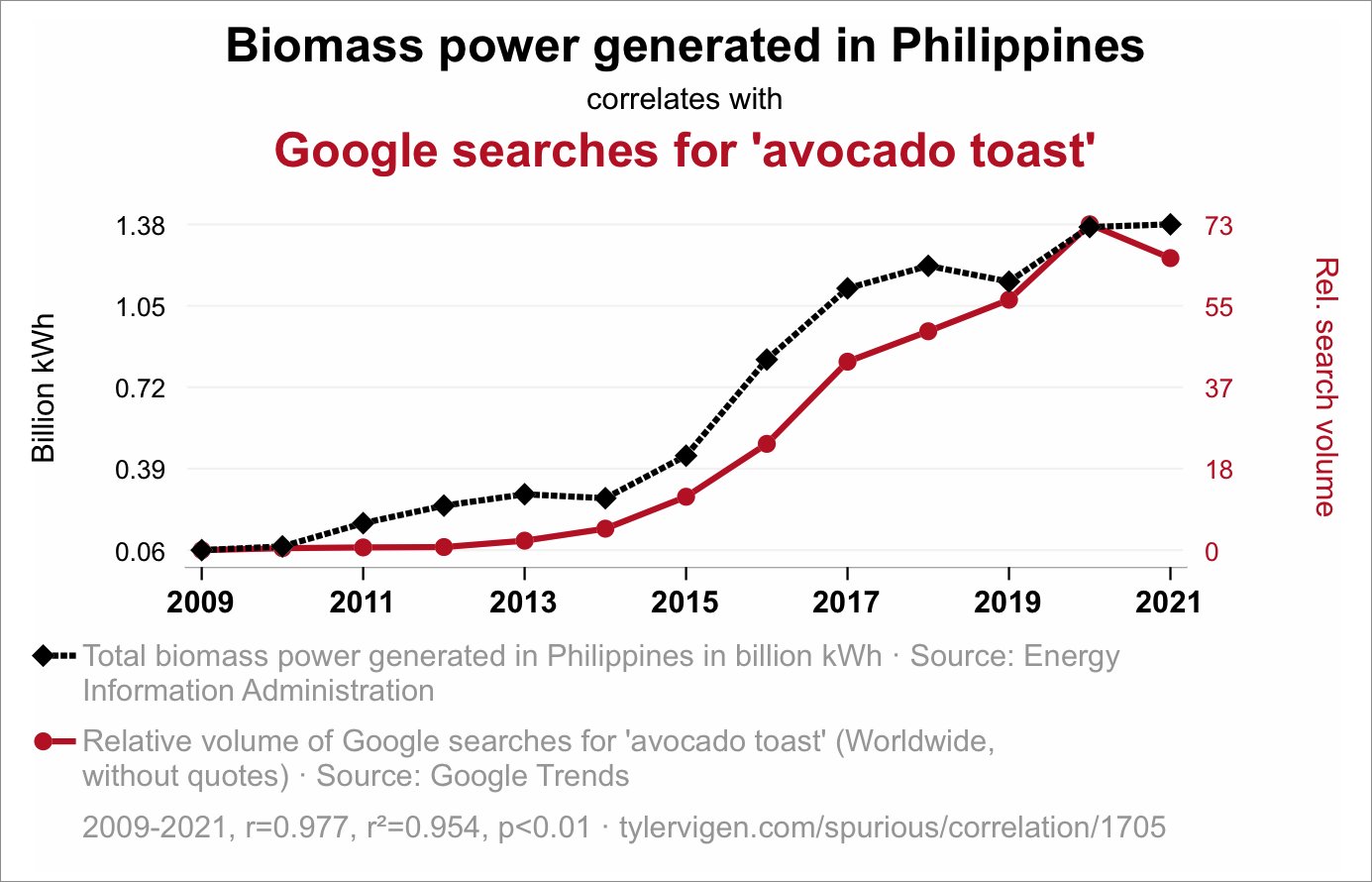
Spurious Correlations
For his Spurious Correlations project, Tyler Vigen compares data sets that are the very definition of “correlation is not causation”. For instance, the number o
Unit Circle Trigonometry - haitham
An interactive sketch for visualizing sine and cosine functions with the unit circle

歴史に刻まれるであろう世界的大流行を起こしている新型コロナウイルス「SARS-CoV-2」。その基本的な特徴・感染のメカニズム・対策など、有益そうなサイエンス情報を図解にまとめてみました。なるべく信頼性の高いと思われる資料を参照しましたが、日々更新される最新情報と合わせつつご活用ください。
歴史に刻まれるであろう世界的大流行を起こしている新型コロナウイルス「SARS-CoV-2」。その基本的な特徴・感染のメカニズム・対策など、有益そうなサイエンス情報を図解にまとめてみました。なるべく信頼性の高いと思われる資料を参照しましたが、日々更新される最新情報と合わせつつご活用ください。 pic.twitter.com/Y68oM0eKjL— ぬまがさワタリ@特別展「鳥」大阪展(〜6/14) (@numagasa) April 9, 2020

Root-raised-cosine filter
In signal processing, a root-raised-cosine filter (RRC), sometimes known as square-root-raised-cosine filter (SRRC), is frequently used as the transmit and receive pulse shaping filter in a digital communication system to perform matched filtering. This helps in constraining the occupied bandwidth of the waveform without introducing intersymbol interference (ISI). The combined response of two such filters is that of the raised-cosine filter. It obtains its name from the fact that its frequency response, H r r c ( f ) {\displaystyle H_{rrc}(f)} , is the square root of the frequency response of the raised-cosine filter, H r c ( f ) {\displaystyle H_{rc}(f)} :
Is Cross-Lingual Transfer in Bilingual Models Human-Like? A Study with Overlapping Word Forms in Dutch and English
Bilingual speakers show cross-lingual activation during reading, especially for words with shared surface form. Cognates (friends) typically lead to facilitation, whereas interlingual homographs (false friends) cause interference or no effect. We examine whether cross-lingual activation in bilingual language models mirrors these patterns. We train Dutch-English causal Transformers under four vocabulary-sharing conditions that manipulate whether (false) friends receive shared or language-specific embeddings. Using psycholinguistic stimuli from bilingual reading studies, we evaluate the models through surprisal and embedding similarity analyses. The models largely maintain language separation, and cross-lingual effects arise primarily when embeddings are shared. In these cases, both friends and false friends show facilitation relative to controls. Regression analyses reveal that these effects are mainly driven by frequency rather than consistency in form-meaning mapping. Only when just friends share embeddings are the qualitative patterns of bilinguals reproduced. Overall, bilingual language models capture some cross-linguistic activation effects. However, their alignment with human processing seems to critically depend on how lexical overlap is encoded, possibly limiting their explanatory adequacy as models of bilingual reading.

Thomas Bloom on Twitter / X
Big news! (And not really my area, but yes, I would rank this as bigger than the unit distance counterexample. Maybe not bigger than a proof of unit distance would have been, but in terms of constructions, this is big.) https://t.co/VDRti1HZ6Z— Thomas Bloom (@thomasfbloom) August 1, 2026
Tyler Angert on Twitter / X
we're working on a new photo search engine called Angles. it's focused on doing one thing well: finding photos + videos by visual similarity.here is raw, unedited footage of me going through my 80,000 photo camera roll *in realtime* with text-to-image search, image-to-image… pic.twitter.com/fsCqIHv00j— Tyler Angert (@tylerangert) March 24, 2026

COBOL Is the Asbestos of Programming Languages
The most widely adopted computer language in history, COBOL is now causing a host of problems. It's also dangerously difficult to remove.

GLEE: Geometric Laplacian Eigenmap Embedding
Graph embedding seeks to build a low-dimensional representation of a graph G. This low-dimensional representation is then used for various downstream tasks. One popular approach is Laplacian Eigenmaps (LE), which constructs a graph embedding based on the spectral properties of the Laplacian matrix of G. The intuition behind it, and many other embedding techniques, is that the embedding of a graph must respect node similarity: similar nodes must have embeddings that are close to one another. Here, we dispose of this distance-minimization assumption. Instead, we use the Laplacian matrix to find an embedding with geometric properties instead of spectral ones, by leveraging the so-called simplex geometry of G. We introduce a new approach, Geometric Laplacian Eigenmap Embedding, and demonstrate that it outperforms various other techniques (including LE) in the tasks of graph reconstruction and link prediction.
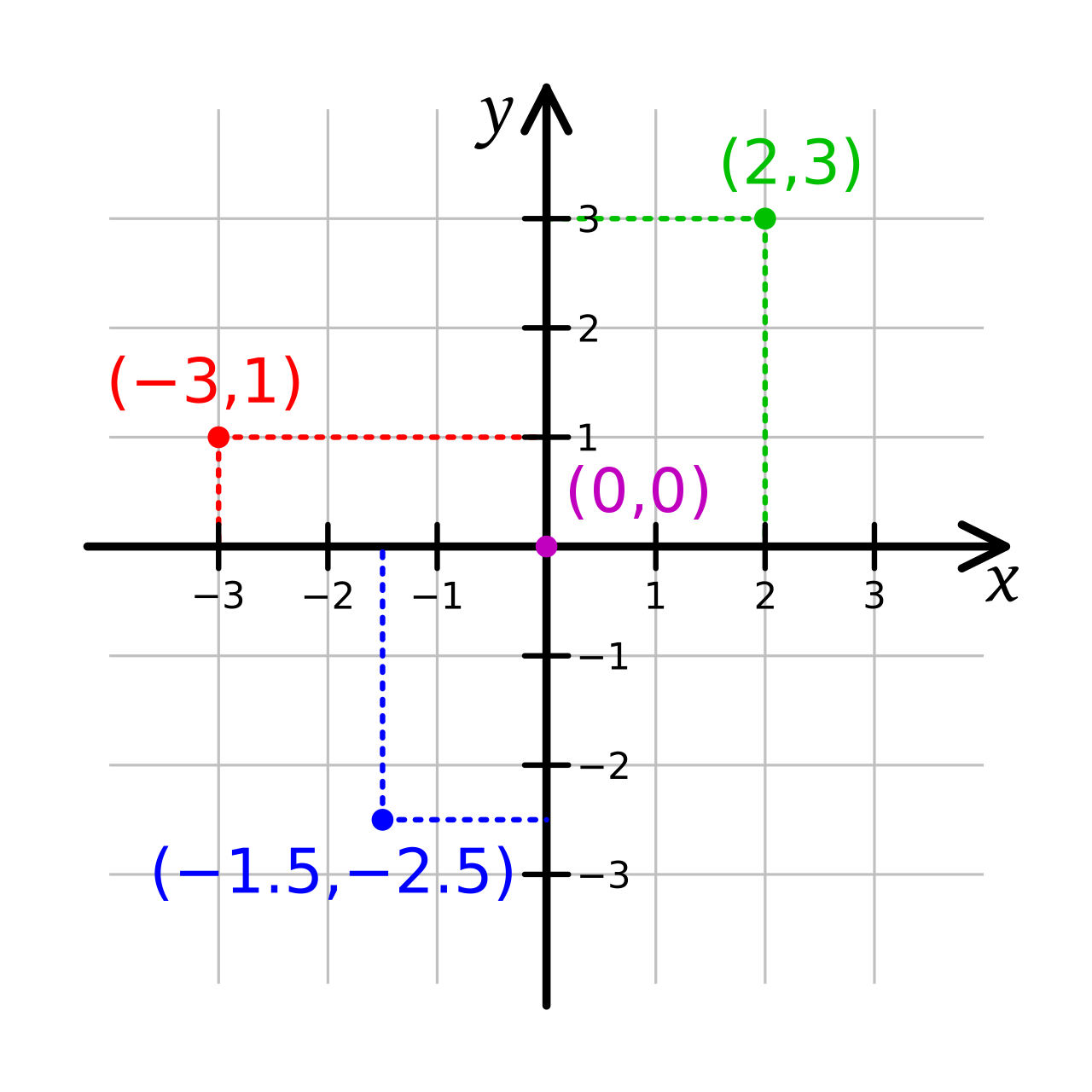
Cartesian coordinate system
In geometry, a Cartesian coordinate system in a plane is a coordinate system that specifies each point uniquely by a pair of real numbers called coordinates, which are the signed distances to the point from two fixed perpendicular oriented lines, called coordinate lines, coordinate axes or just axes of the system. The point where the axes meet is called the origin and has (0, 0) as coordinates. The axes directions represent an orthogonal basis. The combination of origin and basis forms a coordinate frame called the Cartesian frame.
Text rendering and effects using GPU-computed distances
Text rendering is cursed. Anyone who has worked on text will tell you the same; whether it's about layout, bi-directional, shaping, Unicode, or the rendering itself, it's never a completely solved problem. In my personal case, I've been working on trying to render text in the context of a compositing engine for creative content. I needed crazy text effects, and I needed them to be reasonably fast, which implied working with the GPU as much as possible. The distance field was an obvious requirement because it unlocks anti-aliasing and the ability to make many great effects for basically free.

Fontastic Space
Compare Google Fonts with anatomy overlays, metrics & pairing scores. Free.
Nicole Feng
We introduce a method for approximating the signed distance function (SDF) of geometry corrupted by holes, noise, or self-intersections. The method implicitly defines a completed version of the shape, rather than explicitly repairing the given input. Our starting point is a modified version of the heat method for geodesic distance, which diffuses normal vectors rather than a scalar distribution. This formulation provides robustness akin to generalized winding numbers (GWN), but provides distance function rather than just an inside/outside classification. Our formulation also offers several features not common to classic distance algorithms, such as the ability to simultaneously fit multiple level sets, a notion of distance for geometry that does not topologically bound any region, and the ability to mix and match signed and unsigned distance. The method can be applied in any dimension and to any spatial discretization, including triangle meshes, tet meshes, point clouds, polygonal meshes, voxelized surfaces, and regular grids. We evaluate the method on several challenging examples, implementing normal offsets and other morphological operations directly on imperfect curve and surface data. In many cases we also obtain an inside/outside classification dramatically more robust than the one obtained provided by GWN.
Coroutines in C
[Coroutines trilogy: C preprocessor | C++20 native | general philosophy ]
Word embedding
In natural language processing, a word embedding is a representation of a word. The embedding is used in text analysis. Typically, the representation is a real-valued vector that encodes the meaning of the word in such a way that the words that are closer in the vector space are expected to be similar in meaning. Word embeddings can be obtained using language modeling and feature learning techniques, where words or phrases from the vocabulary are mapped to vectors of real numbers.
