

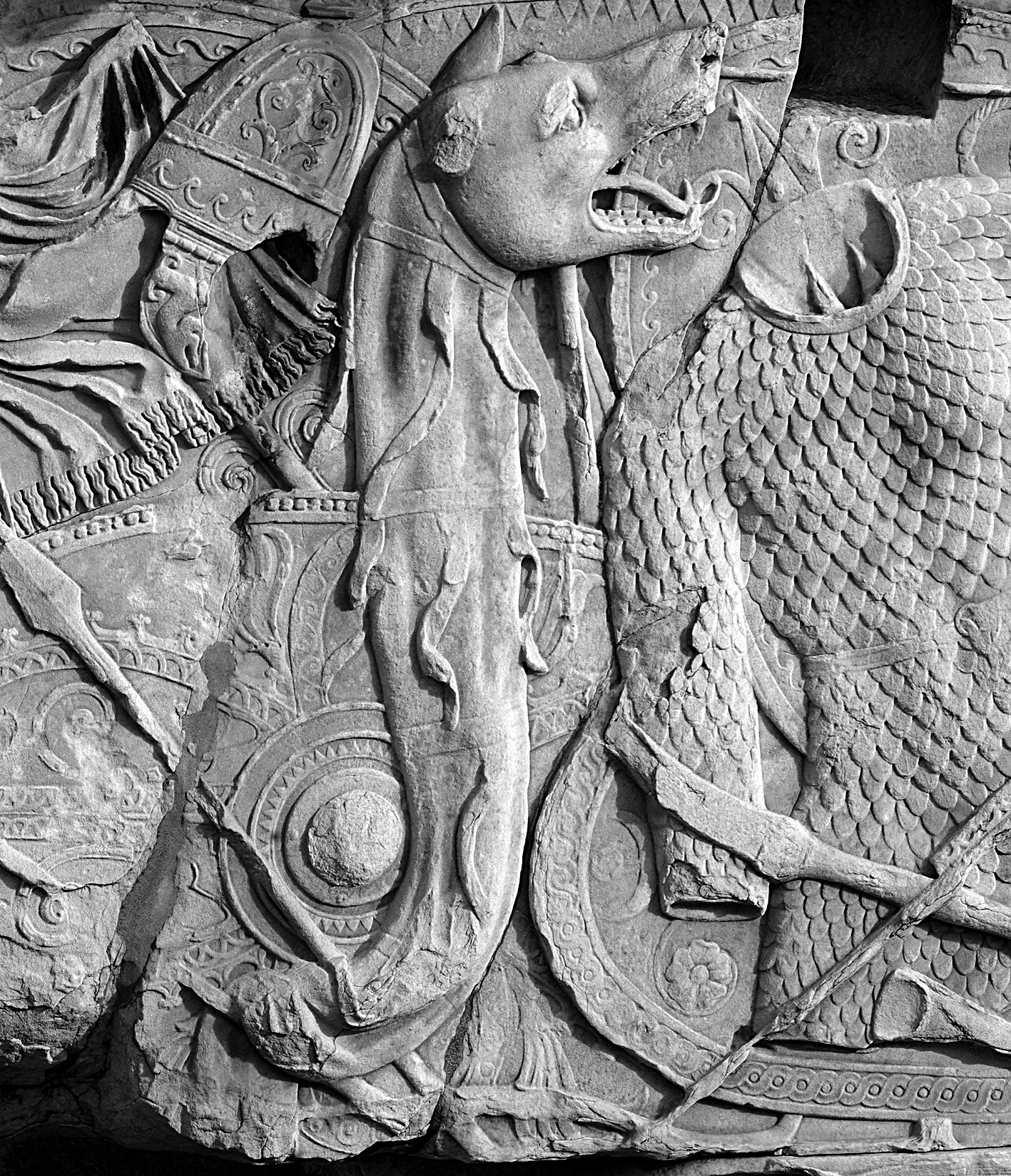
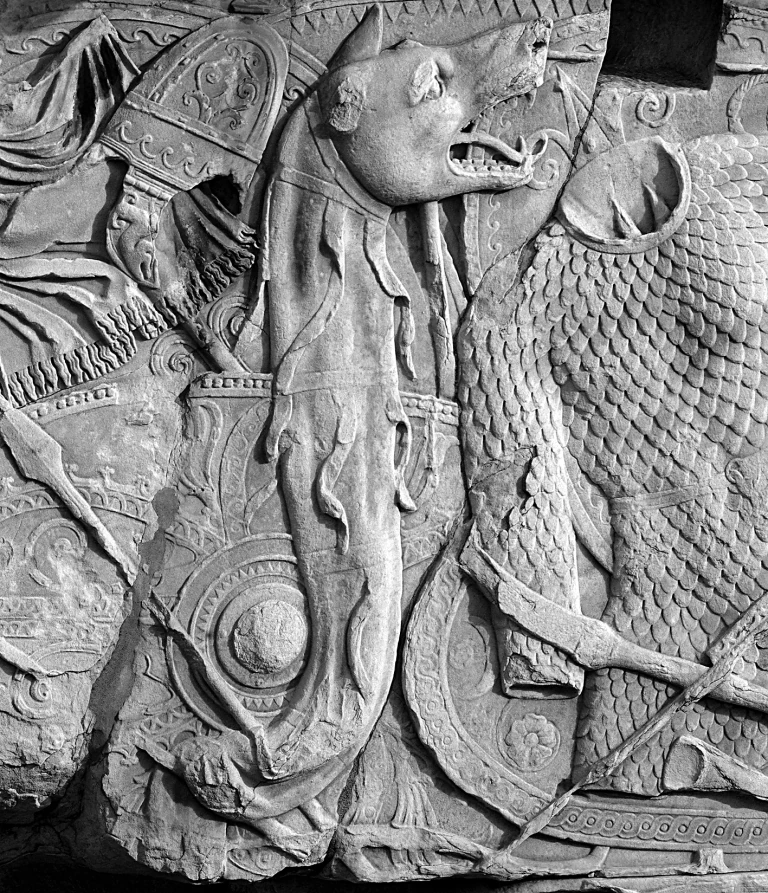
The Dacian draco was a military standard used by troops of the ancient Dacian people, which can be seen in the hands of the soldiers of Decebalus in several scenes depicted on Trajan's Column in Rome, Italy. This wind instrument has the form of a dragon with open wolf-like jaws containing several metal tongues. The hollow dragon's head was mounted on a pole with a fabric tube affixed at the rear. In use, the draco was held up into the wind, or above the head of a horseman, where it filled with air and gave the impression it was alive while making a shrill sound as the wind passed through its strips of material. The Dacian draco likely influenced the development of the similar Roman draco.
Dacian mythology | Myth and Folklore Wiki | Fandom
Rich and diverse, the Dacian mythology is overshadowed by the Greek or Roman mythologies. It stands out particularly for its wolf cult, for its fantastic characters such as the werewolf or the...
The dacian stronghold and the wolf-warriors: SARMISEGETUSA REGIA

Roman Gladiator
A Roman gladiator was an ancient professional fighter who usually specialised with particular weapons and types of armour. They fought before the public in hugely popular organised games held in large...

DynaDraw - A Dynamic Drawing Program
The program Dynadraw implements a dynamic drawing technique that applies a simple filter to mouse positions. Here the brush is modeled as a physical object with mass, velocity and friction. The mouse pulls on the brush with a synthetic rubber band. By changing the amount of friction and mass, various kinds of strokes can be made. This kind of dynamic filtering makes it easy to create smooth, consistent calligraphic strokes.
Bitwig | Home | Bitwig
Bitwig Studio is a digital audio workstation (DAW) and music production software. Design sounds. Build instruments. Make music. Download today.
Hypogeum of the Aurelii
The Hypogeum of the Aurelii or the Hypogeum of Aurelius Felicissimus is a privately run catacomb in Rome.[1] It is sited at the junction of the modern viale Manzoni and via Luzzatti, behind the ancient via Labicana, in the Esquilino district.[2] It is on two levels, the upper one originally being a semi-underground hall (only the bottom part of which survives) and the lower one consisting of two completely underground spaces.[3]
Traces of Necromantic Divinatory Practices in the Picatrix
In the famous medieval magical manual called the Picatrix, the unknown author describes the phenomenon of magic with the term nigromantia. As is well known, the original meaning of the Greek term necromantia has a more concise meaning. It is used for a special kind of divination, i.e., divination through the parts of a cadaver and the conjured spirit of the dead. Seemingly, in the Picatrix, no necromantic ritual can be found; moreover, the author stresses that his main goal is pious, i.e., to find the path leading to the ultimate source of the universe, the one and only God. In my article, I show that on some pages of the Picatrix, there are traces of divinatory practices that may be connected to the original meaning of the term nigromantia. In the third book of the manual, descriptions of some interesting rituals attributed to the pagan Sabeans of Harran and their teacher, the god Hermes can be found. During the practices, the magician involved conjured spirits of the heavenly bodies and powers as well. Because of this, by looking closely at and analyzing the given text, it is possible to piece together a complex web of necromantic and demonic divinatory rituals.

Dacian Fortresses of the Orestie Mountains - UNESCO World Heritage Site
Stridulation
Stridulation is the act of producing sound by rubbing together certain body parts. This behavior is mostly associated with insects, but other animals are known to do this as well, such as a number of species of fish, snakes and spiders. The mechanism is typically that of one structure with a well-defined lip, ridge, or nodules (the "scraper" or plectrum) being moved across a finely-ridged surface (the "file" or stridulitrum—sometimes called the pars stridens) or vice versa, and vibrating as it does so, like the dragging of a phonograph needle across a vinyl record. Sometimes it is the structure bearing the file which resonates to produce the sound, but in other cases it is the structure bearing the scraper, with both variants possible in related groups.[1] Common onomatopoeic words for the sounds produced by stridulation include chirp and chirrup.
There is a best Digital Audio Workstation
A DAW, or Digital Audio Workstation, is a big, fancy environment for working with sound. The common truism is, to an extent, true: you can do anything in any DAW. But the more advanced you get, or the more niche your need, the more friction you'll encounter if you

Introduction · Crafting Interpreters
Fairy tales are more than true: not because they tell us that dragons exist, but because they tell us that dragons can be beaten.
Sarmizegetusa Regia
Sarmizegetusa Regia was the capital and the most important military, religious and political centre of the Dacians before the wars with the Roman Empire. Built on top of a 1200 m high mountain, the fortress, consisting of six citadels, was the core of a strategic and defensive system in the Orăștie Mountains. The archaeological site of Sarmizegetusa Regia is located in the village of Grădiștea de Munte in Hunedoara County.
