


In computational geometry, a Delaunay triangulation or Delone triangulation of a set of points in the plane subdivides their convex hull into triangles whose circumcircles do not contain any of the points; that is, each circumcircle has its generating points on its circumference, but all other points in the set are outside of it. This maximizes the size of the smallest angle in any of the triangles, and tends to avoid sliver triangles.
d3-delaunay/src/delaunay.js at main · d3/d3-delaunay
Compute the Voronoi diagram of a set of two-dimensional points. - d3/d3-delaunay
Red Blob Games: Delaunay+Voronoi on a sphere
I usually work with 2D map generation, in part because it’s easier, but also in part because I enjoy games with flat worlds + heightmaps more than I like games with sphere (curved) worlds. I’ve wanted to learn how to work with spheres so that I could make maps of entire planets, like I saw in this spherical voronoi map generation project[1] on and this spherical hexagon+pentagon map generation project[2] (both of those pages have fantastic screenshots). I decided ProcJam 2018[3] would be a good time to learn this.
Nicole Feng
We introduce a method for approximating the signed distance function (SDF) of geometry corrupted by holes, noise, or self-intersections. The method implicitly defines a completed version of the shape, rather than explicitly repairing the given input. Our starting point is a modified version of the heat method for geodesic distance, which diffuses normal vectors rather than a scalar distribution. This formulation provides robustness akin to generalized winding numbers (GWN), but provides distance function rather than just an inside/outside classification. Our formulation also offers several features not common to classic distance algorithms, such as the ability to simultaneously fit multiple level sets, a notion of distance for geometry that does not topologically bound any region, and the ability to mix and match signed and unsigned distance. The method can be applied in any dimension and to any spatial discretization, including triangle meshes, tet meshes, point clouds, polygonal meshes, voxelized surfaces, and regular grids. We evaluate the method on several challenging examples, implementing normal offsets and other morphological operations directly on imperfect curve and surface data. In many cases we also obtain an inside/outside classification dramatically more robust than the one obtained provided by GWN.
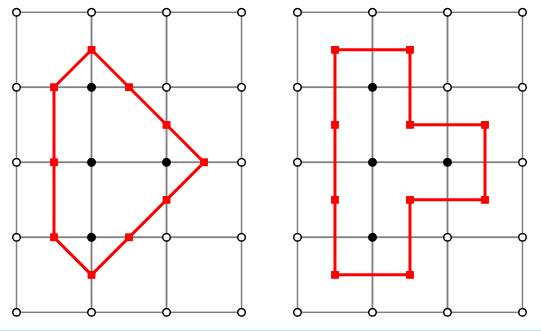
Binary, Hanoi, and Sierpinski, part 2
Computational Geometry in C (Second Edition)
Homepage for textbook on Computational Geometry
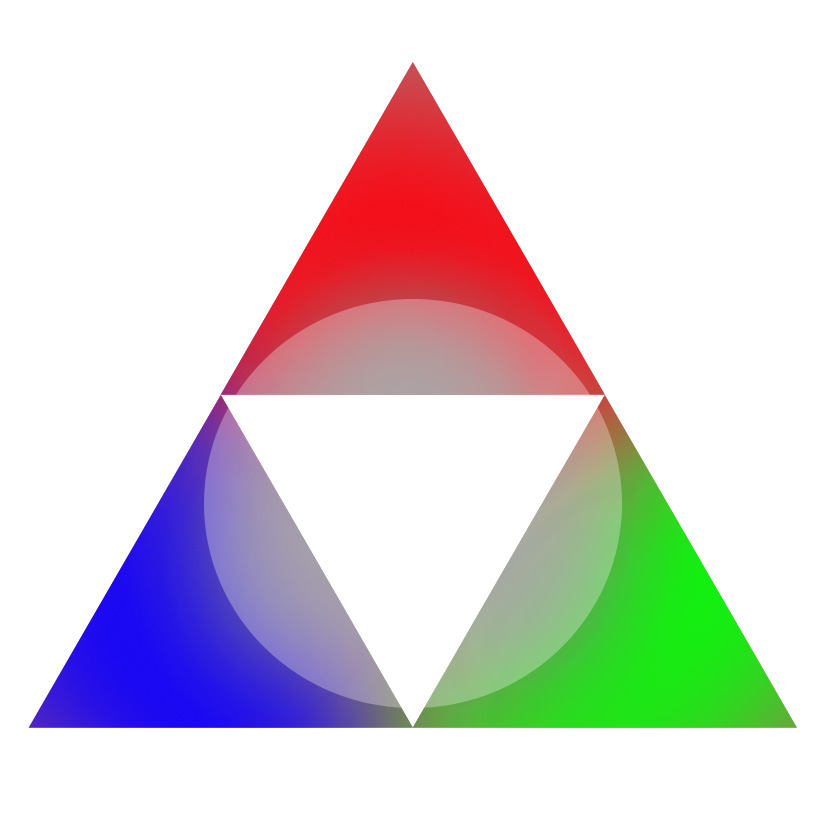
“The Triangle” tool for your game design purposes
I think that game design theory often has the issue of “seeming cool” while not being terribly practically useful, or only having very narrow utility. Of all of the game design theory I’ve worked o…
Dual Contouring Tutorial
How to create a sharp mesh from a function without even trying In part 1 and part 2 of the series, we looked at the Marching Cubes algorithm, and how it can turn any function into a grid based mesh…
Binary, Hanoi and Sierpinski, part 1
Truly Subquadratic 3SUM and Truly Subcubic APSP via Triangles in Sparse Lopsided Graphs
We give the first polynomial improvements over the textbook algorithms for $3$SUM and All-Pairs Shortest Paths (APSP): we show how to deterministically solve $3$SUM on $n$ integers of polynomial size in $O(n^{1.9992})$ time and APSP on directed $n$-vertex graphs with polynomially bounded integer weights in $O(n^{2.9995})$ time. This refutes the $3$SUM and APSP hypotheses. Using known reductions, we also refute the real-valued versions of the $3$SUM and APSP hypotheses, the Exact Triangle hypothesis, the Zero-Weight $k$-Clique hypotheses, and the three rectangular hinted Online Matrix--Vector conjectures of van den Brand, Nanongkai, and Saranurak, and we give polynomial speedups for a variety of other problems. All of these results follow from a single new algorithm for thin matrix products. Let $X$ be an $N\times D$ integer matrix and $Y$ a $D\times N$ integer matrix with $D\le N^{1/18}$, and let $W$ be any set of at most $N^2/\sqrt D$ positions. We compute the entries $(XY)[I,J]$, $(I,J)\in W$, in $O(N^2/D^{0.063})$ operations, which is polynomially less than the time needed to write down $XY$ or to compute $N^2/\sqrt D$ inner products one by one. We design this algorithm by modifying a variant of Coppersmith's rectangular matrix multiplication algorithm, built from a ten-multiplication identity of Schönhage, to perform only the operations needed for the entries in $W$, and show that few operations are needed. Interpreted as a graph algorithm, this solves the All-Edges Sparse Triangle problem in truly subquadratic time on sparse lopsided tripartite graphs where two parts have $n$ vertices but one part has $n^{\varepsilon}$ vertices for $\varepsilon<0.12$. By known reductions, Exact Triangle, and hence $3$SUM and APSP, reduce to this problem. We also give a data structure version that answers queries for single entries of $XY$, not known in advance.

Massively Parallel Rendering of Complex Closed-Form Implicit Surfaces
Figure 1: An assortment of implicit surfaces rendered using our technique. Left: an extruded text string, rotated and rendered as a heightmap. Center: a bear head sculpted using smooth blending operations, with normals found by automatic differentiation. Right: a complex architectural model rendered with screen-space ambient occlusion and perspective. All models are rendered directly from their mathematical representations, without triangulation or raytracing.
Quaternius • Free Game Assets
A library of hundreds of free Low Poly 3D Models, using the CC0 License.

The Affine Plank Conjecture | Zaz Brown
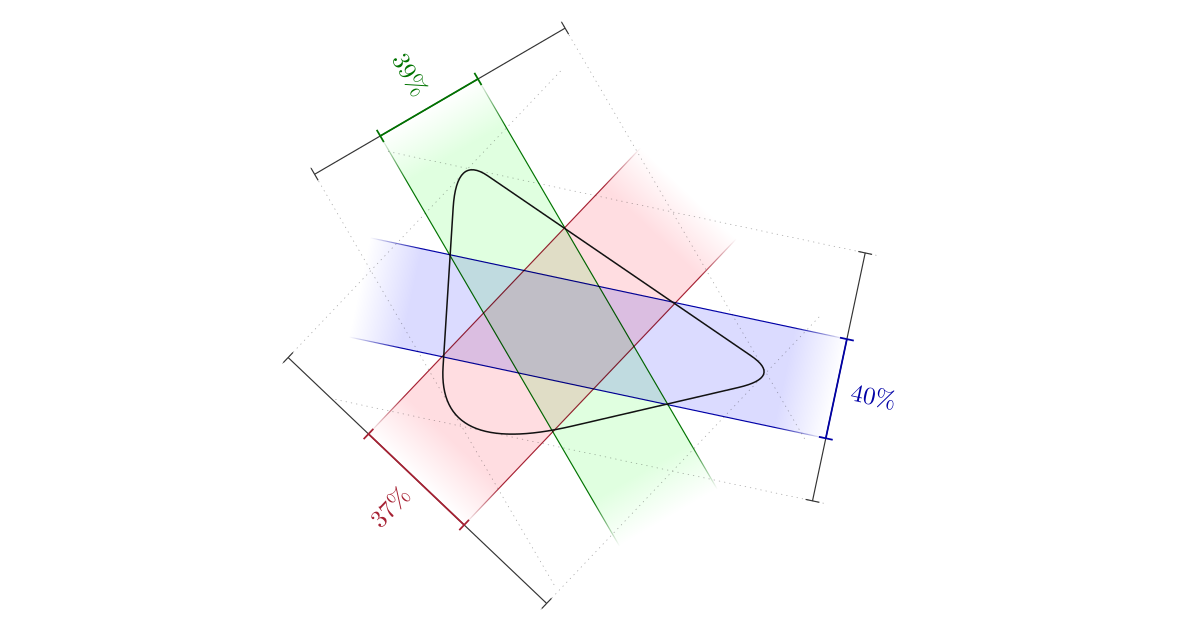
An illustrated explanation of relative plank widths, an interactive visualization, and proofs for three planks.
Micro-Mesh Overview (Part 1) | Of Shaders & Triangles
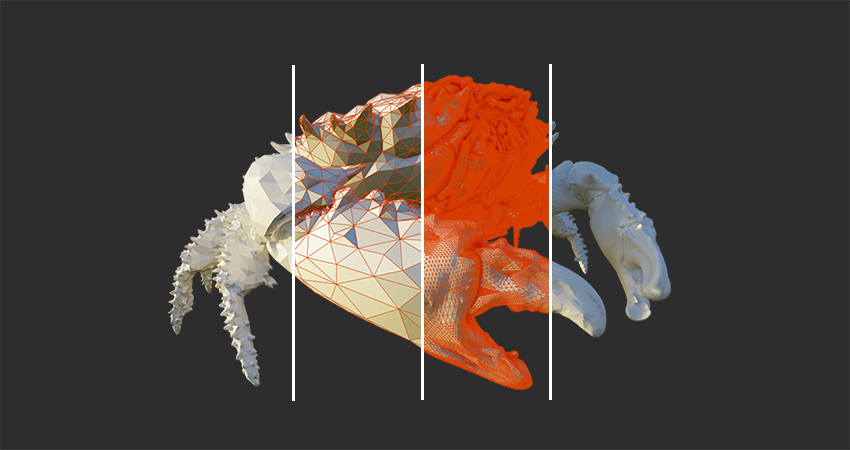
Today, we’ll be talking about micro-meshes. The explanation will be high-level and incomplete because I am still in the course of understanding as well. Micro-mesh as a concept is proposed by NVIDIA, and promises three things, basically:
journey to the center of a triangle