


The demographics of Queens, the second-most populous borough in New York City, are highly diverse. No racial or ethnic group holds a majority in the borough.
Nearly a quarter of NYC’s early voters were new Democratic primary participants
A total of 385,184 New Yorkers voted early in this primary election, compared to 191,197 in 2021.

Get a Library Card | Queens Public Library
Queens Public Library serves 2.3 million people from 66 locations.
As diversity increases, people paradoxically perceive social groups as more similar
With globalization and immigration, societal contexts differ in sheer variety of resident social groups. Social diversity challenges individuals to think in new ways about new kinds of people and where their groups all stand, relative to each other. However, psychological science does not yet specify how human minds represent social diversity, in homogeneous or heterogenous contexts. Mental maps of the array of society’s groups should differ when individuals inhabit more and less diverse ecologies. Nonetheless, predictions disagree on how they should differ. Confirmation bias suggests more diversity means more stereotype dispersion: With increased exposure, perceivers’ mental maps might differentiate more among groups, so their stereotypes would spread out (disperse). In contrast, individuation suggests more diversity means less stereotype dispersion, as perceivers experience within-group variety and between-group overlap. Worldwide, nationwide, individual, and longitudinal datasets ( n = 12,011) revealed a diversity paradox: More diversity consistently meant less stereotype dispersion. Both contextual and perceived ethnic diversity correlate with decreased stereotype dispersion. Countries and US states with higher levels of ethnic diversity (e.g., South Africa and Hawaii, versus South Korea and Vermont), online individuals who perceive more ethnic diversity, and students who moved to more ethnically diverse colleges mentally represent ethnic groups as more similar to each other, on warmth and competence stereotypes. Homogeneity shows more-differentiated stereotypes; ironically, those with the least exposure have the most-distinct stereotypes. Diversity means less-differentiated stereotypes, as in the melting pot metaphor. Diversity and reduced dispersion also correlate positively with subjective wellbeing.

Private School Demographics — ProPublica
Look up the demographics of private schools across the country and see how they compare to the public schools nearby.

New York Road Runners
New York Road Runners serves 695,000 runners of all ages and abilities annually through hundreds of races, community open runs, walks, training, and more. <br/>
More Than Half the World Is Now Urban, UN Report Says
The world’s population is now 6.6 billion, according to a new UN report, and slightly more than half live in urban areas, the majority of them in developing countries.

New York City cast vote record: An initial analysis of the 2025 Democratic mayoral primary - FairVote
This post explores the New York City cast vote record released July 24 – showing how voters used their rankings in the primary.

Louisiana Population - 2023 Stats & Trends | Neilsberg
Explore Louisiana population by race, ethnicity, age, gender and timeline. Find latest trends in Louisiana's population.
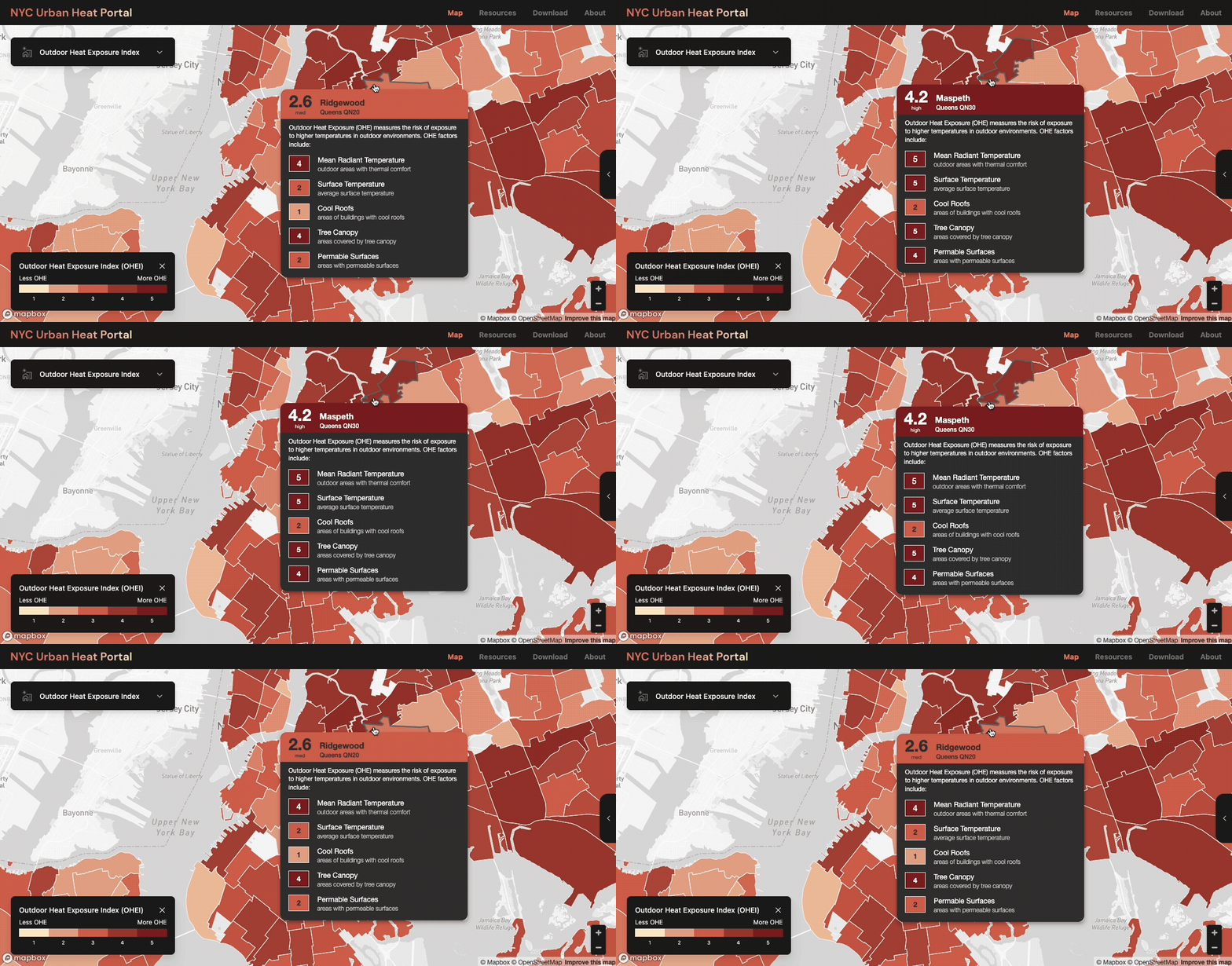
Announcing the NYC Urban Heat Portal: Explore, Understand, and Act on Urban Heat - BetaNYC
BetaNYC is excited to announce the launch of the NYC Urban Heat Portal! Explore it at urbanheat.nyc What is urban heat, and why does it matter? New York City, like many urban areas, faces the Urban Heat Island effect, whereby cityscapes become significantly warmer than surrounding rural areas. The growing challenge of extreme heat is
Why Diversity Programs Fail
After Wall Street firms repeatedly had to shell out millions to settle discrimination lawsuits, businesses started to get serious about their efforts to increase diversity. But unfortunately, they don’t seem to be getting results: Women and minorities have not gained much ground in management over the past 20 years. The problem is, organizations are trying to reduce bias with the same kinds of programs they’ve been using since the 1960s. And the usual tools—diversity training, hiring tests, performance ratings, grievance systems—tend to make things worse, not better. The authors’ analysis of data from 829 firms over three decades shows that these tools actually decrease the proportion of women and minorities in management. They’re designed to preempt lawsuits by policing managers’ decisions and actions. But as lab studies show, this kind of force-feeding can activate bias and encourage rebellion. However, in their analysis the authors uncovered numerous diversity tactics that do move the needle, such as recruiting initiatives, mentoring programs, and diversity task forces. They engage managers in solving the problem, increase contact with women and minority workers, and promote social accountability. In this article, the authors dig into the data, executive interviews, and several examples to shed light on what doesn’t work and what does.

Out-group homogeneity
The out-group homogeneity effect is the perception of out-group members as more similar to one another than are in-group members, i.e. "they are alike; we are diverse".[1] Perceivers tend to have impressions about the diversity or variability of group members around those central tendencies or typical attributes of those group members. Thus, outgroup stereotypicality judgments are overestimated, supporting the view that out-group stereotypes are overgeneralizations.[2] The term "outgroup homogeneity effect", "outgroup homogeneity bias" or "relative outgroup homogeneity" have been explicitly contrasted with "outgroup homogeneity" in general,[3] the latter referring to perceived outgroup variability unrelated to perceptions of the ingroup.
Communities are not fungible
There's a default assumption baked into how Silicon Valley builds products, and it tracks against how urban planners redesign neighbourhoods: that communities are interchangeable, and if you "lose" one, you can manufacture a replacement; that the value of a group of people who share space and history can be captured

Why City Benches Are Becoming More Hostile
In Defense of “Y’all,” a Perfect Word
A New York Times columnist says it’s “much too slangy, regional or what you might even call ethnic to ever gain universal acceptance.” We couldn’t disagree more.

What the latest research tells us about racial bias in policing
What we know, and importantly don't know, about the latest research on racial bias in policing.
Voter Turnout Highest in Half Century as Mamdani Phenomenon Galvanizes Electorate
More than 2 million New York voters cast ballots, the most in a mayoral race since 1969.
