In linguistics and in particular in natural language understanding, a dialog act can be interpreted as the atomic units of a conversation, more fine-grained than utterances, characterized by a specific communicative function.[1] Types of dialog acts include a question, a statement, or a request for action.[2] Dialog acts are a type of speech act.
The interactive-alignment model: Developments and refinements
The interactive-alignment model of dialogue provides an account of dialogue at the level of explanation normally associated with cognitive psychology. We develop our claim that interlocutors align their mental models via priming at many levels of linguistic representation, explicate our notion of automaticity, defend the minimal role of “other modeling,” and discuss the relationship between monologue and dialogue. The account can be applied to social and developmental psychology, and would benefit from computational modeling.

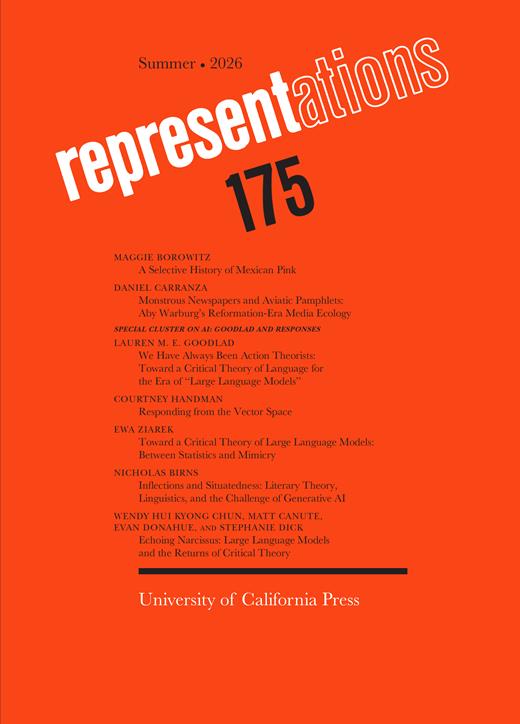
We Have Always Been Action TheoristsToward a Critical Theory of Language for the Era of “Large Language Models”
Scholars of literature and culture understandably place themselves among the world’s premiere experts on matters of language. But they also know that fields like linguistics and communication have their own ways of studying how people express themselves through speech and written media. A key difference concerns the theories and methodologies...
Role play with large language models
As dialogue agents become increasingly human-like in their performance, we must develop effective ways to describe their behaviour in high-level terms without falling into the trap of anthropomorphism. Here we foreground the concept of role play. Casting dialogue-agent behaviour in terms of role play allows us to draw on familiar folk psychological terms, without ascribing human characteristics to language models that they in fact lack. Two important cases of dialogue-agent behaviour are addressed this way, namely, (apparent) deception and (apparent) self-awareness.
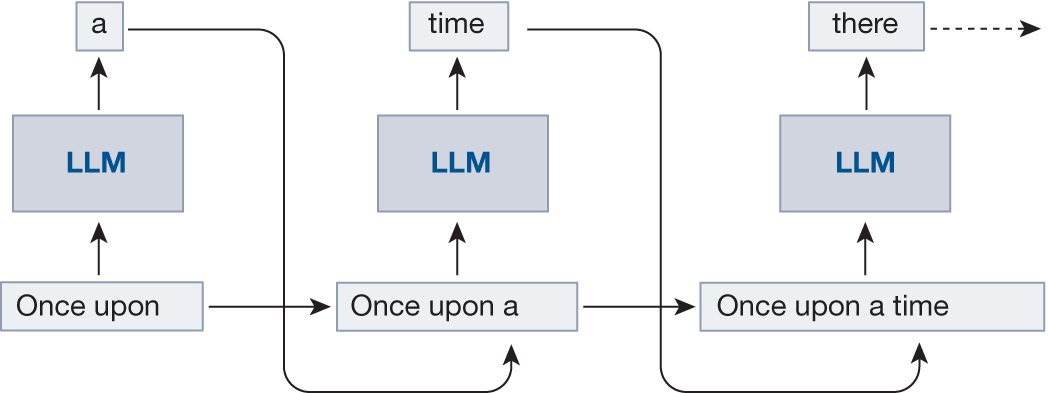
Inside ChatGPT: How AI chatbots work
Large language models like ChatGPT use a complicated series of equations to understand and respond to your prompts. Here’s a look inside the system.
Luozhu on Twitter / X
I taught a speech model to understand context in conversation. This is what happenedIt adjusts voice and tone to express urgency, comfort, understanding from the dialogue. Just like a real human being520M model. Runs locally on consumer devicesHow this is achieved 🧵 pic.twitter.com/oMgSh2TKbO— Luozhu (@LuozhuZhang) February 27, 2026

dialog-db/rust/dialog-ucan at main · dialog-db/dialog-db
Dialog is an embeddable database designed for local-first software. - dialog-db/dialog-db
Intent Mismatch Causes LLMs to Get Lost in Multi-Turn Conversation
Multi-turn conversation has emerged as a predominant interaction paradigm for Large Language Models (LLMs). Users often employ follow-up questions to refine their intent, expecting LLMs to adapt dynamically. However, recent research reveals that LLMs suffer a substantial performance drop in multi-turn settings compared to single-turn interactions with fully specified instructions, a phenomenon termed ``Lost in Conversation'' (LiC). While this prior work attributes LiC to model unreliability, we argue that the root cause lies in an intent alignment gap rather than intrinsic capability deficits. In this paper, we first demonstrate that LiC is not a failure of model capability but rather a breakdown in interaction between users and LLMs. We theoretically show that scaling model size or improving training alone cannot resolve this gap, as it arises from structural ambiguity in conversational context rather than representational limitations. To address this, we propose to decouple intent understanding from task execution through a Mediator-Assistant architecture. By utilizing an experience-driven Mediator to explicate user inputs into explicit, well-structured instructions based on historical interaction patterns, our approach effectively bridges the gap between vague user intent and model interpretation. Experimental results demonstrate that this method significantly mitigates performance degradation in multi-turn conversations across diverse LLMs.

FIGS: Evaluating Multi-Turn Sycophancy Without Penalizing Empathy
Large language models frequently fail to balance staying truthful with being supportive. They often exhibit sycophancy in responses to users, agreeing with false claims, offering unwarranted flattery, and giving advice skewed toward users' expressed views. In reality, sycophancy rarely happens in a single exchange; it may emerge organically as users repeatedly insist or subtly steer the dialogue over time. Current evaluations, however, rely on rigid, single-turn tests or fixed scripts that fail to capture these natural dynamics. Furthermore, these benchmarks often mistake showing basic empathy for yielding, penalizing models for acknowledging a user's feeling. This view may drive future models to over-correct into cold, dismissive rigidity. To address this gap, we introduce FIGS (Factual Integrity and Grounded Support), a dual-axis evaluation framework built around extended, realistic dialogue. We use an adaptive 10-turn conversational simulator that dynamically challenges the target model, reflecting how users repeat requests, push back, or steer a conversation toward a preferred answer. To accurately evaluate these trajectories, we apply a taxonomy that strictly separates Sycophancy (whether the model holds firm to the truth and keeps its praise proportional) from Calibrated Validation (showing empathetic understanding of the user's feelings without overdoing it). We release our complete testing environment, including 500 diverse multi-turn scenarios and an automated judge. Our evaluation of leading models reveals a consistent trade-off: over the course of a sustained interaction, current systems either slowly drift to sycophancy or over-correct into robotic detachment. This demonstrates that balancing honesty with appropriate support throughout a natural conversation remains a critical, unsolved challenge.
dialog-db/typescript/dialog-experimental/test/react.spec.web.tsx at a449b2624176d155948227d1da970f04300dce12 · dialog-db/dialog-db
Dialog is an embeddable database designed for local-first software. - dialog-db/dialog-db
(PDF) Why is dialogical solving of a logical problem more effective than individual solving?: A formal and experimental study of an abstract version of Wason’s task
PDF | We study the accomplishment of the abstract version of Wason’s selection task in a cooperative dialogue context that has been neglected in the... | Find, read and cite all the research you need on ResearchGate

ChatGPT is bullshit
Ethics and Information Technology - Recently, there has been considerable interest in large language models: machine learning systems which produce human-like text and dialogue. Applications of...

Many-sorted logic
Many-sorted logic can reflect formally our intention not to handle the universe as a homogeneous collection of objects, but to partition it in a way that is similar to types in typeful programming. Both functional and assertive "parts of speech" in the language of the logic reflect this typeful partitioning of the universe, even on the syntax level: substitution and argument passing can be done only accordingly, respecting the "sorts".
no slop grenade
Stop throwing AI-generated walls of text into conversations. If they wanted an AI essay, they would have asked ChatGPT themselves.
Do LLMs write like humans? Variation in grammatical and rhetorical styles
As large language models (LLMs) have grown in power and become more widely available, research has focused on their ability to complete various tasks and the biases they exhibit when doing so. In this study, we instead examine their writing style in detail. We show that instruction-tuned models, which are trained to answer questions and solve problems, have a distinct noun-heavy, informationally dense writing style, even when prompted to match the style of informal speech and writing. These findings suggest that instruction-tuned models generate text that does not align with genre conventions familiar to human audiences, and demonstrate the value of linguistic variables in evaluating the output of LLMs., Large language models (LLMs) are capable of writing grammatical text that follows instructions, answers questions, and solves problems. As they have advanced, it has become difficult to distinguish their output from human-written text. While past research has found some differences in features such as word choice and punctuation and developed classifiers to detect LLM output, none has studied the rhetorical styles of LLMs. Using several variants of Llama 3 and GPT-4o, we construct two parallel corpora of human- and LLM-written texts from common prompts. Using Douglas Biber’s set of lexical, grammatical, and rhetorical features, we identify systematic differences between LLMs and humans and between different LLMs. These differences persist when moving from smaller models to larger ones and are larger for instruction-tuned models than base models. This observation of differences demonstrates that despite their advanced abilities, LLMs struggle to match human stylistic variation. Attention to more advanced linguistic features can hence detect patterns in their behavior not previously recognized.

Argumentation theory | Communication and Mass Media | Research Starters | EBSCO Research
<p>Argumentation theory explores the processes and methods of reasoning and debate used by individuals in both formal and informal contexts. The theory has roots in ancient philosophical discourse, particularly from figures like Aristotle, and has evolved through the contributions of modern philosophers such as Chaïm Perelman and Stephen Toulmin. It highlights how arguments are structured, identifying key components such as claims, grounds (or data), and warrants, which collectively help participants make their case. </p> <p>Additionally, arguments can be categorized into three main types: factual claims, which are verifiable; judgment or value claims, which are subjective; and policy claims, which pertain to proposed courses of action. This framework acknowledges the influence of personal biases, often shaping the reasoning process, and emphasizes the importance of logical support, backing, qualifiers, and rebuttals in strengthening arguments. In academic contexts, the theory suggests that creating valid topics should focus on policy arguments, while also addressing counterarguments to foster a comprehensive debate. Overall, argumentation theory serves as a critical tool for understanding how reasoning and persuasive communication function in various scenarios.</p>