


In business theory, disruptive innovation is innovation that creates a new market and value network or enters at the bottom of an existing market and eventually displaces established market-leading firms, products, and alliances. In theory, disruptive innovation makes it hard for leading firms to stay at the top of their industry. The term, "disruptive innovation" was popularized by the American academic Clayton Christensen and his collaborators beginning in 1995.
Disruption is not a strategy
I was at a research lab to talk about commercialization. The presenter put up a slide of some exciting new technologies. The slide’s tagline said these technologies would “disrupt the b…

TransCap Initiative
A collaborative innovation space for building the field of systemic investing

Separating AI’s Technological Problems From its Capitalism Problems
Nathan E. Sanders and Bruce Schneier say integrating a technology as disruptive as AI responsibly requires deep structural reforms.

Dawn of a new era in Search: Balancing innovation, competition, and public good | Kagi Blog
Google search is in the news.
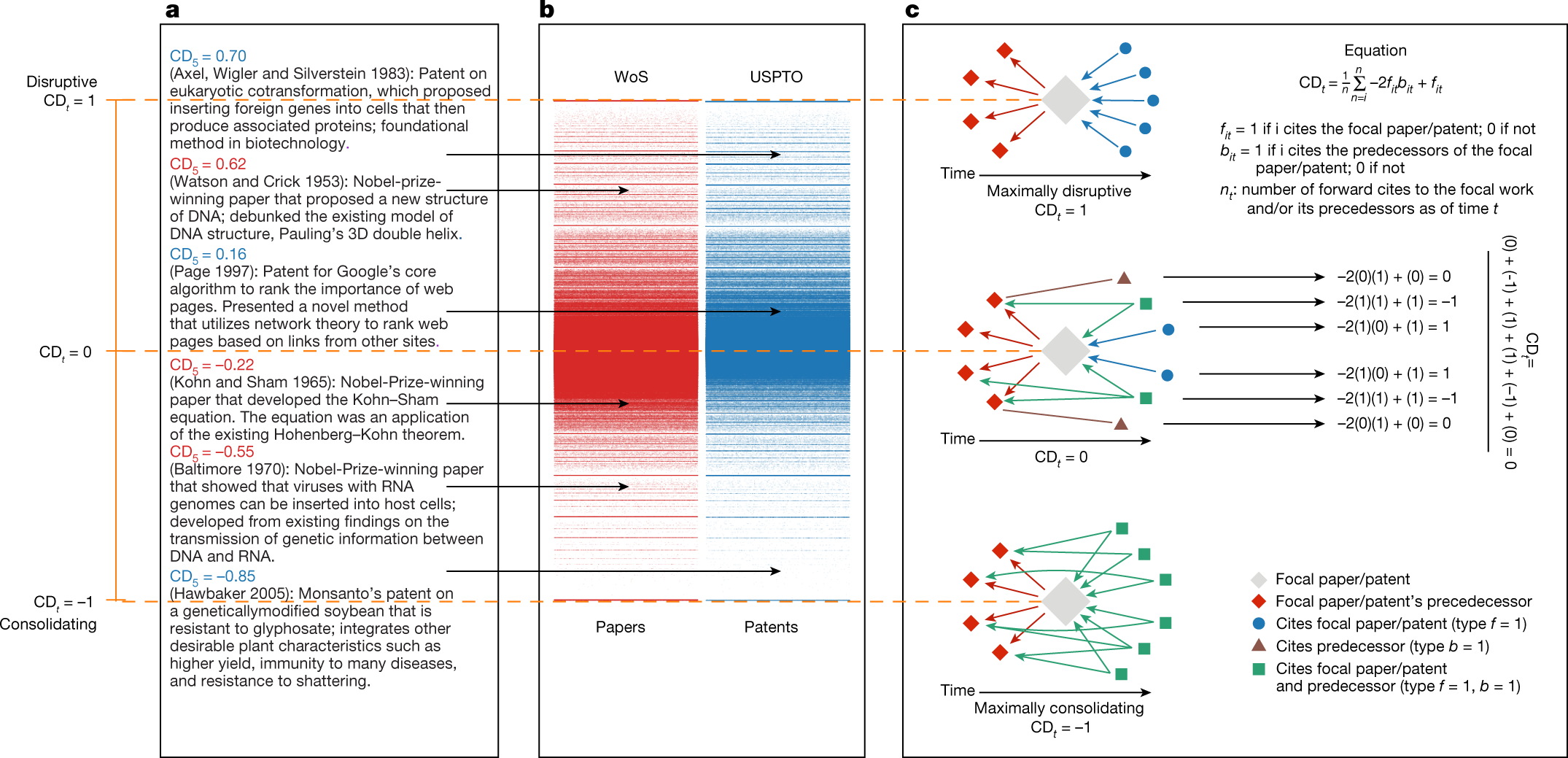
Papers and patents are becoming less disruptive over time
Theories of scientific and technological change view discovery and invention as endogenous processes1,2, wherein previous accumulated knowledge enables future progress by allowing researchers to, in Newton’s words, ‘stand on the shoulders of giants’3–7. Recent decades have witnessed exponential growth in the volume of new scientific and technological knowledge, thereby creating conditions that should be ripe for major advances8,9. Yet contrary to this view, studies suggest that progress is slowing in several major fields10,11. Here, we analyse these claims at scale across six decades, using data on 45 million papers and 3.9 million patents from six large-scale datasets, together with a new quantitative metric—the CD index12—that characterizes how papers and patents change networks of citations in science and technology. We find that papers and patents are increasingly less likely to break with the past in ways that push science and technology in new directions. This pattern holds universally across fields and is robust across multiple different citation- and text-based metrics1,13–17. Subsequently, we link this decline in disruptiveness to a narrowing in the use of previous knowledge, allowing us to reconcile the patterns we observe with the ‘shoulders of giants’ view. We find that the observed declines are unlikely to be driven by changes in the quality of published science, citation practices or field-specific factors. Overall, our results suggest that slowing rates of disruption may reflect a fundamental shift in the nature of science and technology.
Business Model Innovation - an overview | ScienceDirect Topics
Coopting Disruption
Our economy is dominated by five aging tech giants – Alphabet, Amazon, Apple, Meta, and Microsoft. In the last twenty years, no company has commercialized a new

Lessons From Three Women Founders Using AI To Disrupt Billion-Dollar Industries
Three women founders share how they're using AI to disrupt billion-dollar industries—and the mindset it takes to keep going when everything feels stacked against you.

Who—and What—Will Customers Become? - DesignIntelligence
Innovation transforms the customer as well as the product

Silicon Valley, disruption, and the end of uncertainty
This paper reflects on the relationship between high-tech disruption narratives and uncertainty. My main argument is that an economic sociology of the future is incomplete without addressing the ‘d...

The Evolutionary Ecology of Software: Constraints, Innovation, and the AI Disruption
This chapter investigates the evolutionary ecology of software, focusing on the symbiotic relationship between software and innovation. An interplay between constraints, tinkering, and frequency-dependent selection drives the complex evolutionary trajectories of these socio-technological systems. Our approach integrates agent-based modeling and case studies, drawing on complex network analysis and evolutionary theory to explore how software evolves under the competing forces of novelty generation and imitation. By examining the evolution of programming languages and their impact on developer practices, we illustrate how technological artifacts co-evolve with and shape societal norms, cultural dynamics, and human interactions. This ecological perspective also informs our analysis of the emerging role of AI-driven development tools in software evolution. While large language models (LLMs) provide unprecedented access to information, their widespread adoption introduces new evolutionary pressures that may contribute to cultural stagnation, much like the decline of diversity in past software ecosystems. Understanding the evolutionary pressures introduced by AI-mediated software production is critical for anticipating broader patterns of cultural change, technological adaptation, and the future of software innovation.

CanInnovate | Kyle Briggs | Substack
I write about innovation, entrepreneurship, intellectual property, and related policy. I comment on the incentives created by existing policy structures and recommend practical ways to enact positive change. Click to read CanInnovate, by Kyle Briggs, a Substack publication with hundreds of subscribers.

Natalia Emanuel on Twitter / X
Coffee shops boost innovation. 10% more Starbucks in an area --> 3-4% more inventions. People gather over a cuppa. They share ideas, discuss how to untangle a knotty problem, help see an issue from another perspective. These conversations lead to breakthroughs and inventions.… pic.twitter.com/3LwKtrgG5E— Natalia Emanuel (@NataliaHEmanuel) October 9, 2026

Capital and CHI: Technological Capture and How It Structures CHI Research
This paper advances a theoretical argument about the role capital plays in structuring CHI research. We introduce the concept of technological capture to theorize the mechanism by which this happens. Using this concept, we decompose the effect on CHI into four broad forms: technological capture creates market-creating, market-expanding, market-aligned, and externality-reducing CHI research. We place different CHI subcommunities into these forms -- arguing that many of their values are inherited from capital underlying the field. Rather than a disciplinary- or conference-oriented conceptualization of the field, this work theorizes CHI as tightly-coupled with capital via technological capture. The paper concludes by discussing some implications for CHI.