


Double Diamond is a design process model popularized by the British Design Council in 2005. The process was adapted from the divergence-convergence model proposed in 1996 by Hungarian-American linguist Béla H. Bánáthy. The two diamonds represent a process of exploring an issue more widely or deeply and then taking focused action . It suggests that, as a design method, the design process should have four phases:Discover: Understand the issue, rather than assuming its nature: speak to and spend time with people who are affected by the issue, to find out which problems are common among users. It is critical to start from the issue you aim to address, and not from the solution you wish to use. Define: With insight gathered from the discovery phase, distill the information, identify chains of cause-and-effect, and define the problem. This requires both differentiating and synthesizing the challenges faced by many users, to outline the problem space and appreciate its complexity. Develop: Come up with different solutions to the clearly defined problem, seeking inspiration from elsewhere and co-designing with a range of different people and specialties. Approaching a problem with a variety of strategies accesses creative solutions which may not be apparent to those experienced in one particular field. Deliver: Test different solutions at a small scale, and iterate and improve the solutions which address users' needs. Reject solutions that do not work, or cannot scale up to practical application.
An introduction to radical participatory design: decolonising participatory design processes
Outside of community-led design projects, most participatory design processes initiated by a company or organisation maintain or even strengthen power imbalances between the design organisation and the community on whose purported behalf they are designing, further increasing the absencing experience. Radical participatory design (RPD) is a radically relational answer to the coloniality inherent in participatory design where the community members’ disappointment is greater due to the greater expectations and presencing potential of a ‘participatory design’ process. We introduce the term RPD to show how research and design processes can be truly participatory to the root or core. Instead of treating participatory design as a method, a way of conducting a method, or a methodology, we introduce RPD as a meta-methodology, a way of doing any methodology. We explicitly describe what participation means and compare and contrast design processes based on the amount of participation, creating a typology of participation. We introduce ‘designer as community member’, ‘community member as designer,’ and ‘community member as facilitator’ models and provide characteristics for the meta-methodology of RPD.
An introduction to radical participatory design: decolonising participatory design processes
Outside of community-led design projects, most participatory design processes initiated by a company or organisation maintain or even strengthen power imbalances between the design organisation and the community on whose purported behalf they are designing, further increasing the absencing experience. Radical participatory design (RPD) is a radically relational answer to the coloniality inherent in participatory design where the community members’ disappointment is greater due to the greater expectations and presencing potential of a ‘participatory design’ process. We introduce the term RPD to show how research and design processes can be truly participatory to the root or core. Instead of treating participatory design as a method, a way of conducting a method, or a methodology, we introduce RPD as a meta-methodology, a way of doing any methodology. We explicitly describe what participation means and compare and contrast design processes based on the amount of participation, creating a typology of participation. We introduce ‘designer as community member’, ‘community member as designer,’ and ‘community member as facilitator’ models and provide characteristics for the meta-methodology of RPD.
Special Issue Editorial – Accumulation and Evolution of Design Knowledge in Design Science Research: A Journey Through Time and Space
Sir Isaac Newton (1676) famously said, “If I have seen further, it is by standing on the shoulders of giants.” Research is a collaborative, evolutionary endeavor—and it is no different with design science research (DSR), which builds upon existing design knowledge and creates new design knowledge to pass on to future projects. However, despite the vast, growing body of DSR contributions, scant evidence of the accumulation and evolution of design knowledge has been articulated in an organized DSR body of knowledge. Most contributions rather stand on their own feet than on the shoulders of giants, and this continues to limit how far we can see, curtailing the extent of the broader impacts that can be made through DSR. In this editorial, we aim at providing guidance on how to position design knowledge contributions in wider problem and solution spaces. We propose (1) a model conceptualizing design knowledge as a resilient relationship between problem and solution spaces, (2) a model that demonstrates how individual DSR projects consume and produce design knowledge, (3) a map to position a design knowledge contribution in problem and solution spaces, and (4) principles on how to use this map in a DSR project. We show how fellow researchers, readers, editors, and reviewers, as well as the IS community as a whole, can make use of these proposals, and also illustrate future research opportunities.
Jenny Wen: The design process is dead. Why Designers can no longer trust it.
Design Sprints
A structured, time-boxed process for rapidly exploring problems, generating ideas, and validating solutions with real users.

Designs for the pluriverse: radical interdependence, autonomy, and the making of worlds
"Arturo Escobar presents a new vision of design theory by arguing for the creation of what he calls 'autonomous design'--a design practice aimed at channeling design's world-making capacity toward ways of being and doing that are deeply attuned to justice and the Earth"--Publisher description

A Design Science Research Methodology for Expert Systems Development
The knowledge of design science research (DSR) can have applications for improving expert systems (ES) development research. Although significant progress of utilising DSR has been observed in particular information systems design – such as decision support systems (DSS) studies – only rare attempts can be found in the ES design literature. Therefore, the aim of this study is to investigate the use of DSR for ES design. First, we explore the ES development literature to reveal the presence of DSR as a research methodology. For this, we select relevant literature criteria and apply a qualitative content analysis in order to generate themes inductively to match the DSR components. Second, utilising the findings of the comparison, we determine a new DSR approach for designing a specific ES that is guided by another result – the findings of a content analysis of examination scripts in Mathematics. The specific ES artefact for a case demonstration is designed for addressing the requirement of a ‘wicked’ problem in that the key purpose is to assist human assessors when evaluating multi-step question (MSQ) solutions. It is anticipated that the proposed design knowledge, in terms of both problem class and functions of ES artefacts, will help ES designers and researchers to address similar issues for designing information system solutions.
Thinking in Triplicate — Mule Design
To align design and business, visualize the shared narratives

Why design systems are a single point of failure
Tools and techniques to prevent design system collapse
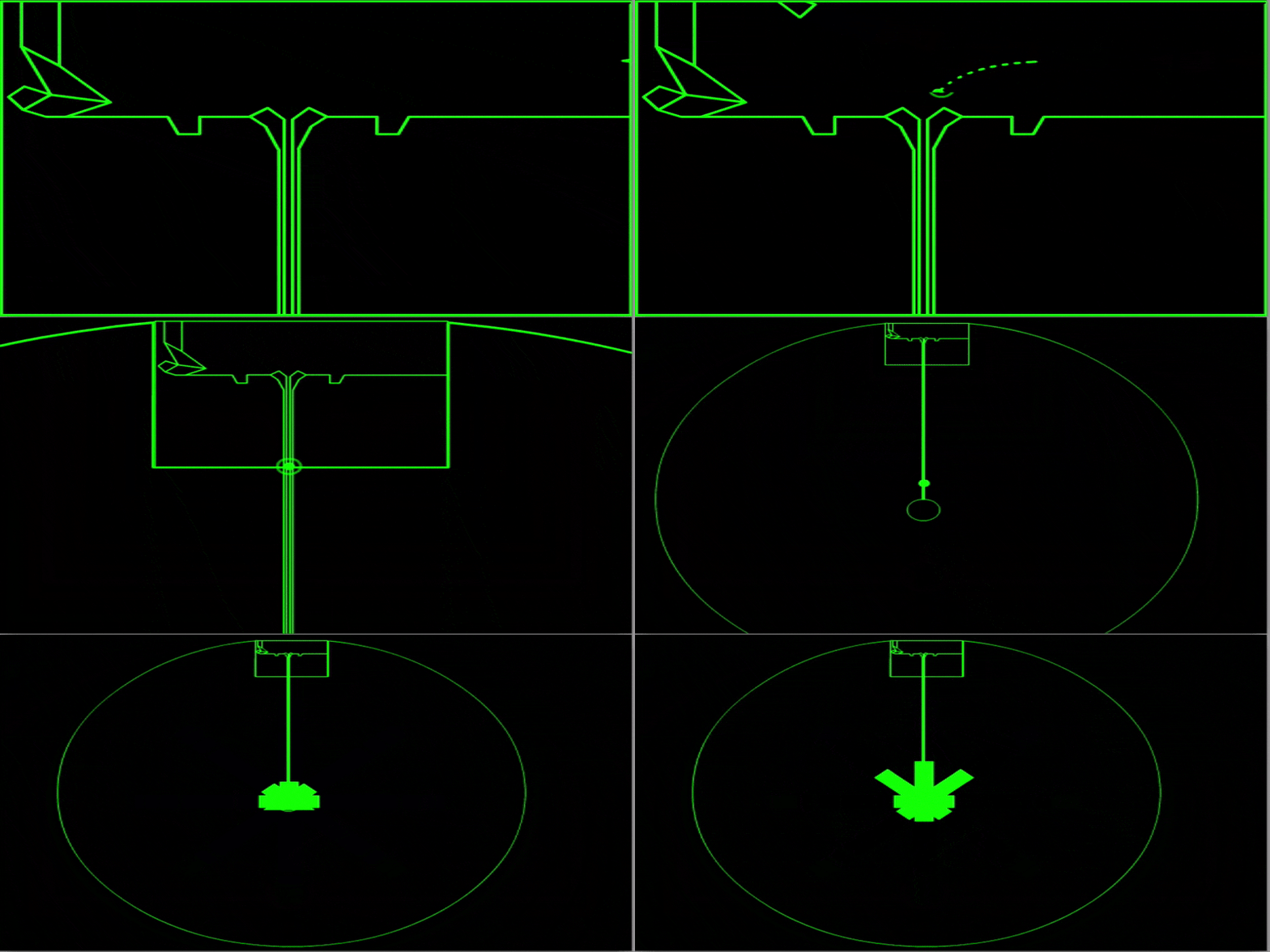
We need to talk about the social graph - Philip Sheldrake
Concepts are the fundamental building blocks of thinking, of designing. While there are plenty of things in the mix when it comes to contemplating system design, if the primary concepts remain unchallenged and unchanged from what came before, then the outcome will likely look very familiar.

Inside Design Tokens: Modeling & Communication
Design system architecture with focus on design tokens, that form the vocabulary of your visual design language, helping to streamline the communication amongst stakeholders. Modeling the system with boundaries to ensure clear purpose and predictability for design tokens and stability guarantees wit
Welcome to the Relational Design Lab | LX Cast | 19 comments
Today I am VERY excited to share with all of you about my new home, Relational Design Lab! This R&D studio brings together a number of projects and will, I hope, grow to encompass many more. I imagine this lab as a gathering place for curious people who want to think about systems, and not in the typical mechanistic way they are described and implemented in technology. Instead, we'll feel into living systems, fractal ways of being, where the how is as important as the what. Over time, I hope the Lab will be a home or a waypoint for designers, researchers, community organizations, artists, storytellers, and technologists to explore togetherness together. Our 'theory of change' focuses on paradigm shift. Big change takes practice and possibility. Paradoxically, paradigm shift is a result of many small changes and repetitions in our behaviour and belief systems. We embrace emergence, mutual support, collective practice, and storytelling. One thing feels pretty clear, we need technology that is designed in solidarity with mutual care, does not depend on the whims of big corporations or its surveillance, and is joyful to use. To live in this reality, we also need to consider how business, funding, governance, scale, and context affect our work. We need embodied ways of knowing and sharing knowledge alongside our technical reasoning. And we need to face the reality of the consequences of our actions and those of our ancestors. This is not a project that aims to solve all the world's problems, but instead, to nurture the capacity for doing things together. We support and practice responding with curiosity and care, not with answers or attachment to ideals that no longer make sense amid collapsing systems. We are not "hiring" for this project now but there are many ways to get involved and would welcome opportunities to collaborate. Some of the projects we're holding include Folk Tech, Spacious, SEED Founding, and Relational Source License. We're also developing a very cool workshop process to help other organizations explore relational design through a community-driven futurism process. As ecosystem supporters, we are developing relationships with many aligned groups and projects as well. There will be more communications coming! If this all sounds like something you would like to support, contribute to, keep track of, or develop relationship with, for now you can subscribe to our calendar here https://lnkd.in/gPRFW7zC and message me directly! | 19 comments on LinkedIn

Co-creating with emergent processes ✦ Hijinx World
Existential musings over algorithmic design with creative programming legend Dan Tapper.

Worst Possible Idea
There are many brainstorming methods (including bodystorming, p.30, brainwriting 6-3-5, p.32 and group passing, p.82) that are each useful in different circumstances. However, sometimes it can be difficult for people in a group setting to generate ideas. This may be because people are too stuck in current ways of thinking, or they might be concerned about being judged by others for the ideas they propose. Giving people the permission to come up with their worst possible ideas creates a playful, safe environment and helps to get a brainstorming session off to a good start. Ideas might build on each other during the process, and it is indeed possible to generate an idea or way of thinking about the problem that can be fed back into the design process. Managers that have used this method with their teams report that it outperforms by far any other brainstorming method (Dorf, 2017), largely because of its ability to energise a room and enable lateral thinking.