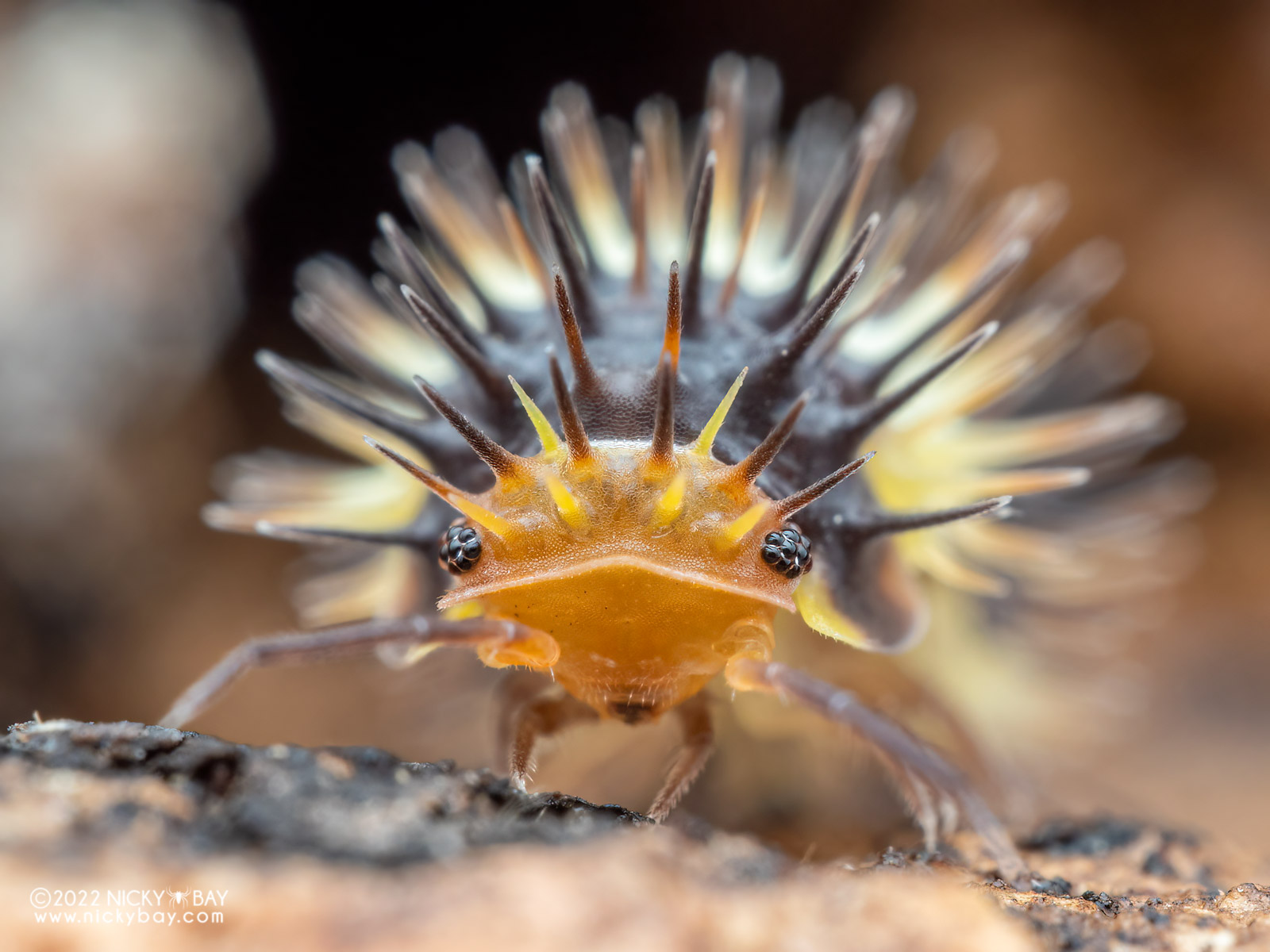
Ecdysis is the moulting of the cuticle in many invertebrates of the clade Ecdysozoa. Since the cuticle of these animals typically forms a largely inelastic exoskeleton, it is shed during growth and a new, larger covering is formed. The remnants of the old, empty exoskeleton are called exuviae.
Exoskeleton
An exoskeleton is a skeleton that is on the exterior of an animal in the form of hardened integument, which both supports the body's shape and protects the internal organs, in contrast to an internal endoskeleton which is enclosed underneath other soft tissues. Some large, hard and non-flexible protective exoskeletons are known as shell or armour.
Instar
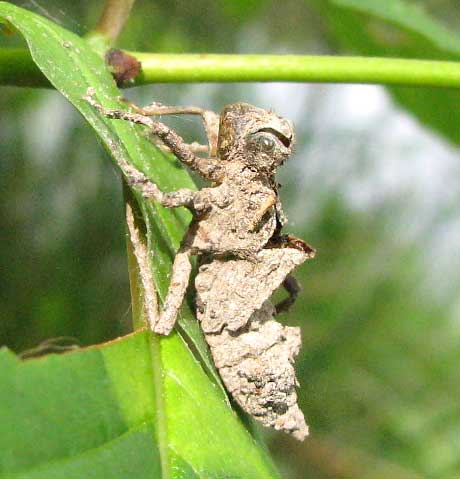
An instar is a developmental stage of arthropods, such as insects, which occurs between each moult (ecdysis) until sexual maturity is reached. Arthropods must shed the exoskeleton in order to grow or assume a new form. Differences between instars can often be seen in altered body proportions, colors, patterns, changes in the number of body segments or head width.

Arthropod exoskeleton
Arthropods are covered with a tough, resilient integument, cuticle or exoskeleton of chitin. Generally the exoskeleton will have thickened areas in which the chitin is reinforced or stiffened by materials such as minerals or hardened proteins. This happens in parts of the body where there is a need for rigidity or elasticity. Typically the mineral crystals, mainly calcium carbonate, are deposited among the chitin and protein molecules in a process called biomineralization. The crystals and fibres interpenetrate and reinforce each other, the minerals supplying the hardness and resistance to compression, while the chitin supplies the tensile strength. Biomineralization occurs mainly in crustaceans. In insects and arachnids, the main reinforcing materials are various proteins hardened by linking the fibres in processes called sclerotisation and the hardened proteins are called sclerotin. The dorsal tergum, ventral sternum, and the lateral pleura form the hardened plates or sclerites of a typical body segment.
Siphonophore
Siphonophores are cnidarian animals of the hydrozoan order Siphonophorae. According to the World Register of Marine Species, the order contains 194 species described thus far.

Spiracle (arthropods)
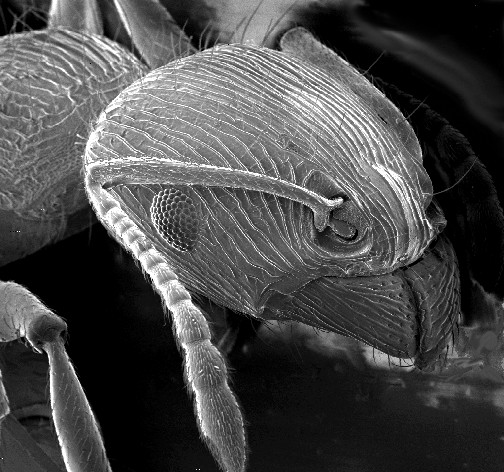
A spiracle or stigma is the opening in the exoskeletons of insects, myriapods, velvet worms and many arachnids that admits air into the respiratory system.

Nymph (biology)
In biology, a nymph is the juvenile form of some invertebrates, particularly insects, which undergoes gradual metamorphosis (hemimetabolism) before reaching its adult stage. Unlike a typical larva, a nymph's overall form already resembles that of the adult, except for a lack of wings and the emergence of genitalia. In addition, while a nymph moults, it never enters a pupal stage. Instead, the final moult results in an adult insect. Nymphs undergo multiple stages of development called instars.

Symbiotic organs in insects: diversity, functional implications, and terminology
Abstract With over a million described species, insects represent the most successful group of animals on Earth. One of the drivers of insect diversity is their ability to engage in multifold beneficial symbioses with microorganisms, often involving specialized host organs to accommodate intra- or extracellular symbionts. The existence of such organs and their importance for sustaining and transmitting beneficial symbionts has been known for over a century, and specific terms have been established for categorizing organs harbouring intracellular bacteria (bacteriomes) or fungi (mycetomes), or cuticular crypts containing extracellular fungi (mycetangia). For others, however, general terms are lacking, e.g. organs containing extracellular bacteria associated with the cuticle or with the digestive tract. Furthermore, previously established terms have been misused in other contexts. Notably, ‘bacteriome’ has been increasingly employed in the microbiome field to refer to bacterial communities, instead of the term’s original meaning of specialized organs housing intracellular bacterial symbionts. Here, we review and categorize the diversity of symbiotic organs in insects and propose a unified terminology. Our hope is that this common language will facilitate communication and thereby support the field of symbiosis research in unravelling commonalities and differences in the evolution, ecology, development, physiology and molecular basis across symbiotic interactions. This article is part of the theme issue ‘Life in natural microcosms’.

Description of a new species of the hyperparasitic barnacle <i>Duplorbis</i> Smith, 1906 and its cypris larva, with the molecular phylogenetic placement of the enigmatic family Duplorbidae Høeg & Rybakov, 1992 (Cirripedia: Rhizocephala)
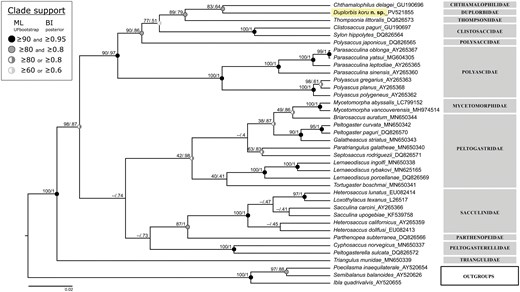
Abstract Most species of Rhizocephala are obligate parasites of decapod crustaceans, but species in three families parasitize non-decapod hosts: Chthamalophilidae Bocquet-Védrine, 1961 (parasites of barnacles), Duplorbidae Høeg & Rybakov, 1992 (parasites of isopods and cumaceans), and Thompsoniidae Høeg & Rybakov, 1992 (mostly parasites of decapods but includes one species that is a parasite of stomatopods). Hyperparasitism (form of parasitism in which a secondary parasite lives on or in a primary parasite of a host) is extremely rare in Rhizocephala, but Duplorbis Smith, 1906, the type genus of the enigmatic family Duplorbidae, currently contains two named species hyperparasitic on bopyrid isopods (abdominal and branchial parasites of decapods) and one species on free-living isopods. A lectotype is selected for Duplorbis smithi Nierstrasz & Brender à Brandis, 1923. Recent work on the parasites of squat lobsters from New Zealand revealed a putative new species of this genus, described herein as Duplorbis korun. sp., hyperparasitic on branchial bopyrids of the genera Paragigantione Barnard, 1920 and Parapleurocryptella Bourdon, 1972. Each parasitized female bopyrid contained 3–8 externae of D. korun. sp. in the brood chamber. Externae of one host contained mature cypris larvae, a stage previously poorly known in this genus. These larvae are described herein using SEM and are shown to have a pair of long frontal filaments (retained from the nauplius stage), an exclusive feature shared among Duplorbidae. The first molecular (18S rRNA sequence) analysis of the family was also conducted. Duplorbids appear nested within a well-supported monophyletic lineage also comprising of Polyascidae Høeg & Glenner in Høeg, Noever, Rees, Crandall & Glenner, 2019, Polysaccidae Lützen & Takahashi, 1996, Clistosaccidae Boschma, 1928, Thompsoniidae Høeg & Rybakov, 1992, and Chthamalophilidae Bocquet-Védrine, 1961, most closely related to chthamalophilids. The discovery of this new species expands our knowledge of the species diversity, host use, and larval development of hyperparasitic rhizocephalans.
Bluesky Siphonophore Viewer
Posts now gather into a translucent siphonophore-like colony drifting through dark water. Oldest posts begin at one end of the spine and newer ones accumulate toward the other. Engagement thickens bells, membranes, and feeding clusters. Drag to orbit, mouse wheel to zoom, right-drag to pan, hover for a specimen overlay, click a segment to glide toward it, and double click the background to zoom to the whole organism.
Stridulation
Stridulation is the act of producing sound by rubbing together certain body parts. This behavior is mostly associated with insects, but other animals are known to do this as well, such as a number of species of fish, snakes and spiders. The mechanism is typically that of one structure with a well-defined lip, ridge, or nodules (the "scraper" or plectrum) being moved across a finely-ridged surface (the "file" or stridulitrum—sometimes called the pars stridens) or vice versa, and vibrating as it does so, like the dragging of a phonograph needle across a vinyl record. Sometimes it is the structure bearing the file which resonates to produce the sound, but in other cases it is the structure bearing the scraper, with both variants possible in related groups.[1] Common onomatopoeic words for the sounds produced by stridulation include chirp and chirrup.
Earliest octopuses were giant top predators in Cretaceous oceans
Top predators drive changes in ecosystem structure. For the last ~370 million years, large-sized vertebrates have dominated the apex of the marine food chain, while invertebrates have served as smaller prey. Here we describe invertebrate top predators ...

phylo — Mammalia — minomobi
phylo — Mammalia — minomobi
Isopod Site
Pillbugs, sowbugs, roly-polies and woodlice, collectively referred to as isopods, are land-dwelling crustaceans that feed on decaying organic matter.