

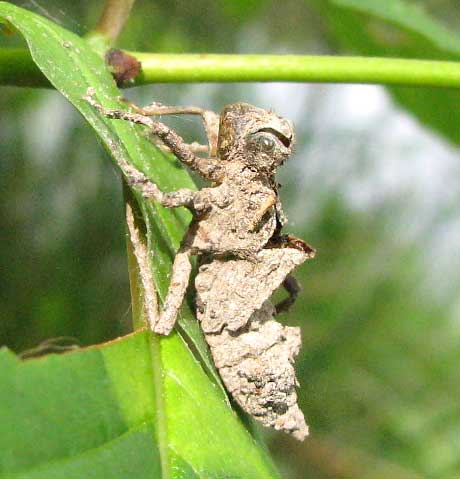
An exoskeleton is a skeleton that is on the exterior of an animal in the form of hardened integument, which both supports the body's shape and protects the internal organs, in contrast to an internal endoskeleton which is enclosed underneath other soft tissues. Some large, hard and non-flexible protective exoskeletons are known as shell or armour.
Ecdysis
Ecdysis is the moulting of the cuticle in many invertebrates of the clade Ecdysozoa. Since the cuticle of these animals typically forms a largely inelastic exoskeleton, it is shed during growth and a new, larger covering is formed. The remnants of the old, empty exoskeleton are called exuviae.

Arthropod exoskeleton
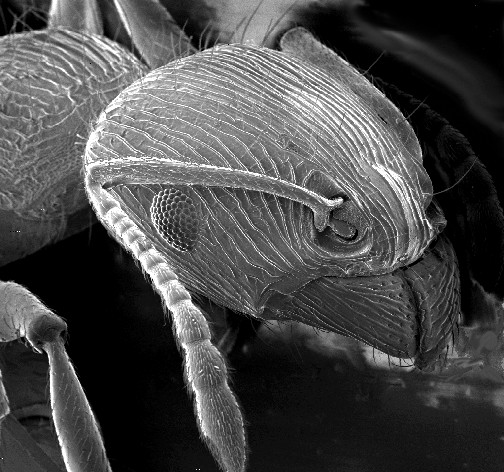
Arthropods are covered with a tough, resilient integument, cuticle or exoskeleton of chitin. Generally the exoskeleton will have thickened areas in which the chitin is reinforced or stiffened by materials such as minerals or hardened proteins. This happens in parts of the body where there is a need for rigidity or elasticity. Typically the mineral crystals, mainly calcium carbonate, are deposited among the chitin and protein molecules in a process called biomineralization. The crystals and fibres interpenetrate and reinforce each other, the minerals supplying the hardness and resistance to compression, while the chitin supplies the tensile strength. Biomineralization occurs mainly in crustaceans. In insects and arachnids, the main reinforcing materials are various proteins hardened by linking the fibres in processes called sclerotisation and the hardened proteins are called sclerotin. The dorsal tergum, ventral sternum, and the lateral pleura form the hardened plates or sclerites of a typical body segment.
Instar
An instar is a developmental stage of arthropods, such as insects, which occurs between each moult (ecdysis) until sexual maturity is reached. Arthropods must shed the exoskeleton in order to grow or assume a new form. Differences between instars can often be seen in altered body proportions, colors, patterns, changes in the number of body segments or head width.

Integrated Bone Tissue Physiology: Anatomy and Physiology
Spiracle (arthropods)
A spiracle or stigma is the opening in the exoskeletons of insects, myriapods, velvet worms and many arachnids that admits air into the respiratory system.

Pluralistic: Technocarcinization (01 Jul 2026) – Pluralistic: Daily links from Cory Doctorow
"Carcinization" is a curious biological phenomenon: given enough time, across many environments, many species will evolve into crabs. The body-type of a crab, with its low center of gravity, sideways gait (useful for evading predators), ease of concealment and protected organs is suitable to many different environments:
Earliest octopuses were giant top predators in Cretaceous oceans
Top predators drive changes in ecosystem structure. For the last ~370 million years, large-sized vertebrates have dominated the apex of the marine food chain, while invertebrates have served as smaller prey. Here we describe invertebrate top predators ...

Osteoblast Differentiation at a Glance
ABSTRACT Ossification is a tightly regulated process, performed by specialized cells called osteoblasts. Dysregulation of this process may cause inade...

exosphere.site/app
Exosphere is a set of small, modular, self-hostable community tools built on the AT Protocol.
exosphere.site/app
Exosphere is a set of small, modular, self-hostable community tools built on the AT Protocol.
New perspectives on body size and shape evolution in dinosaurs
ABSTRACT Diversity in the body shapes and sizes of dinosaurs was foundational to their widespread success during the Mesozoic era. The ability to quantify body size and form reliably is therefore critical to the study of dinosaur biology and evolution. Body mass estimates for any given fossil animal are, in theory, most informative when derived from volumetric models that account for the three‐dimensional shapes of the entire body. In addition to providing estimates of total body mass, volumetric approaches can be used to determine the inertial properties of specific body segments and the overall distribution of mass throughout the body, each of which are essential for the modelling and interpretation of form–function relationships and their associations with ecology. However, the determination of body volumes in fossil taxa is often subjective, and may be sensitive to varied artistic inference. This highlights the need for an approach to body mass estimation in which body segment volumes are systematically constrained by quantitative scaling relationships between the hard tissues that fossilise and the soft tissues only observable in extant taxa. To this end, we used recently published skeletal to soft tissue volumetric scaling factors derived from CT data of extant sauropsids to estimate body segment mass properties from skeletal models of 52 non‐avian dinosaurs representing the majority of major clades and body plans. The body masses estimated by this study range from less than 200 g in the tiny avialan Yixianornis to over 60 tonnes in the giant sauropod Patagotitan , which is currently the largest dinosaur known from mostly complete skeletal remains. From our models, we infer that many previous reconstructions of soft tissue envelopes may be too small, and that many dinosaurs were therefore heavier than previous estimates. Our models generally overlap with the range of body mass estimates derived from limb bone shaft dimensions, but with considerable quantitative variability among major clades. This suggests that different taxa either differed in skeletal to soft tissue volume ratios, or that their limb bone dimensions varied relative to body mass, perhaps related to differences in locomotor dynamics and postural evolution. Our models also allowed us to investigate variation in mass distribution and body proportions across different dinosaurs from a perspective grounded in extant anatomical data, framing long‐standing hypotheses about their form, function, and behaviour in a quantitative context. For example, reconstructed disparity in whole‐body centres of mass reflects a broad array of postures in different dinosaur clades, while the lack of strong positive allometry in the dimensions of the weight‐bearing limb segments relative to total body mass corroborates previous studies suggesting an overall decrease in dinosaur locomotor performance as body size increased.

Spatial extension of a bone remodeling dynamics model and its finite element analysis
Abstract There are many works dealing with the dynamics of bone remodeling, proposing increasingly complex and complete models. In the recent years, the efforts started to focus on developing models that not only reproduce the temporal evolution, but also include the spatial aspects of this phenomenon. In this work, we propose the spatial extension of an existing model that includes the dynamics of osteocytes. The spatial dependence is modeled in terms of a linear diffusion, as proposed in previous works dealing with related problems. The resulting model is then written in its variational form, and fully discretized using the well‐known finite element method and a combination of the implicit and explicit Euler schemes. The numerical algorithm is then analyzed, proving some a priori error estimates and its linear convergence. Finally, we extend the examples already published for the temporal model to one and two dimensions, showing the dynamics of the solution in the spatial domain.

agentOS — A faster, lighter, cheaper alternative to sandboxes
A portable open-source operating system for agents. Stateful runtime, universal agent interface, and secure code execution. One SDK, deploy anywhere.

Strukto · The Structured Layer for AI Agents
Strukto is the structured layer that makes AI agents actually do work. A Lite Agent OS and a Unified Virtual Filesystem Workspace.

This is called anthropomorphizing, when we ascribe human traits, emotions or behaviors to non-human things, such as animals or inanimate objects. Instead, explain what a system does, how well it performs, who built it and who could be affected by it. apnews.com/article/openai-safety-ai-fram…
https://apnews.com/article/openai-safety-ai-framework-089e75b95bc935af092da7b79d92706d
apnews.comAlt text: Black-and-white illustrations of a bat, a peacock, an elephant, and some kind of a monkey with their skeletons on top of faint silhouettes of their bodies. The bat and peacock also have studies of their skulls on the page

The Public Domain Review
From Comparative Osteology (1821–38) with illustrations by the Italian-born German naturalist Edouard Joseph d’Alton, an artist and art history professor whose students included a young Karl Marx. More of his wonderful images here: publicdomainreview.org/collection/comparative-osteol…

