

Functional analytic psychotherapy (FAP) is a psychotherapeutic approach based on clinical behavior analysis (CBA) that focuses on the therapeutic relationship as a means to maximize client change. Specifically, FAP suggests that in-session contingent responding to client target behaviors leads to significant therapeutic improvements.
Research Evidence Supporting the FCLA-SGFA Modes Framework
Comprehensive Literature Review: Mapping Autistic Cognitive States to the Six Modes
Like a Therapist, But Not: Reddit Narratives of AI in Mental Health Contexts
Large language models (LLMs) are increasingly used for emotional support and mental health-related interactions outside clinical settings, yet little is known about how people evaluate and relate to these systems in everyday use. We analyze 5,126 Reddit posts from 47 mental health communities describing experiential or exploratory use of AI for emotional support or therapy. Grounded in the Technology Acceptance Model and therapeutic alliance theory, we develop a theory-informed annotation framework and apply a hybrid LLM-human pipeline to analyze evaluative language, adoption-related attitudes, and relational alignment at scale. Our results show that engagement is shaped primarily by narrated outcomes, trust, and response quality, rather than emotional bond alone. Positive sentiment is most strongly associated with task and goal alignment, while companionship-oriented use more often involves misaligned alliances and reported risks such as dependence and symptom escalation. Overall, this work demonstrates how theory-grounded constructs can be operationalized in large-scale discourse analysis and highlights the importance of studying how users interpret language technologies in sensitive, real-world contexts.

How LLM Counselors Violate Ethical Standards in Mental Health Practice: A Practitioner-Informed Framework
Large language models (LLMs) were not designed to replace healthcare workers, but they are being used in ways that can lead users to overestimate the types of roles that these systems can assume. While prompt engineering has been shown to improve LLMs' clinical effectiveness in mental health applications, little is known about whether such strategies help models adhere to ethical principles for real-world deployment. In this study, we conducted an 18-month ethnographic collaboration with mental health practitioners (three clinically licensed psychologists and seven trained peer counselors) to map LLM counselors' behavior during a session to professional codes of conduct established by organizations like the American Psychological Association (APA). Through qualitative analysis and expert evaluation of N=137 sessions (110 self-counseling; 27 simulated), we outline a framework of 15 ethical violations mapped to 5 major themes. These include: Lack of Contextual Understanding, where the counselor fails to account for users' lived experiences, leading to oversimplified, contextually irrelevant, and one-size-fits-all intervention; Poor Therapeutic Collaboration, where the counselor's low turn-taking behavior and invalidating outputs limit users' agency over their therapeutic experience; Deceptive Empathy, where the counselor's simulated anthropomorphic responses (``I hear you'', ``I understand'') create a false sense of emotional connection; Unfair Discrimination, where the counselor's responses exhibit algorithmic bias and cultural insensitivity toward marginalized populations; and Lack of Safety & Crisis Management, where individuals who are ``knowledgeable enough'' to correct LLM outputs are at an advantage, while others, due to lack of clinical knowledge and digital literacy, are more likely to suffer from clinically inappropriate responses. Reflecting on these findings through a practitioner-informed lens, we argue that reducing psychotherapy—a deeply meaningful and relational process—to a language generation task can have serious and harmful implications in practice. We conclude by discussing policy-oriented accountability mechanisms for emerging LLM counselors.
Countertransference
Countertransference is a widely established concept originating in Freudian psychotherapy, in which a therapist's own history and emotions affect how they feel about and treat the patient. It can be a response to transference, in which the patient's history affects how they feel about and react to the therapist.[citation needed]
mediation: R Package for Causal Mediation Analysis
In this paper, we describe the R package mediation for conducting causal mediation analysis in applied empirical research. In many scientific disciplines, the goal of researchers is not only estimating causal effects of a treatment but also understanding the process in which the treatment causally affects the outcome. Causal mediation analysis is frequently used to assess potential causal mechanisms. The mediation package implements a comprehensive suite of statistical tools for conducting such an analysis. The package is organized into two distinct approaches. Using the model-based approach, researchers can estimate causal mediation effects and conduct sensitivity analysis under the standard research design. Furthermore, the design-based approach provides several analysis tools that are applicable under different experimental designs. This approach requires weaker assumptions than the model-based approach. We also implement a statistical method for dealing with multiple (causally dependent) mediators, which are often encountered in practice. Finally, the package also offers a methodology for assessing causal mediation in the presence of treatment noncompliance, a common problem in randomized trials.

Beyond Deficits:
The FCLA-SFGA Model and a Paradigm Shift in Autism Understanding
“It happened to be the perfect thing”: experiences of generative AI chatbots for mental health
The global mental health crisis underscores the need for accessible, effective interventions. Chatbots based on generative artificial intelligence (AI), like ChatGPT, are emerging as novel solutions, but research on real-life usage is limited. We interviewed nineteen individuals about their experiences using generative AI chatbots for mental health. Participants reported high engagement and positive impacts, including better relationships and healing from trauma and loss. We developed four themes: (1) a sense of ‘emotional sanctuary’, (2) ‘insightful guidance’, particularly about relationships, (3) the ‘joy of connection’, and (4) comparisons between the ‘AI therapist’ and human therapy. Some themes echoed prior research on rule-based chatbots, while others seemed novel to generative AI. Participants emphasised the need for better safety guardrails, human-like memory and the ability to lead the therapeutic process. Generative AI chatbots may offer mental health support that feels meaningful to users, but further research is needed on safety and effectiveness.
Psychiatry at the Margins | Awais Aftab | Substack
Exploring critical, philosophical, and scientific debates in psychiatric practice and the psy-sciences. Click to read Psychiatry at the Margins, by Awais Aftab, a Substack publication with tens of thousands of subscribers.

CPS based functional references
I have recently come up with a new way of representing functional references.
How to take things less personally and avoid mind reading | Psyche Guides
Always blaming yourself or assuming others think ill of you? A CBT therapist shares ways to break these self-critical habits

Introduction to Statistical Mediation Analysis
This volume introduces the statistical, methodological, and conceptual aspects of mediation analysis. Applications from health, social, and developmental psychology, sociology, communication, exercise science, and epidemiology are emphasized throughout. Single-mediator, multilevel, and longitudinal models are reviewed. The author's goal is to help the reader apply mediation analysis to their own data and understand its limitations. Each chapter features an overview, numerous worked examples, a summary, and exercises (with answers to the odd numbered questions). The accompanying CD contains outputs described in the book from SAS, SPSS, LISREL, EQS, MPLUS, and CALIS, and a program to simulate the model. The notation used is consistent with existing literature on mediation in psychology. The book opens with a review of the types of research questions the mediation model addresses. Part II describes the estimation of mediation effects including assumptions, statistical tests, and the construction of confidence limits. Advanced models including mediation in path analysis, longitudinal models, multilevel data, categorical variables, and mediation in the context of moderation are then described. The book closes with a discussion of the limits of mediation analysis, additional approaches to identifying mediating variables, and future directions. Introduction to Statistical Mediation Analysis is intended for researchers and advanced students in health, social, clinical, and developmental psychology as well as communication, public health, nursing, epidemiology, and sociology. Some exposure to a graduate level research methods or statistics course is assumed. The overview of mediation analysis and the guidelines for conducting a mediation analysis will be appreciated by all readers.

Do social media experiments prove a link with mental health: A methodological and meta-analytic review.
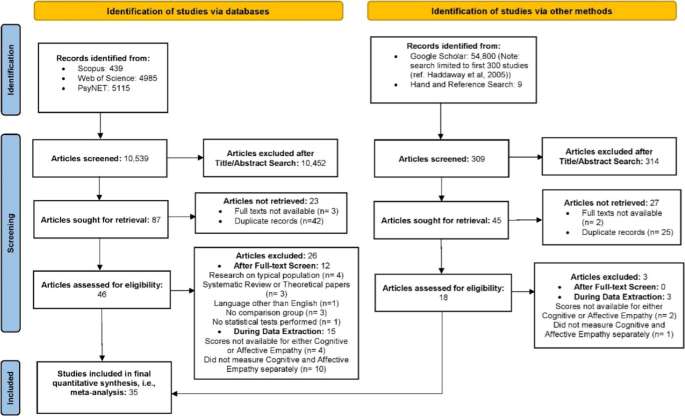
Cognitive and Affective Empathy in Autism Spectrum Disorders: A Meta-analysis
Research has consistently shown that individuals with Autism Spectrum Disorder (ASD) exhibit Empathy deficits. The aim of this study was to systematically review and meta-analyze the research conducted in the domain of cognitive and affective Empathy in Autism. The author also attempted to see the influence of moderators, such as age, culture, and measure-used, on the effect sizes. To fulfill the objective, the meta-analysis was performed on 35 studies that fulfilled the inclusion criteria with the help of the Meta-essentials, which is a free excel meta-analysis tool that facilitates the integration of effect sizes from various studies. The results indicated that the ASD group differs significantly from typically developing (TD) group in both cognitive and affective empathy. The effect size for cognitive empathy was very large (1.26), whereas, for affective empathy, the effect size was medium (0.58). Further, there was a significant moderating effect of the type of measure used on cognitive empathy. However, there are a few limitations of the present meta-analysis. Firstly, it does not shed light on how symptom severity in Autism influences empathy. Secondly, all the possible moderating variables influencing empathy could not be considered. Lastly, the generalizability of the findings may be limited owing to the limitations present in the included studies themselves. The present meta-analysis has implications for conceptualizing cognitive and affective empathy appropriately, and developing appropriate measures to assess empathy in the Autism population.
In February 2024, I wrote Scientific Reports about a published meta-analysis claiming that mindfulness interventions affect neural plasticity, 'cementing the neuropsychological basis of mindfulness-based interventions'. The paper was retracted yesterday—here a little summary of the process.🧵
