


Gradient descent is a method for unconstrained mathematical optimization. It is a first-order iterative algorithm for minimizing a differentiable multivariate function.
Backpropagation
In machine learning, backpropagation is a gradient computation method commonly used for training a neural network in computing parameter updates.
Coresets for Data-efficient Training of Machine Learning Models
Incremental gradient (IG) methods, such as stochastic gradient descent and its variants are commonly used for large scale optimization in machine learning. Despite the sustained effort to make IG methods more data-efficient, it remains an open question how to select a training data subset that can theoretically and practically perform on par with the full dataset. Here we develop CRAIG, a method to select a weighted subset (or coreset) of training data that closely estimates the full gradient by maximizing a submodular function. We prove that applying IG to this subset is guaranteed to converge to the (near)optimal solution with the same convergence rate as that of IG for convex optimization. As a result, CRAIG achieves a speedup that is inversely proportional to the size of the subset. To our knowledge, this is the first rigorous method for data-efficient training of general machine learning models. Our extensive set of experiments show that CRAIG, while achieving practically the same solution, speeds up various IG methods by up to 6x for logistic regression and 3x for training deep neural networks.
Leshem (Legend) Choshen 🤖🤗 @ACL @ICML on Twitter / X
I agree, what I say is that you talk about how much you lose of the gradient you compute, and I say, but if you just compute less, the result would lose less and still be equivalent or worse probably?More steps=more information that's true, but a bit of a separate battle right?— Leshem (Legend) Choshen 🤖🤗 @ACL @ICML (@LChoshen) August 17, 2026
Loss function
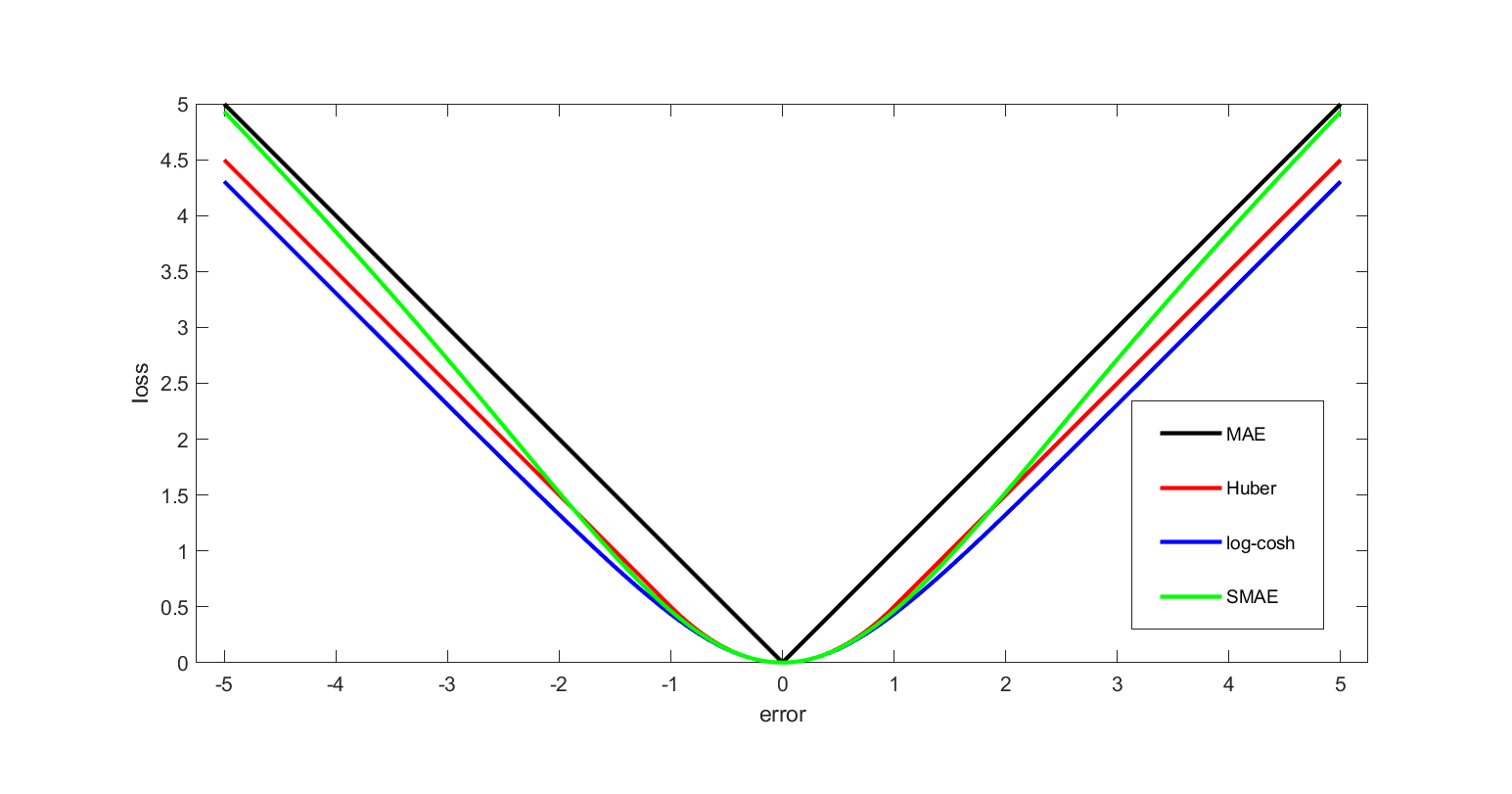
In mathematical optimization and decision theory, a loss function or cost function is a function that maps an event or values of one or more variables onto a real number intuitively representing some "cost" associated with the event. An optimization problem seeks to minimize a loss function. An objective function is either a loss function or its opposite, in which case it is to be maximized. The loss function could include terms from several levels of the hierarchy.
Better Training Data Attribution via Better Inverse Hessian-Vector Products
Training data attribution (TDA) provides insights into which training data is responsible for a learned model behavior. Gradient-based TDA methods such as influence functions and unrolled differentiation both involve a computation that resembles an inverse Hessian-vector product (iHVP), which is difficult to approximate efficiently. We introduce an algorithm (ASTRA) which uses the EKFAC-preconditioner on Neumann series iterations to arrive at an accurate iHVP approximation for TDA. ASTRA is easy to tune, requires fewer iterations than Neumann series iterations, and is more accurate than EKFAC-based approximations. Using ASTRA, we show that improving the accuracy of the iHVP approximation can significantly improve TDA performance.

What Are Machine Learning Algorithms? | IBM
A machine learning algorithm is the procedure and mathematical logic through which an AI model learns patterns in training data and applies to them to new data.

Estimating Training Data Influence by Tracing Gradient Descent
We introduce a method called TracIn that computes the influence of a training example on a prediction made by the model. The idea is to trace how the loss on the test point changes during the training process whenever the training example of interest was utilized. We provide a scalable implementation of TracIn via: (a) a first-order gradient approximation to the exact computation, (b) saved checkpoints of standard training procedures, and (c) cherry-picking layers of a deep neural network. In contrast with previously proposed methods, TracIn is simple to implement; all it needs is the ability to work with gradients, checkpoints, and loss functions. The method is general. It applies to any machine learning model trained using stochastic gradient descent or a variant of it, agnostic of architecture, domain and task. We expect the method to be widely useful within processes that study and improve training data.
Machine Learning Algorithms, Applications: Key Methods, Real-World Uses
Key Takeaways Traditional algorithms such as regression, decision trees, boosting, clustering, and PCA remain highly useful for practical ML problems.Neural net

Curriculum learning
Humans and animals learn much better when the examples are not randomly presented but organized in a meaningful order which illustrates gradually more concepts, and gradually more complex ones. Here, we formalize such training strategies in the context of machine learning, and call them "curriculum learning". In the context of recent research studying the difficulty of training in the presence of non-convex training criteria (for deep deterministic and stochastic neural networks), we explore curriculum learning in various set-ups. The experiments show that significant improvements in generalization can be achieved. We hypothesize that curriculum learning has both an effect on the speed of convergence of the training process to a minimum and, in the case of non-convex criteria, on the quality of the local minima obtained: curriculum learning can be seen as a particular form of continuation method (a general strategy for global optimization of non-convex functions).
The Data Minimization Principle in Machine Learning
The principle of data minimization aims to reduce the amount of data collected, processed or retained to minimize the potential for misuse, unauthorized access, or data breaches. Rooted in...
Machine Learning Glossary | Google for Developers
This glossary defines a wide range of machine learning terms, including those specific to TensorFlow and large language models.

The Global Brain Algorithm
<p>This is a collection of explanations on the global brain algorithm. We explain core concepts in simple terms that help to understand the algorithms as a whole.</p>
tinygrad: A simple and powerful neural network framework
We write and maintain tinygrad, the fastest growing neural network framework
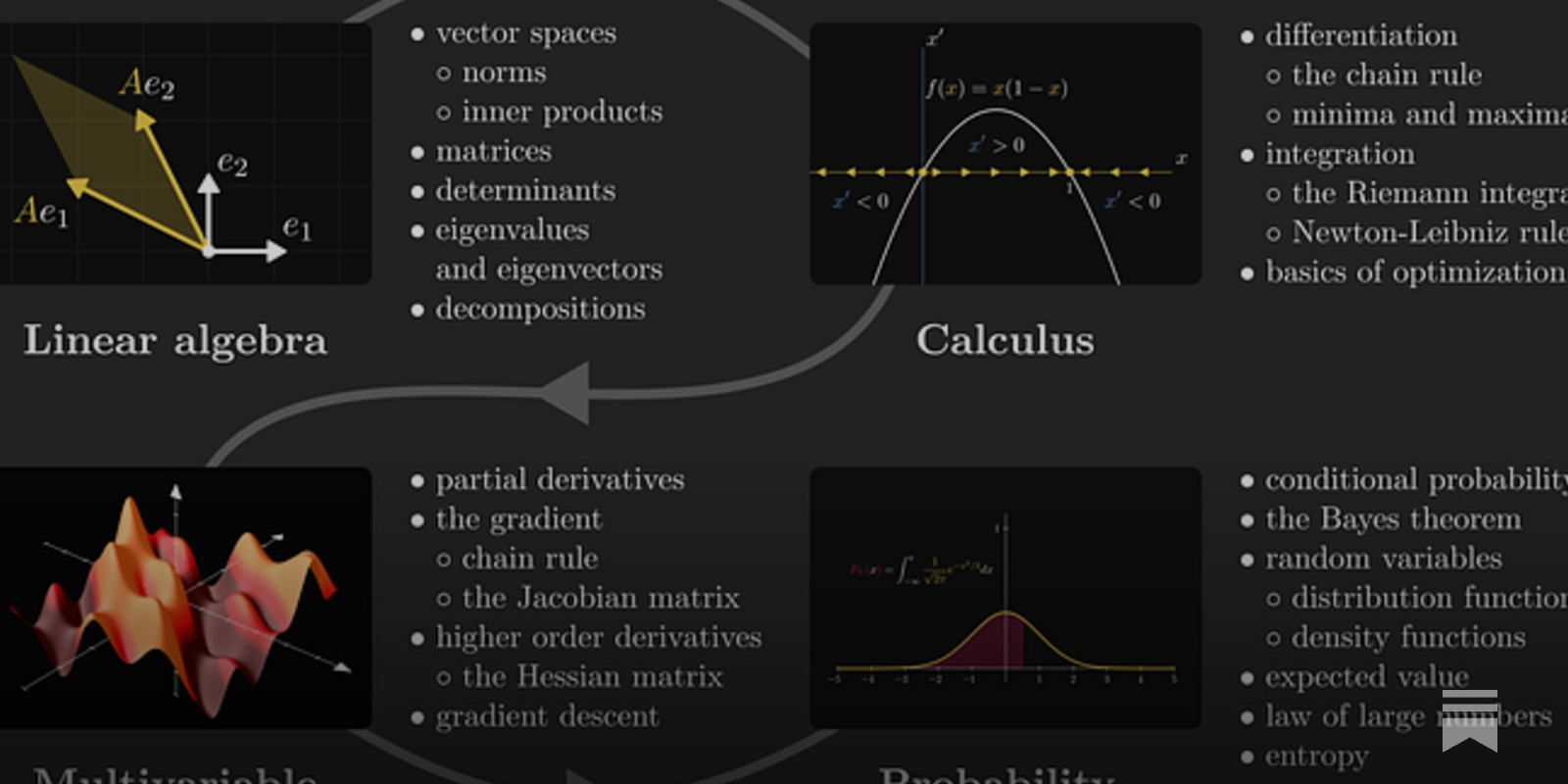
The Roadmap of Mathematics for Machine Learning
A complete guide to linear algebra, calculus, and probability theory
Optimal and Diffusion Transports in Machine Learning
Slides for a general introduction to the use of Optimal Transport methods in learning, with an emphasis on diffusion models, flow matching, training 2 l…

Descent-to-Delete: Gradient-Based Methods for Machine Unlearning
We study the data deletion problem for convex models. By leveraging techniques from convex optimization and reservoir sampling, we give the first data deletion algorithms that are able to handle an arbitrarily long sequence of adversarial updates while promising both per-deletion run-time and steady-state error that do not grow with the length of the update sequence. We also introduce several new conceptual distinctions: for example, we can ask that after a deletion, the entire state maintained by the optimization algorithm is statistically indistinguishable from the state that would have resulted had we retrained, or we can ask for the weaker condition that only the observable output is statistically indistinguishable from the observable output that would have resulted from retraining. We are able to give more efficient deletion algorithms under this weaker deletion criterion.