


In physics, gravity, also known as gravitation or a gravitational interaction, is a fundamental interaction, which may be described as the force that draws material objects towards each other.
Bernhard Mueller on Twitter / X
Our Theory-of-Everything, OPH, completely unifies the Standard Model with gravity: A SINGLE constant determines both Newton's constant G and the particle spectrum. Mass-less photons, gravitons and gluons emerge for free. https://t.co/dUh6TLAlop— Bernhard Mueller (@muellerberndt) April 4, 2026
Gravita — The force that brings communities together
Build your community's home on the open social web.

Black hole
A black hole is an astronomical body so compact that its gravity prevents anything, including light, from escaping. Albert Einstein's theory of general relativity, which describes gravitation as the curvature of spacetime, predicts that any sufficiently compact mass will form a black hole. The boundary of no escape is called the event horizon. In general relativity, crossing a black hole's event horizon traps an object inside but produces no locally detectable change. General relativity also predicts that every black hole should have a central singularity, where the curvature of spacetime is infinite.

Dark matter
In astronomy and cosmology, dark matter is an invisible and hypothetical form of matter that does not interact with light or other electromagnetic radiation. Dark matter is implied by gravitational effects that cannot be explained by general relativity unless more matter is present than can be observed. Such effects occur in the context of formation and evolution of galaxies, gravitational lensing, the observable universe's current structure, mass position in galactic collisions, the motion of galaxies within galaxy clusters, and cosmic microwave background anisotropies. Dark matter is thought to serve as gravitational scaffolding for cosmic structures. After the Big Bang, dark matter clumped into blobs along narrow filaments with superclusters of galaxies forming a cosmic web at scales on which entire galaxies appear like tiny particles.

Entanglement Builds Space-Time. Now “Magic” Gives It Gravity. | Quanta Magazine
In holographic theories, physicists may have traced the pliability of space-time to its quantum roots: a measure of quantumness known as “magic.”
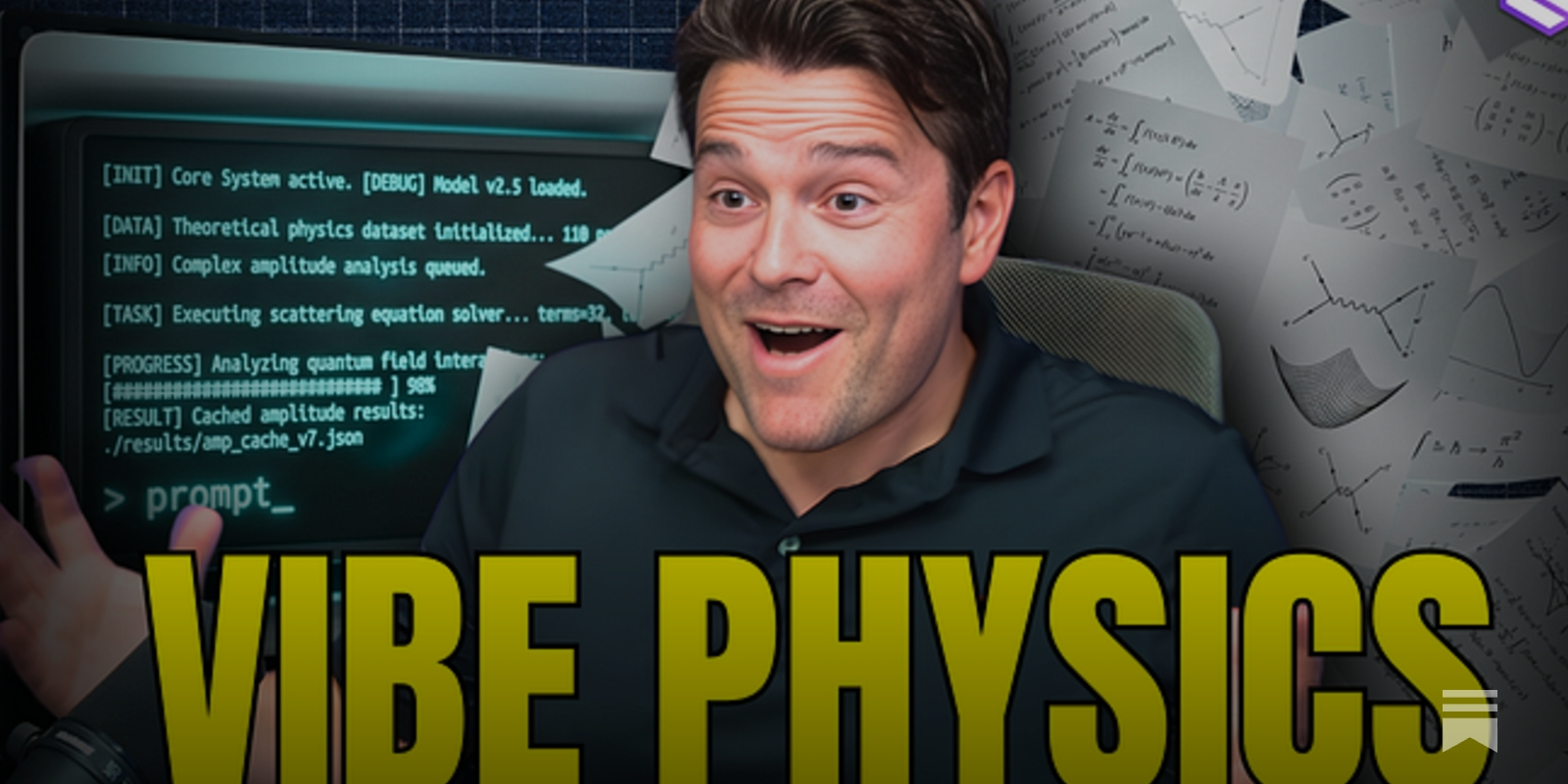
🔬Doing Vibe Physics — Alex Lupsasca, OpenAI
The full story of how GPT‑5.x derived new results in theoretical physics and quantum gravity.
Compact object
In astronomy, the term compact object (or compact star) refers collectively to white dwarfs, neutron stars, and black holes. It could also include exotic stars if such hypothetical, dense bodies are confirmed to exist. All compact objects have a high mass relative to their radius, giving them a very high density compared to ordinary atomic matter. The term is used as a generalization for cases where the exact nature of a significant gravitational effect isolated to a small radius is not known.
gRPC | Google Open Source
gRPC is a modern RPC framework that can run in any environment. It can efficiently connect services in and across data centers with pluggable support for load balancing, tracing, health checking and authentication. It is also applicable in last mile of distributed computing to connect devices, mobile applications and browsers to backend services.
QPequi
In the language of modern physics, gauge theories are the grammar of interaction. They tell us that the laws of nature are not merely equations describing fields and particles, but the manifestation of a deep principle: certain transformations can be performed everywhere in space and time without changing the physical content of the theory. The mathematical name for this principle is local symmetry, and it lies at the heart of our most successful physical frameworks—from electromagnetism to the Standard Model of particle physics. Gauge invariance tells us what must remain unchanged when we shift our mathematical descriptions, and in doing so, it dictates what kinds of interactions and fields must exist.
Defying Gravity - The Metropolitan Museum of Art
Learn about the transformative collaboration between the designer Zelda Wynn Valdes and the entertainer Joyce Bryant.

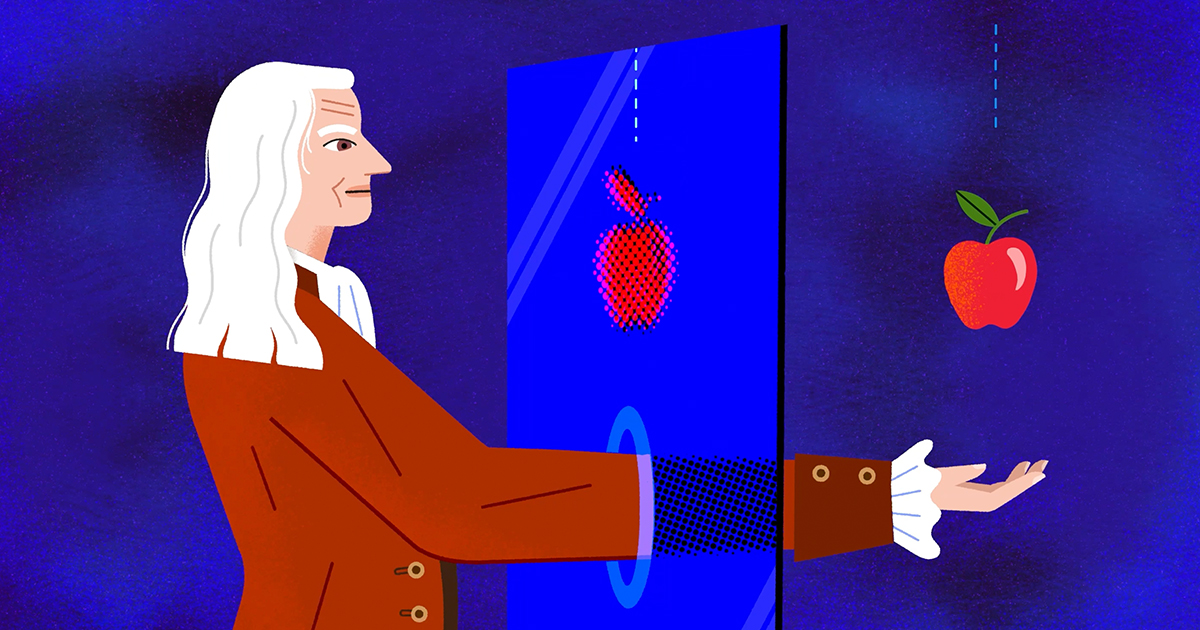
AI-Newton: A Concept-Driven Physical Law Discovery System without Prior Physical Knowledge
While current AI-driven methods excel at deriving empirical models from individual experiments, a significant challenge remains in uncovering the common fundamental physics that underlie these models -- a task at which human physicists are adept. To bridge this gap, we introduce AI-Newton, a novel framework for concept-driven scientific discovery. Our system autonomously derives general physical laws directly from raw, multi-experiment data, operating without supervision or prior physical knowledge. Its core innovations are twofold: (1) proposing interpretable physical concepts to construct laws, and (2) progressively generalizing these laws to broader domains. Applied to a large, noisy dataset of mechanics experiments, AI-Newton successfully rediscovers foundational and universal laws, such as Newton's second law, the conservation of energy, and the universal gravitation. This work represents a significant advance toward autonomous, human-like scientific discovery.

Games Demystified: Super Mario Galaxy
Want to see how Mario Galaxy created its unique gravity-based physics effects for the in-game planets? Developer Alessi analyzes and reproduces the same concepts with a playable game prototype and source code.
How physics at the roots of reality point to a grand unified theory | Aeon Essays
Physics displays an uncanny alignment at its very deepest levels. Is a grand theory of everything finally within reach?
Galaxy
A galaxy is a system of stars, stellar remnants, interstellar gas, dust, and dark matter bound together by gravity. The word is derived from the Greek galaxias (γαλαξίας), literally 'milky', a reference to the Milky Way galaxy that contains the Solar System. Galaxies, averaging an estimated 100 million stars, range in size from dwarfs with less than a thousand stars, to the largest galaxies known – supergiants with one hundred trillion stars, each orbiting its galaxy's centre of mass. Most of the mass in a typical galaxy is in the form of dark matter, with only a few percent of that mass visible in the form of stars and nebulae. Supermassive black holes are a common feature at the centres of galaxies.
